
Intercultural Ministry
Featured

The Emmanuel Gospel Center is partnering with the Fellowship of Haitian Evangelical Pastors of New England on “Pwojè Rebati” to raise funds for restoration efforts in Southern Haiti.

Mental models are assumptions we make about how the world works. What mental models do we hold about refugees? How willing are we to challenge those mental models with new information? Olivia Blumenshine walks us through a process for uncovering our own mental models about refugees. She discusses five common mental models about refugees and where those models may be incomplete, outdated, or based on false information.
![Hidden Treasures: Celebrating Refugee Stories [photojournal]](https://images.squarespace-cdn.com/content/v1/57ff1c7ae58c62d6f84ba841/1512579164575-AKNVCYX4Q5DW8IN2CNYP/P1070998.jpg)
Photojournal of the refugee stories, cuisine, videos, and panels guests enjoyed at the 2017 GBRM Fundraiser. If you missed this memorable evening, you can still take part in the fundraiser -- help them reach their $50K goal for 2018!

The dynamics of shaming affect your church community more than you might think. Guest contributor Sang-il Kim raises awareness for Boston Christian leaders to a surprising level of honor-shame dynamics in US urban culture. Join the conversation!
More
The Emmanuel Gospel Center is partnering with the Fellowship of Haitian Evangelical Pastors of New England on “Pwojè Rebati” to raise funds for restoration efforts in Southern Haiti.
Mental models are assumptions we make about how the world works. What mental models do we hold about refugees? How willing are we to challenge those mental models with new information? Olivia Blumenshine walks us through a process for uncovering our own mental models about refugees. She discusses five common mental models about refugees and where those models may be incomplete, outdated, or based on false information.
Photojournal of the refugee stories, cuisine, videos, and panels guests enjoyed at the 2017 GBRM Fundraiser. If you missed this memorable evening, you can still take part in the fundraiser -- help them reach their $50K goal for 2018!
The dynamics of shaming affect your church community more than you might think. Guest contributor Sang-il Kim raises awareness for Boston Christian leaders to a surprising level of honor-shame dynamics in US urban culture. Join the conversation!
![Ethiopian Churches in Greater Boston [map]](https://images.squarespace-cdn.com/content/v1/57ff1c7ae58c62d6f84ba841/1506113852983-TSLLC1FENTJJGZYIO7MM/orthodox+cross+church.jpeg)
Find Ethiopian churches in the greater Boston area.

Newly updated resources for understanding the diverse journeys of Ethiopian Christians in Greater Boston.

Is your church looking for strategic ways to serve refugees? Welcoming refugees into our community network can transform their employment and entrepreneurship journey.

Work is one the most challenging issues for refugees rebuilding their lives in the U.S. — and a perfect place for the Church to step in.
![Saffron: A Refugee Story [VIDEO]](https://images.squarespace-cdn.com/content/v1/57ff1c7ae58c62d6f84ba841/1549999821579-83XWBWFG0C5QT4ARUXM3/Screenshot+2019-02-12+14.30.04.png)

From just two Chinese churches in greater Boston 50 years ago, the number has grown to more than 25 congregations serving an expanding Chinese population. The growth of the Chinese church in and around the Boston area is something to celebrate. Its strength and integrity, and the quality of its network—unified for prayer, for youth and college ministry, and for international missions—stand as a model for other immigrant and indigenous church systems.

A listing of Chinese churches in Greater Boston, derived from many online sources and from the ongoing research of EGC. This serves as a resource page to a 2016 article on the current status of Chinese churches in this region. There is also a link to a corresponding map.

New England’s Book of Acts is a 2007 publication of the Emmanuel Gospel Center that captures the stories of how God has been growing his Church among many people groups and ethnic groups in New England.
For EGC, the 2010 Ethnic Ministries Summit was not a one-time event as much as another step along the way in our participation in and encouragement of the Kingdom of God in Boston expressed in all its cultural diversity. Here are a few of the milestones for EGC as we have watched God building his church in Boston, anticipating the church described in Revelation.

About 30% of all Brazilians living in the U.S., approximately 68,197, reside in New England, and Portuguese is the third most spoken language in the region, after English and Spanish. What are the strengths and opportunities of the predominant Brazilian-speaking churches in New England today? Kaye Cook and Sharon Ketcham offer a quick update on the status of New England’s Brazilian churches, their history, strengths, and challenges.

A practical guide to encourage, inspire, and inform churches how to organize and plan an intercultural ministry event in their city.

Listen in on a video conversation on Christian engagement with Muslims in the U.S. where panelists talk about positive and objectionable interactions Christians may have with our Muslim neighbors.

Do you want to see transformation in your organization? You might want to give some thought to the importance of creating a safe environment, where your team can learn together to trust, practice confidentiality, become good listeners, stop judging, and develop a culture of patience, forgiveness, and celebrating the best in one another.

“The Summit was a reality check. And it wasn’t a reality check that the world is becoming more multi-ethnic, but rather that God’s Kingdom is already multi-ethnic, and what am I going to do about it? How am I going to respond?”

“In June of 1972, I was discouraged because a year had gone by since I had graduated from seminary, and I hadn’t raised a penny to go back to Haiti, which had been my goal. So after preaching at a church in New York City, two ladies asked me whether they could join my wife and me for a night of prayer.

Cultural misunderstandings, theological controversies, and power issues influence our relationships and encounters between churches of different ethnic backgrounds and denominations.
While it is the nature of teens to consider their parents to be “out of touch” and the nature of older people to complain about the younger generation, the biblical mandate to pass the faith on to our children becomes extremely difficult in immigrant communities where younger people rapidly assimilate into a culture very different from their parents’. While this is not a new issue, to those experiencing the conflict, it is an issue that seems to threaten the very future of their faith.
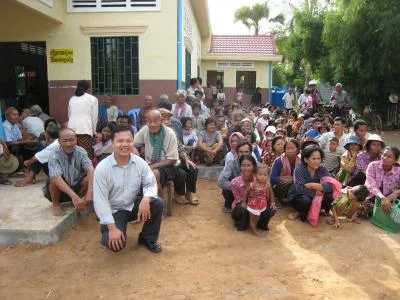
The Killing Fields of the Cambodian holocaust that took place from 1975 to 1979 under the leadership of the Khmer Rouge left over a million dead and led to a flood of refugees fleeing from Cambodia. Many escaped from this horrific event to neighboring countries, while others sought safety around the world. A portion of the refugees came to the United States in the early 1980s in an attempt to start their lives afresh. Today, the Greater Boston area has the second highest concentration of Cambodians in America, some estimating as many as 30,000, with the majority living in Lynn, just 10 miles north of Boston, and Lowell, 30 miles to the northwest.
On Friday, March 4, 2005, Pastor Reth Nhar said goodbye to his wife, climbed into a car with four Cambodian friends, and headed out into the evening rush hour for the 60-mile drive north out of Providence, through the heart of Boston, to Lynn, Massachusetts. There the five made their way up to the second floor of an office building at 140 Union Street, grabbed some tea, and at 6:45 p.m., they crammed into a meeting room at the new Cambodian Ministries Resource Center.