

BLOG: APPLIED RESEARCH OF EMMANUEL GOSPEL CENTER

Exploring Church Spaces: Managing Church Buildings, Property Assets
Ten practical, hard-earned lessons from church leaders on avoiding costly property mistakes: from hiring the right professionals and building strong financial systems to reviewing leases and protecting core ministry assets from over-leverage.

Photo credit: design-beast via Lightstock
Exploring Church Spaces: Managing Church Buildings, Property Assets
Ten practical tips for avoiding key pitfalls.
by Saranya Sathananthan, Researcher in Residence
Church leaders often talk about property in terms of mission: how a building can serve its neighbors, support new ministries, and generate revenue that sustains operations. Those possibilities are exciting to dream about and discuss. But across our interviews, some of the most important lessons leaders shared about protecting that mission were not grand or pie-in-the-sky. They were far more practical.
In the Exploring Church Spaces project, we asked church leaders what they wish they had done differently in managing their church buildings and property assets. Their answers were honest and sobering, advice intended to help other churches avoid the painful and often demoralizing challenges that their churches experienced. Many of these hard-earned lessons came from decisions, agreements, or systems that became costly over time, sometimes affecting a church’s financial health and constraining its ministry capacity for years. Churches talked about leases that locked them into decades of financial loss, unclear agreements that strained relationships, maintenance issues that threatened their ability to host and leverage their space, and financial systems that were not strong enough for the complexity of grants, rentals, renovations, and capital projects.
Though they aren’t the strategies that are primarily about innovation, creative programming, or bold new uses of space, they may be some of the most important for keeping churches stable and running effectively for the long haul. They are preventative in nature, focusing on the systems and safeguards that keep churches from losing money, trust, and mission capacity.
At their core, these practices are about stewardship: how churches care for what God has entrusted to them. A church building is often one of the most valuable and generative assets a congregation holds, yet when churches lack strong legal, financial, administrative, and facilities systems, they can unintentionally harm themselves, their tenants, their partners, and the mission they are trying to serve. The good news is that many costly mistakes can be prevented by putting some of these basic practices in place early, before signing contracts, making rental agreements, receiving grants for new initiatives, or entering into large capital projects.
1. Hire professionals for work that must be done professionally.
Many churches operate relationally and rely heavily on volunteers to get things done. A church member may have professional experience, or someone may know a professional who is willing to help at a reduced rate. This can be a real gift to churches, but it can also create confusion if expectations are not set clearly.
“We were so spiritually minded, we were business-foolish and managerially incompetent, and we suffered for that.”
Some church work can be done by volunteers. But some work is just too important, too technical, or too risky to depend on a volunteer-work structure. When churches are managing multiple or large grant-funded projects, major renovations, historic preservation, leases, property acquisitions or sales, tax questions, and other high-stakes processes, informal volunteer systems can quickly become inadequate. In these cases, the issue is not whether volunteers are trustworthy or capable. The issue is that volunteer help often happens around other jobs, family responsibilities, ministry commitments, and limited time. When the stakes are high, the church needs reliability, accountability, and clear responsibility.
Without that structure, churches can miss important deadlines that keep projects moving forward; communicate poorly with funders, contractors, or other partners who expect follow-through; delay important decisions; keep financial records that are not strong enough for audits or grants; sign contracts that expose the church to long-term liability; or damage trust with partners, tenants, and public agencies. These mistakes can cost the church money, support from others, and public credibility, closing the doors for future opportunities.
One church leader put it bluntly: “We were so spiritually minded, we were business-foolish and managerially incompetent, and we suffered for that. We failed to secure appropriate resources like finding a lawyer to help us and an accountant. We should have done that a long time ago. It would have saved us a lot of mess.”
This does not mean churches cannot receive help from volunteers or members with professional expertise. It means the church should be clear about what kind of help it is offering. Is the person giving informal advice? Occasional volunteer help? Discounted professional services? Or taking full professional responsibility for a critical piece of work? The more responsibility required, the more a church should consider creating a written agreement or memorandum of understanding that names the scope of work, timeline, deliverables, communication expectations, decision-making authority, compensation, and what happens if the work is delayed or incomplete.
Churches sometimes feel guilty holding people accountable, especially when they are helping for free or at a reduced rate. But if the work matters, the expectations need to be clear regardless.
When to hire?
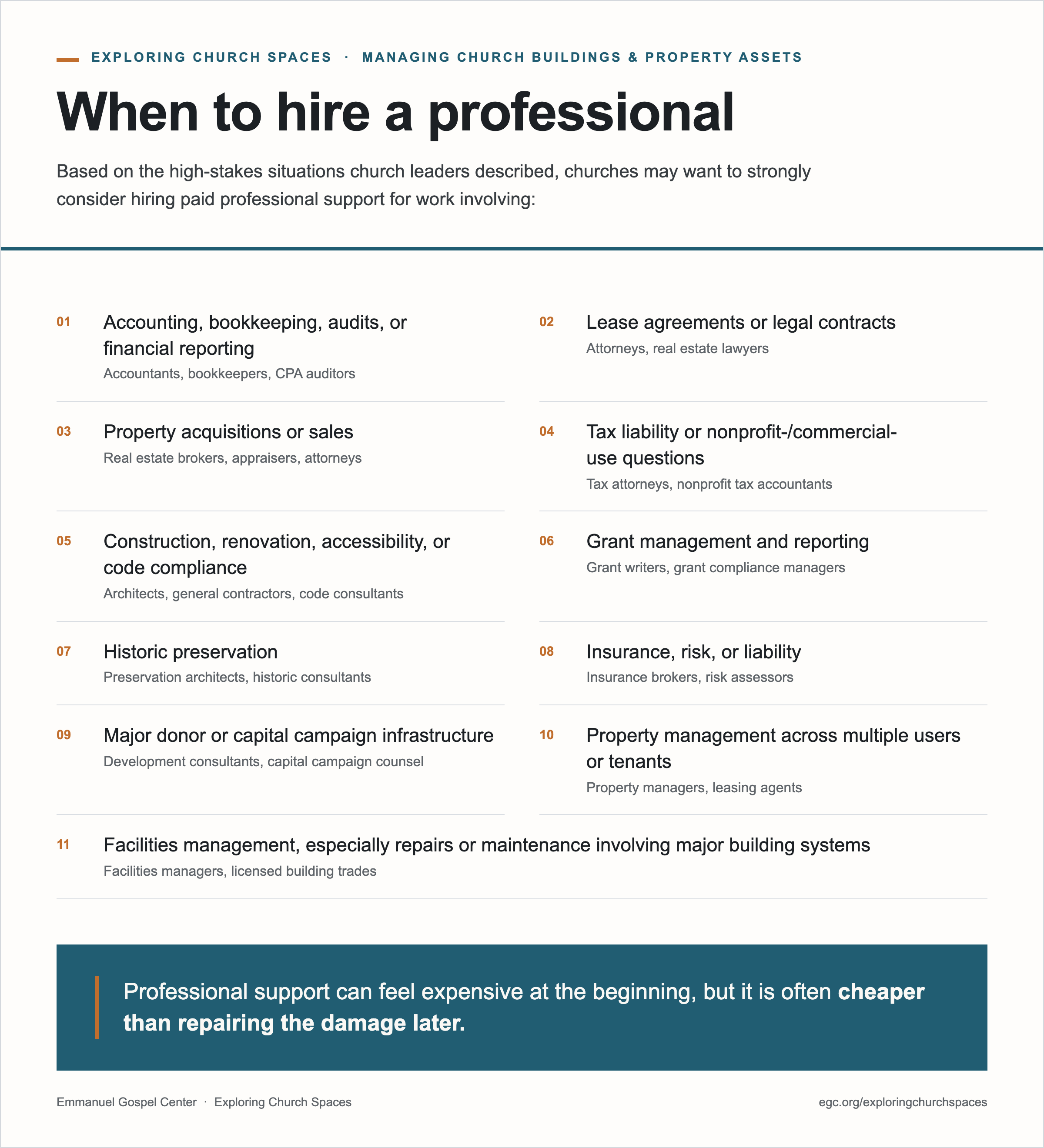
Based on the high-stakes situations church leaders described, churches may want to strongly consider hiring paid professional support for work involving:
accounting, bookkeeping, audits, or financial reporting
lease agreements or legal contracts
property acquisitions or sales
tax liability or nonprofit-/commercial-use questions
construction, renovation, accessibility, or code compliance
grant management and reporting
historic preservation
insurance, risk, or liability
major donor or capital campaign infrastructure
property management across multiple users or tenants
facilities management, especially repairs or maintenance involving major building systems
Professional support can feel expensive at the beginning, but it is often cheaper than repairing the damage later. One leader emphasized that churches should not be afraid to invest in consultants and coaches. Their organization had spent significant money on outside expertise, but saw it as part of what made larger funding opportunities possible. For example, securing a major multimillion-dollar project required substantial upfront consulting costs, some of which were structured to be paid through the project rather than directly by the church.
Churches should also account for paying people for work that requires professional skill and responsibility. If the church needs the work done well, on time, and with accountability, it should be treated as a professional service, even when the provider cares about the church or offers a reduced rate. A discount can be a gift, but it should not replace fair compensation, clear expectations, or professional standards.
2. Build strong accounting and financial reporting systems.
If a church wants to receive grants, manage multiple revenue sources outside of tithing, or take on building projects, it needs financial systems that can withstand outside scrutiny. Good financial systems are not just for internal decision-making; they also matter when funders, lenders, auditors, partners and investors, tenants, contractors, or public agencies need to understand how money is being managed.
Separate operating funds, building funds (including rental income and building expenses), restricted grants, and capital project funds. When accounts are mixed together, it becomes difficult to know what money belongs where, what funds are restricted, and how to report expenses accurately. Some funders may also require restricted project funds to be kept in a separate account from church operating funds or other grant-funded projects. Churches should decide what belongs in each budget or account and apply those categories consistently.
Require regular financial reports. A church should be able to provide a clear financial report when needed for internal review, funder reporting, grant applications, or major project planning. Profit and loss statements, project budgets, grant reports, and, when relevant, 990s for a separate nonprofit entity should be clear and easy to interpret. Line items should be specific enough that outside reviewers do not have to guess what they mean or wonder whether expenses are being categorized appropriately.
Use bookkeeping software consistently. Several churches described situations in which software had been purchased but was not used consistently, or in which financial information was tracked in multiple places and in different ways. That makes it much harder to reconcile accounts, prepare reports, or understand the church’s actual financial position. It is worth the time to set up the system properly, get professional help if needed, provide training on how to use it, and maintain it regularly.
“If I could do it all over again, my first hire would be an accountant before a personal assistant.”
One church leader described a situation in which different financial systems had developed over time: one for treasury, another for operations, and another for investments, without enough oversight between them. The problem became clear when a grantmaker requested a financial report, and the church had to confront the need for stronger accountability and an integrated, unified financial system.
Build in checks and balances. Financial management should not depend on only one person. Even when a church has a trusted treasurer, bookkeeper, or operations director, there should be regular reviews by a finance team, board, or outside accountant. Clear roles, shared reporting, and periodic review help prevent confusion, accidental mismanagement, and the appearance of impropriety. They also protect the person handling the finances by ensuring they are not carrying responsibility alone.
Pay for bookkeeping or accounting help before finances become too complex. Many churches have volunteer treasurers or members who help manage the books, and that may work for a simple church operating budget. But it is usually not enough when a church is managing major capital projects, multiple grants, rental income, property expenses, restricted funds, or several accounts. As one church leader reflected, “If I could do it all over again, my first hire would be an accountant before a personal assistant. They would have saved us so many headaches.”
Paying for bookkeeping or accounting support can prevent confusion, accidental mismanagement, delays, and reporting problems that could jeopardize thousands of dollars in funding. A few hundred dollars a month for reliable bookkeeping may save the church from losing far more in missed opportunities or broken trust with funders.
Prepare for funder expectations, even if churches are not legally required to file the same reports as nonprofits. Some funders ask for audits, financial statements, or 990s, even if churches are exempt from certain filing requirements. In some cases, the ability to provide strong financial documentation can make the difference between receiving or missing out on significant funding. Financial transparency should not be something churches fear. Accountability, integrity, and clear stewardship are part of the witness of the church.
3. Bring legal counsel in before signing agreements.
Several churches we interviewed experienced significant challenges with long-term lease agreements, especially cell tower leases. When churches were first approached by cell companies, many leases locked in churches for 30 or 40 years. For churches that needed cash for repairs or building improvements, the upfront revenue was appealing. However, when the tax laws changed during the life of the lease, the commercial use of church property triggered property tax liability.
Because the contracts did not clearly protect the church, that liability fell back on the congregation. Though churches received upfront revenue through those deals, it ultimately ended up costing churches thousands of dollars a year, and for some who were not able to work their way out of that liability, it cost them hundreds of thousands over the life of the lease. In those cases, the long-term costs outweighed the income the church received when it first signed the agreement.
“The factor that has hindered us most is ignorance. In our system, we are driven from a religious perspective based on a religious organization, and we were not oriented around business or management.”
Do not sign major agreements without legal review. Churches should have a lawyer review long-term leases, cell tower agreements, tenant leases, construction contracts, purchase and sale agreements, easements, financing documents, and any agreement that could affect the church’s property, tax status, liability, or long-term control. Legal review is essential, but it does not replace ongoing oversight.
In one church, a lease had been reviewed by a legal team, but when the leasing company reduced its payments, no one caught the change for ten months. The church only discovered it when preparing the annual budget. By then, the monthly payment had dropped by nearly $1,000, resulting in significant lost income. As the leader reflected, “I didn’t know what I needed to know. And other people didn’t catch it either.”
Be especially careful when negotiating with corporations or entities that have far more legal experience than the church. Corporations have attorneys drafting agreements to protect their own interests. If churches enter business arrangements, they need legal counsel to help them understand the risks and negotiate terms that protect the church.
One church leader reflected on how costly that learning curve can be: “The factor that has hindered us most is ignorance. In our system, we are driven from a religious perspective based on a religious organization, and we were not oriented around business or management.”
Another leader described the mindset shift churches need when entering more complex property arrangements: “If we want to play in the big leagues, then we need to elevate our level of gameplay. We are going to make mistakes, but we have to step our game up, or else they are going to run right over us. We have to be ready to elevate to that level of operating. Not every pastor is capable of that. So you need to have the right people.”
Together, these reflections point to the same lesson: churches do not need to abandon their spiritual mission, but they do need the right legal, financial, and managerial support when making high-stakes property decisions.
Build protections into the agreement. Where appropriate, agreements should include review points, rent escalators, termination clauses, clear tax responsibility, insurance requirements, maintenance responsibilities, and remedies for breach. These protections are aimed at mitigating changes that may occur over the life of a lease and make the difference between an agreement that supports the church and one that creates a long-term financial burden.
Do not assume a standard contract protects the church. Every agreement should be reviewed and revised for the specific circumstances being negotiated. The longer the agreement, the more important this becomes. A few thousand dollars in legal review at the beginning may save the church from decades of financial loss later.
4. Clarify tax liability.
A tenant’s business should not become the church’s tax burden. This was mentioned in the previous strategy, but it is important enough to be named separately.
In every lease agreement, churches should clarify who is responsible for any property tax triggered by commercial, for-profit, or non-exempt use of the space. One-time use of the building will usually not trigger this kind of liability, but even short-term space-use agreements should include basic language about responsibility for fees related to the user’s activities.
For more information on tax liability, read our Tax-Exemption Issues for Massachusetts Churches resource.
For longer-term leases, include language that addresses changes in tax law or municipal interpretation. If the arrangement depends on a tenant’s nonprofit status, require documentation of that status and update it as needed. Churches should also review whether uses such as cell towers, childcare centers, schools, offices, commercial kitchens, housing, or other income-generating activities could affect their property-tax exemption.
5. Know what your space costs.
Many churches want to be generous with their space. They may offer below-market rent to a nonprofit partner whose work aligns with the church’s mission, allow another congregation to rent at low cost, or let a community group use the building for free. Churches may also feel pressure not to charge market rates because of the pervasive perception that “churches are not in the business of making money.” While generosity can be a faithful witness, it needs to be balanced with what the church can realistically sustain, and it should be a decision the church makes intentionally, not on a whim or by default.
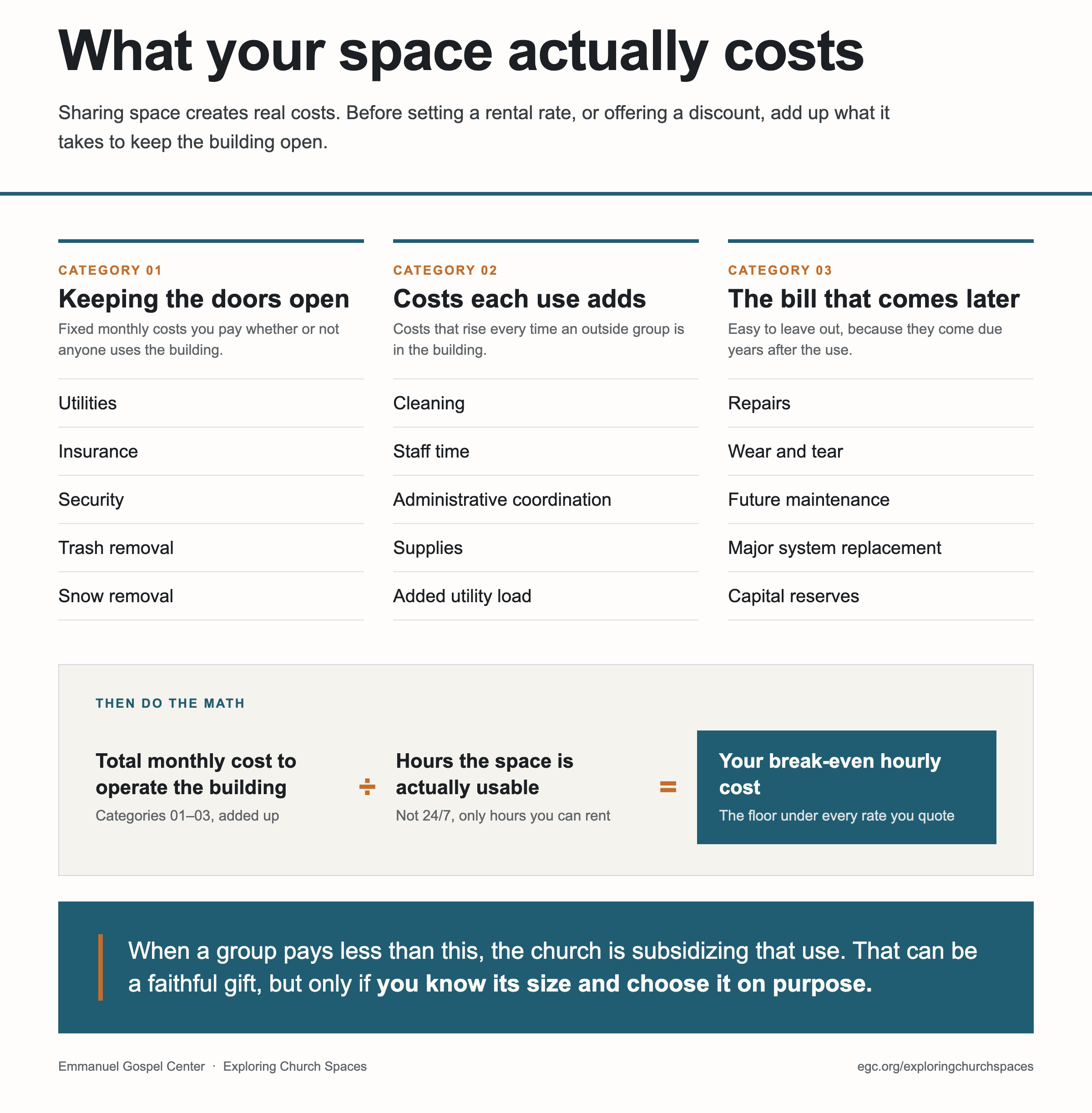
Sharing space creates real costs. Churches still have to pay for utilities, cleaning, staff time, administrative coordination, insurance, trash removal, repairs, security, supplies, wear and tear, snow removal, and future maintenance. When a group pays little or nothing, the church is subsidizing that use.
Calculate the real cost of building use. Churches should make an effort to obtain a basic understanding of what it costs to operate the building each month and what additional costs are connected to outside use. This helps leaders make informed decisions about rental rates, how much to discount or subsidize, and what they are willing to offer for free.
One church we interviewed takes this seriously by naming the actual rental price up front. If a group begins by asking for a discount, the church sees that as a sign that the group may not yet understand the value or cost of the space. The church may still choose to offer a discount later, but it first wants to know that the group understands the space’s value and is prepared to contribute fairly.
Decide intentionally which groups receive reduced rent or free use. Not every group that needs space can or should receive the same subsidy. Churches should decide which uses align most closely with their mission and what level of support they can realistically offer. This makes generosity intentional rather than accidental.
Name the subsidy as part of the church’s mission. If the church is offering space below cost, name that clearly. For example: “We are choosing to subsidize this use because it serves our neighborhood, supports another congregation, or aligns with our mission.” Naming the gift helps others understand that the reduced rent means the church is covering the remaining cost as a ministry investment.
Make sure generosity is sustainable. A church can be generous and still be honest about its limits. If below-market rent prevents the church from maintaining the building, paying staff, or covering basic costs, the arrangement may eventually harm both the church and the people it is trying to serve. Sustainable generosity requires knowing what the church can afford to give.
6. Monitor rental income, lease terms, and contract changes.
A signed lease is not a system. Someone still has to monitor whether both parties are following the agreement.
Once an agreement is signed, it can be easy to assume everything is settled. But leases and rental agreements need ongoing attention. Tenants may fall behind on payments, pay less than agreed, use more space than originally included, or allow terms to shift informally over time. If no one is assigned to track these details, the church may lose income, miss opportunities to address concerns early, or allow resentment to build around unspoken changes to the agreement.
Track whether tenants are paying what was agreed. Churches should have a simple system for tracking rental payments, due dates, late payments, and outstanding balances. This should not depend on memory or informal check-ins. If a tenant is paying less than agreed, paying late, or missing payments, someone should know quickly and follow up. Rental income should be monitored regularly, not only when it is time to build the annual budget.
“If no one is assigned to track the details of a contract, the church may lose income, miss opportunities to address concerns early, or allow resentment to build around unspoken changes to the agreement.”
Review leases and rental agreements annually. Church leaders should know what each agreement actually says: which spaces are included, the rent, the tenant’s responsibilities, and the responsibilities that remain with the church. Reviewing agreements annually helps the church catch places where actual practice has drifted from what was originally agreed and decide whether any terms need to be clarified or renegotiated. It can also be helpful to hold a mid-year check-in with tenants to discuss how things are going and whether any adjustments are needed.
Assign responsibility for lease compliance. Whether it is a building manager, treasurer, property committee, or administrator, one person or team should be responsible for monitoring rental income, lease terms, and tenant responsibilities. Regular oversight helps churches catch problems early, communicate clearly, maintain good relationships with tenants, and protect the building’s financial health.
7. Create clear space-use agreements.
Every use of church space carries some level of responsibility and liability. A clear agreement protects both the church and the person or group using the space by defining the terms of use before problems arise. It helps everyone understand what is allowed, what is expected, who is responsible for what, and what happens if something goes wrong.
For one-time use, the agreement may be simple, but it should still be clear. It should include the date, time, rooms being used, purpose of the event, expected number of people, setup and cleanup responsibilities, insurance requirements (if any), food or equipment use, security expectations, and who is responsible for damage or incidents.

Photo credit: Chalermphon via Lightstock
For short- or long-term leases, the agreement needs to be more detailed. It should define which spaces are included, days and times of use, storage, keys or building access, shared areas, cleaning, trash, insurance, repairs, security, payment terms, and whether the group can invite outside groups, sublet, use the church’s mailing address, or access other parts of the building.
Longer-term agreements should also be reviewed regularly. Over time, a group may begin using more space, storing more materials, staying later, inviting additional users, or relying on building access in ways not part of the original agreement. When that happens, churches should address it directly, document the conversation in writing, and update the agreement if needed.
8. Build basic administrative systems for scheduling, keys, storage, and communication.
Shared space breaks down when the right information does not reach the right people at the right time.
“Our biggest challenge is keeping things organized,” as one church leader described the problem plainly. “The apartments next door were going to host an annual meeting in our building. It wasn’t on our calendar, and they didn’t have our contact, so they couldn’t get in for their meeting.”
As more people and groups use a church building, informal communication is usually not enough. Without clear systems, churches can end up with double bookings; people entering the building without approval; confusion about who will open it when a group needs access; or frustration over setup, cleanup, and storage.
Almost every church we interviewed had a master calendar that tracked all building use, including worship services, internal ministries, tenant use, one-time events, maintenance appointments, and community use. There should also be a clear process for requesting space, whether for a one-time event or recurring use. People should know who approves requests, how far in advance they need to ask, and when their use is officially confirmed.
“These systems do not need to be complicated, but they do need to be clear.”
It is also important to have clear points of contact. Each user group should have one primary contact, and the church should have one primary contact to communicate with that group. Backup contacts should also be listed in case of emergencies, last-minute changes, or building issues.
Churches should create written policies for keys, codes, storage, setup, breakdown, cleaning, parking, and locking up. If groups are allowed to store materials, assign specific storage areas and make sure everyone knows what belongs where. If something breaks, goes missing, or an incident happens, there should be a simple process for reporting it.
These systems do not need to be complicated, but they do need to be clear. The more a church shares its space, the more it needs basic administrative infrastructure to protect the building, reduce confusion, and maintain good relationships with everyone using it.
For more information on ways to make decisions about space use and creating management systems, read our Church-Space Decisions resource.
9. Do not over-leverage property and protect core ministry assets.
Property can be a powerful tool for mission, but it can also create serious risk when churches borrow against their most important assets without a strong repayment plan. Some churches take on debt to renovate, acquire property, or launch new projects. Others borrow against one property to cover shortfalls somewhere else. Debt is not always the problem. The danger comes when a church takes on debt without understanding what is at stake if the project does not go as planned.
In one case we learned about, a church with strong membership had taken on significant debt for a capital project. On the outside, the church looked stable and still had lots of money in the bank. But after a leadership transition, the congregation lost a large portion of its membership, leaving the church in a difficult financial position. Even after reaching out to another church for help, the church ultimately had to sell its building and use its remaining funds to pay off debts, forcing it to close. The leader who was asked to help that church described it as:
They were taking on debt to pay another debt until they folded like a deck of cards when they couldn’t pay it anymore. They lost everything. A lot of churches use their equity to cover their operating budget. They take money out of their properties to fill budget gaps or pay salaries, and that is a huge, huge mistake. You are basically spending your children’s inheritance. I understand why churches do it, but at that point, they are almost giving their church a death date.
That same leader described their church’s approach: using investment income carefully while preserving property proceeds for future property needs.
We have cash that is invested, and a percentage of the interest from that investment goes into our budget. We can use some of it, but not all of it. Some of it supports building needs, and some may support day-to-day operations, but we are careful with it. When we sell a property or take out a line of equity, we do not touch that money until we are ready to buy another property with it.
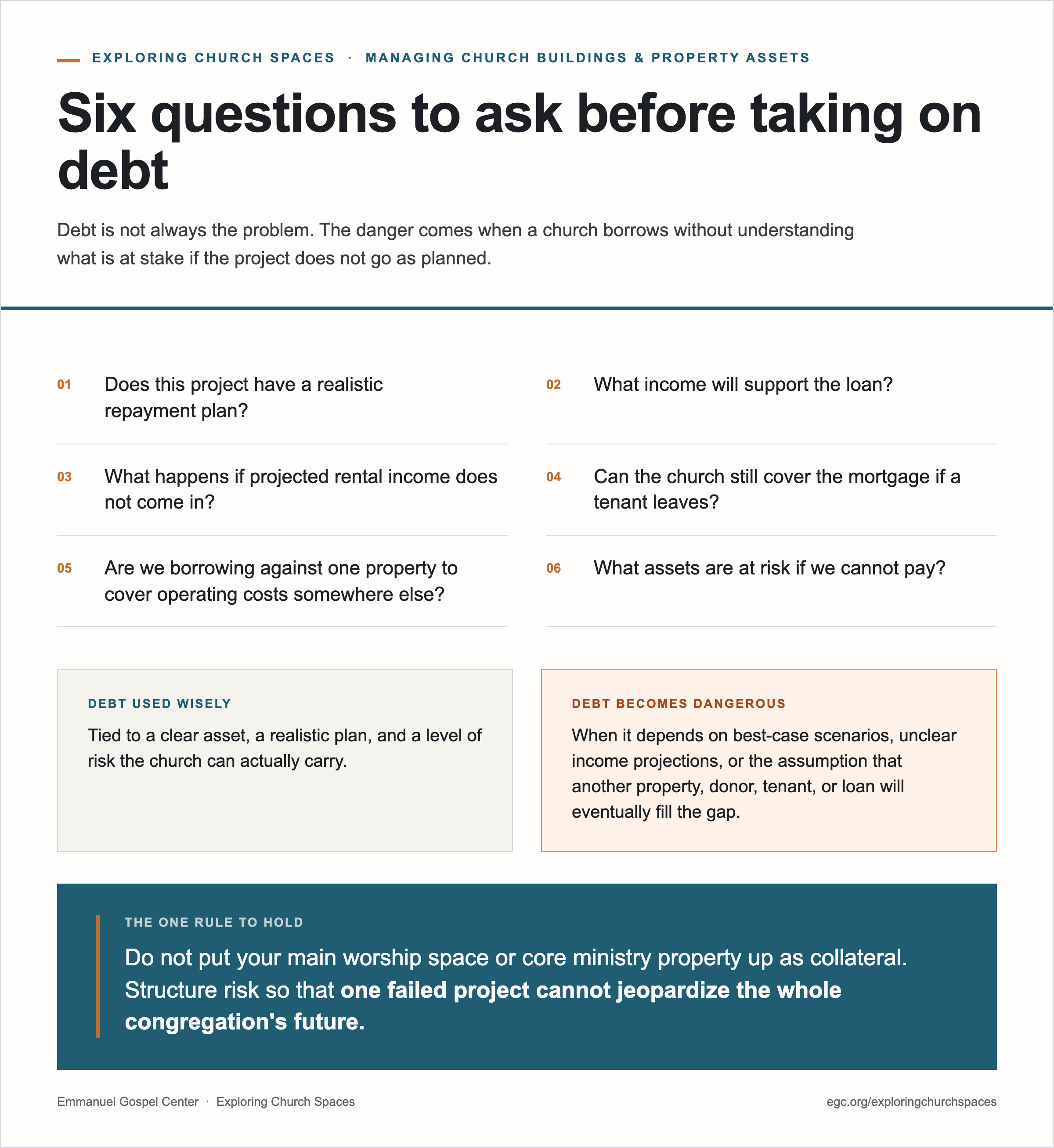
Churches should be especially careful about using their main worship space or core ministry property as collateral for new projects. If a new venture fails, a tenant leaves, interest rates rise, major repairs hit, giving drops, or leadership changes destabilize the congregation, the church should not be at risk of losing the property that anchors its worship and community life.
One church leader explained how they manage risk by protecting their core worship property:
None of our loans have our main worship and retreat center as collateral. For some reason, if the market went to zero, nobody rented from us, and interest rates all went to 30%, we could give up all the properties, but we would still have our main worship center. We just can’t over-leverage.
Before taking on debt, churches should ask hard questions: Does this project have a realistic repayment plan? What income will support the loan? What happens if projected rental income does not come in? Can the church still cover the mortgage if a tenant leaves? Are we using debt from one property to cover unrelated operating deficits? What assets are at risk if we cannot pay?
Secured debt can be used wisely when it is tied to a clear asset, a realistic plan, and a level of risk the church can actually carry. But debt becomes dangerous when it depends on best-case scenarios, unclear income projections, or the assumption that another property, donor, tenant, or loan will eventually fill the gap.
Protecting core ministry assets is an act of stewardship. Churches can take thoughtful risks, but they should structure those risks so that one failed project does not jeopardize the whole congregation’s future.
10. Plan and budget for deferred maintenance.
Many churches live with building issues for years because the list feels overwhelming, and the money is not immediately available. But roofs, HVAC systems, plumbing, electrical systems, water leaks, accessibility barriers, and code issues do not simply stay the same. When they are ignored, they often become more expensive, more urgent, and more disruptive over time.
A building assessment is a good place to start when churches do not know where to begin. An assessment by an architecture or engineering firm can help leaders understand the condition of the property, identify urgent safety concerns, estimate costs, and prioritize what needs to happen first. These assessments should be updated every five years, especially if the church plans to apply for preservation grants or other forms of capital funding, as funders often want current information on the condition of the building and the proposed scope of work.
“Planning for maintenance is not just about preserving a building; it is about protecting the ministries that depend on it.”
Churches should also create a capital maintenance reserve, even if they can only start small. Setting aside money regularly for major repairs helps prevent every building issue from becoming a crisis. Maintenance costs should also be built into annual budgets and rental rates. If tenants and community groups are using the building, the cost of keeping that building safe, accessible, heated, and functional needs to be part of the financial picture.
A dream without a plan is just a wish [as one church leader reflected]. This church is good at dreaming and wishing, but how do we get to a place of planning to get these things to happen? Not just flying by the seat of our pants. Flexibility is great, but also a challenge. Now that we are acquiring assets and budgets are increasing, we are entering into a new level which requires a different approach.”
When prioritizing repairs, churches should focus first on safety, accessibility, roof, HVAC, plumbing, electrical, water intrusion, and code issues. These are the kinds of problems that can quickly shut down worship, programming, community use, tenants, and rental income. It can also help to keep updated quotes for major projects, even if the church cannot complete them right away. Quotes change, but they give leaders a realistic sense of the project’s scale and better prepare the church when funding opportunities arise.
Deferred maintenance can quietly threaten every other property strategy. A church may have tenants, partners, programs, or rental income, but one major building failure can put all of that at risk. Planning for maintenance is not just about preserving a building; it is about protecting the ministries that depend on it.
Stewardship that Sustains Mission
All of these practices can feel tedious. Tracking leases, reviewing agreements, maintaining calendars, working with professionals, building reserves, planning for repairs, and communicating consistently with funders, community partners, and tenants can sometimes feel like drudgery.
However, these leaders have learned personally that it is worth it. Good systems protect more than the building. They protect relationships with tenants and partners. They protect trust with funders, neighbors, and public agencies. They protect the congregation from avoidable financial strain, stress, and burnout. And they protect the church’s ability to use its property for mission over the long term.
A church does not need to do everything perfectly all at once. But every step toward clearer agreements, stronger financial systems, better communication, and more intentional stewardship puts the church in a stronger position for the future. These practices are not separate from ministry; they are a critical part of what allows ministry to flourish and last.


Keywords
- #ChurchToo
- 365 Campaign
- ARC Highlights
- ARC Services
- AbNet
- Abolition Network
- Action Guides
- Activism
- Administration
- Adoption
- Aggressive Procedures
- Andrew Tsou
- Annual Report
- Anti-Gun
- Anti-racism education
- Applied Research
- Applied Research and Consulting
- Asking for help
- Ayn DuVoisin
- Balance
- Battered Women
- Berlin
- Bianca Duemling
- Bias
- Biblical Leadership
- Biblical leadership
- Black Church
- Black Church Vitality Project
- Book Recommendations
- Book Reviews
- Book reviews
- Books
- Boston
- Boston 2030
- Boston Church Directory
- Boston Churches
- Boston Education Collaborative
- Boston General
- Boston Globe
- Boston History
- Boston Islamic Center
- Boston Neighborhoods
- Boston Public Schools
- Boston-Berlin
- Brainstorming
- Brazil
- Brazilian
- COVID-19
- CUME
- Cambodian










With limited meeting space in some of our cities, how do churches who practice their faith in different ways gather under the same roof and learn to love each other?