
BLOG: APPLIED RESEARCH OF EMMANUEL GOSPEL CENTER
Practicing Postures for Shalom
When you march 160 miles, you quickly discover how much you need other people — and how hard it is to let go of control. For white Christians working toward racial justice, that discomfort isn't an obstacle. It’s the point.
Emmanuel Gospel Center
Practicing Postures for Shalom
Invitations from a 160-mile march on how to work toward shalom in the ordinary
by Megan Lietz, Founding Director, Race & Christian Community Initiative
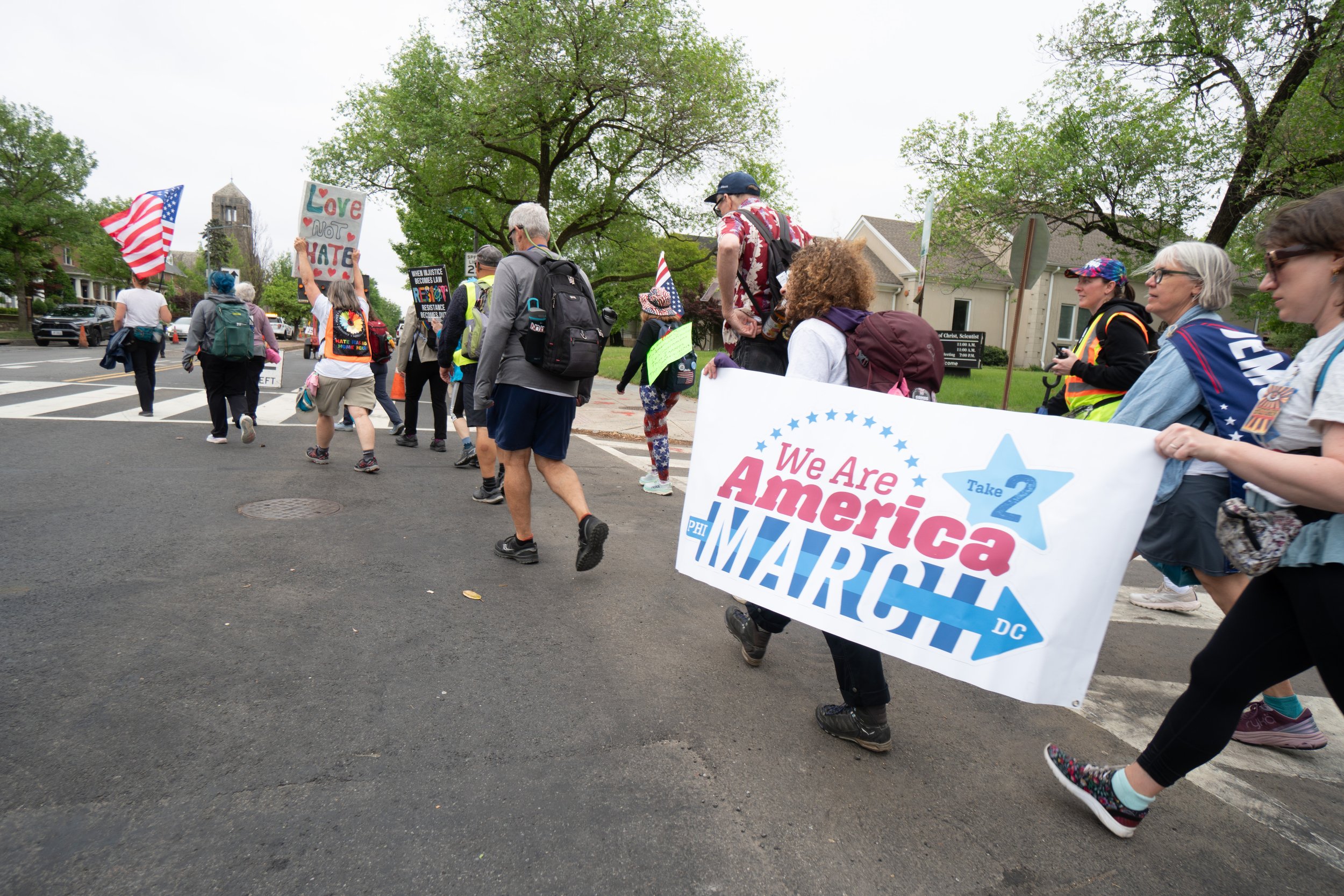
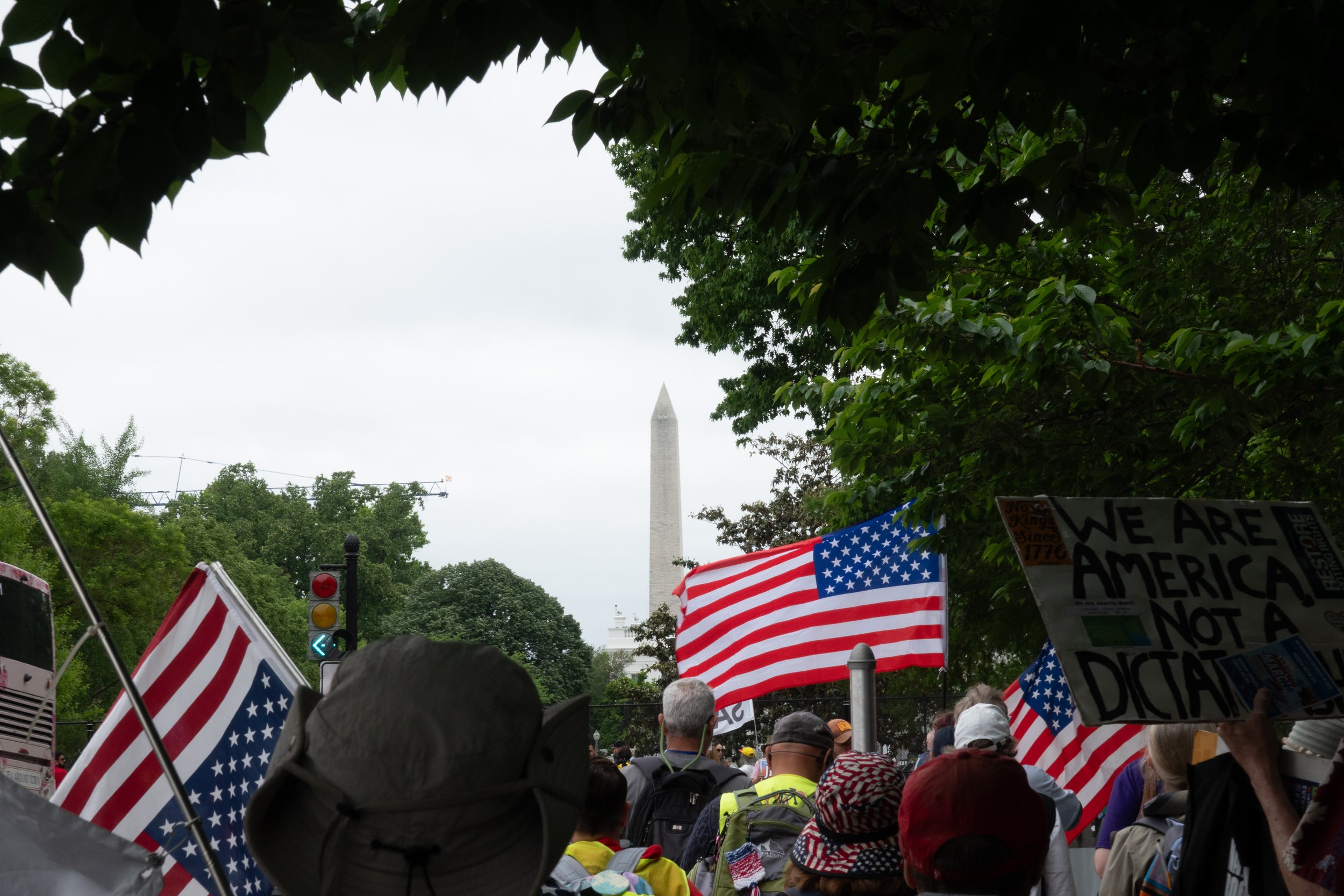
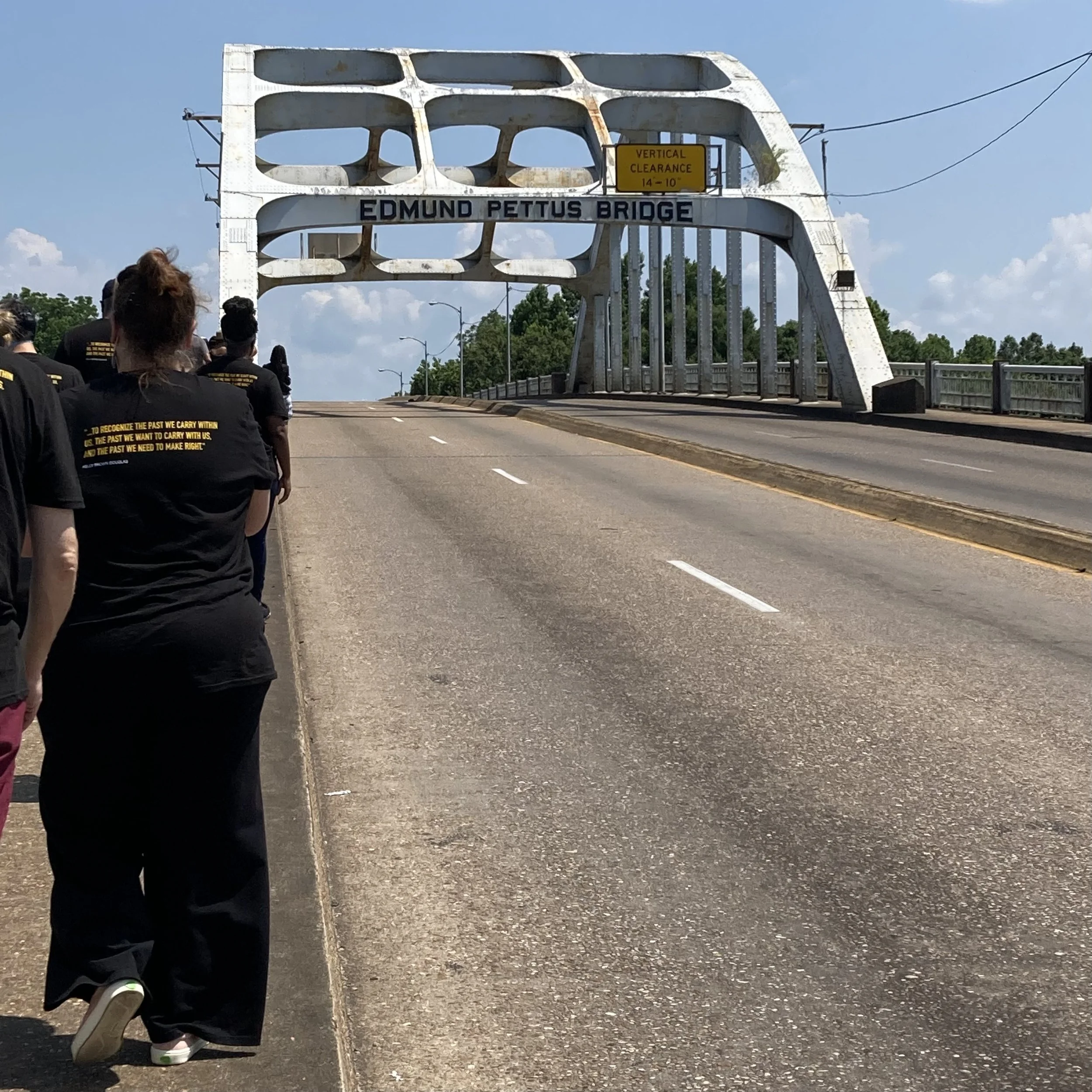
With racism and xenophobia on the rise, the Church must stand up and take action. I had the honor of participating in a portion of the We Are America March: a 160-mile journey from Philadelphia to Washington, D.C.
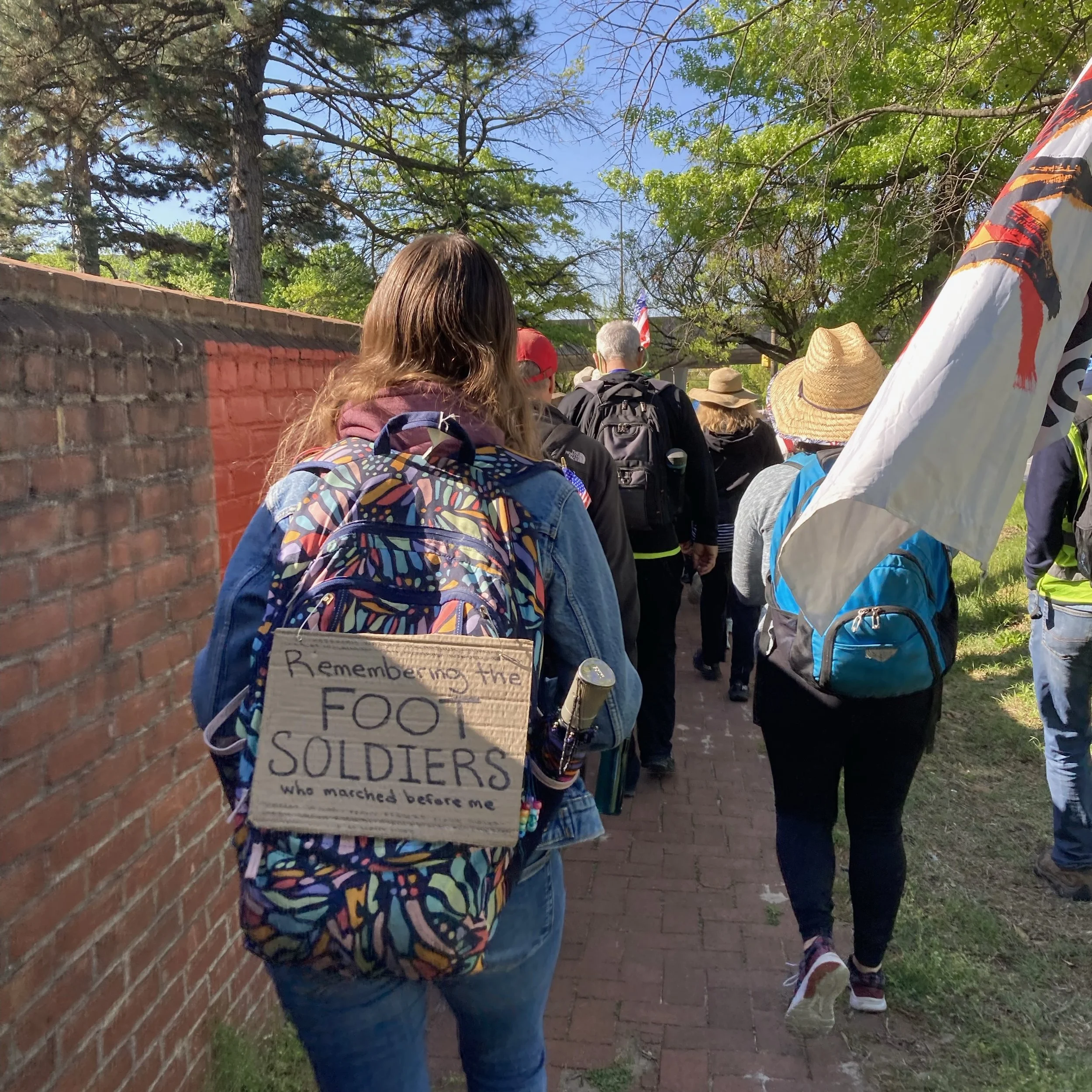
The one thing that united marchers was a desire to see our country live into our democratic ideals. But with such a diverse group, there were many reasons people participated. I marched to honor those who marched before me, to learn, and to be a faithful witness to Jesus. Throughout the march, I spoke about the foot soldiers of the civil rights movement who inspired me to engage in civic life. I was touched by the power of community and spoke openly about how my faith in Jesus motivates my justice journey.
What struck me most was how the march provided an invitation to practice the postures of shalom-building. This led me to reflect on the importance of Christians practicing these postures today.
Participating in an inter-state march is no small undertaking. It comes at a cost. But I found that the cost was paid back many times over through the way God formed me and the blessings of community. I highlight three areas I feel the march invited participants to grow—areas white Christians need to practice to nurture shalom and invest in our own liberation.
ulzimate
Letting Go of Control
When you’re on a week-long march, there’s much that isn’t in your control. Plans pivot. Weather changes. You don’t always know what you want to know.
I’m someone who likes to be in control. To have a plan. To know what’s next. Though shaped in part by my personality and experiences, I also recognize that this desire for control is a core component of whiteness. From the earliest days of racialization, it motivated racial hierarchy and was used to keep it in place. And whether I realize it or not, I’ve been socialized in ways that lead me to desire, expect, and grasp for control in order to feel OK.
The march was an opportunity to have faith, to know that God is in control, and to release the need to know. When I wanted to check the online schedule or ask how a change would affect the rest of the day, I paused. I don’t need to know. Others are working it out. Trust others to take the lead. I don’t need to be in control.
When I released my desire to be in control to God, I received the gift of being more present to my work that day. I was also better positioned to be formed by my Lord and Savior.
While these dynamics are amplified in an immersive experience like a march, we have—and should take—the opportunity to practice releasing control in the day-to-day.
“While these dynamics are amplified in an immersive experience like a march, we have—and should take—the opportunity to practice releasing control in the day-to-day.”
As white people who desire to contribute to the dismantling of racism, it’s critical that we learn how to let go of control and share leadership. But this is hard to do in real time. We hope we’ll be the kind of people who let go of control when it counts, but how will we do so without practice?! We won’t do it when it counts the most if we aren’t learning to release control in other areas of our lives.
Practical suggestions for learning to let go of control
Next time you’re noticing you’re not in control and feeling anxious about it or like you want to take action to put the ball back in your court, take a breath. Ask yourself, “Do I need to be in control right now?” Questions that can help you determine this include:
Whose comfort is my need for control really serving?
Is my urge to lead coming from competence and calling, or from habit and privilege?
What am I afraid will happen if I'm not in charge?
Have I been invited into leadership here, or have I assumed it?
Noticing when we’re vying for control—and intentionally giving it up—can build our muscle to do so when racial equity is on the line. It helps us practice more liberated ways of being.
This is hard work, but it can be done with God’s help. I offer the following breath prayers as a grounding exercise: Breathe in: “You are God.” / Breathe out: “I am not.”
ulzimate
Trusting for Care and Abundance
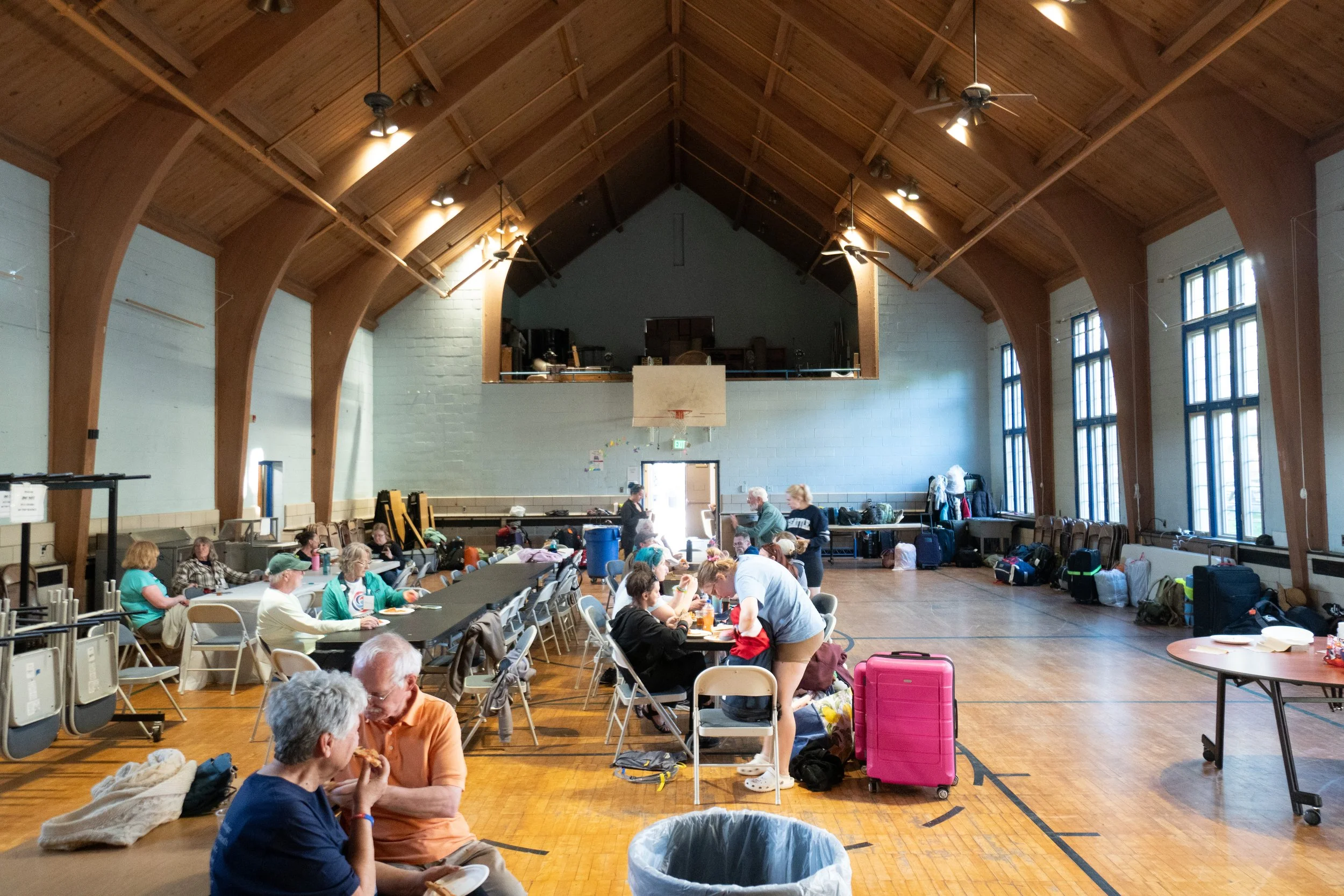
On the march, we would pack up our meager belongings, put on our shoes, and walk an average of 10 miles a day until we reached where we would sleep that night. When we arrived, we would be welcomed by our hosts, fed dinner, and claim a space to set up our sleeping bag. This rhythm reminded me of God’s people on the move in the wilderness, following the cloud by day and pillar of fire by night (Exod. 13:21-22).
When marchers set out each morning, we wouldn’t have everything we needed for the day. We had to trust in the generosity and hospitality of others. Churches that opened their doors. Volunteers who made sandwiches. Medic teams who cared for our feet. And not least of all, my fellow marchers who consistently offered encouragement and kindness, be it helping me carry my luggage, finding a lost pillow, or giving up their own spot so I could have a more comfortable place to sleep.
Marching invited participants to trust God’s providence and care through his people. In doing so, I grew in my faith. I experienced encouragement and healing as I received kindness from strangers. I came to better understand why Jesus would have sent out his disciples with little more than a staff (Mark 6:8), or told the Israelites to only gather enough manna for the day (Exod. 16:4): Because it was an exercise of faith.
So much of the racism and xenophobia in our nation is derived from the belief that there’s not enough to go around. That if one group thrives, there won’t be enough for another. It is counter to God’s heart for mutual thriving and his instructions to seek the peace of the city and pray for it “because if it prospers, you will prosper” (Jer. 29:7).
“Marching invited participants to trust God’s providence and care through his people.”
Especially as people of privilege, many of us can meet our daily needs on our own. But learning to trust others and receive their care is itself a gift. I believe it can reassure us that, even as we are giving generously and sacrificially to others, we can be cared for too. God himself will provide through his people. We are an interconnected, interdependent body (1 Cor. 12:12-27), and are designed to function as such.
For me, the march served as an invitation to embrace our interdependence and lean into community. Like letting go of control, we need to practice doing this. We don’t need to hoard resources or hold things too tightly. We should bless others, because they are God’s blessing to us.
Practical suggestions for trusting in care and abundance
These spiritual practices help me trust that God will care for me, even as I give of myself:
Regularly give tithes and offerings: I can give to God and others and still have enough myself.
Incremental fasting: I can give up things I feel I need, like caffeine or sugar, and still have enough energy and emotional resources to do what God has for me that day.
Ask for help when I need it: This is a hard one, but the more I’m willing to ask for help and receive from others in the small things, the better able I am to embrace the interdependent nature of the body of Christ!

ulzimate
Persevering Through Discomfort
Overall, during the march, I felt comfortable, cared for, and safe. But there were certainly moments of discomfort, like realizing that I’d be sleeping next to strangers, not having all the info I wanted when I wanted it, marching through the rain, or moving stiff muscles and sore feet.
The march provided an invitation to persevere through discomfort. Because white folks are a part of the dominant culture, we are often afforded the opportunity to be in spaces and cultural contexts that are familiar to us and reflect our preferences. When we are not, we can feel uncomfortable. But as white people, too often we associate our discomfort with not being safe. We then tend to center our own emotions until comfort is regained—often while diminishing the needs and feelings of people of color.
“Learning how to persevere through discomfort is necessary to nurture shalom across racial lines.”
Like letting go of control or trusting in God to care for us, shalom-seekers can benefit from learning how to persevere through discomfort. Crossing cultural lines, decentering oneself, or participating in civic engagement is often not comfortable work. It is sacrificial. Learning how to persevere through discomfort is necessary to nurture shalom across racial lines.
Practical suggestions for persevering through discomfort
Some practices I use to persevere through discomfort include:
Noticing when I feel uncomfortable and naming it. (Mindfulness is the first step!)
Doing a body scan to notice where I may be holding tension and/or emotions in my body.
Practicing self-soothing exercises to work through discomfort.
ulzimate
Conclusion: Opportunities for Formation in the Ordinary
It doesn’t take an immersive experience like a march to practice these things. While I found the march to be an invitation to formation, it highlighted the work we need to be doing in the day-to-day. Consider the opportunities to:
Let go of control as you navigate changes in the office or collaborate on a group project.
Show kindness and generosity to a neighbor that extends beyond what you would normally give.
Vote in ways that may seem against your best interest in order to care for vulnerable populations and trust that God will care for you.
Practice self-soothing during a tense conversation with a friend or family member.
Intentionally orient yourself to your day with an open hand and flexibility.
“Lord Jesus, I invite you to form my ways of being. Come set me free. May I be more like you.”
There are opportunities for liberation in the ordinary. Would you look for them with me? Would you learn with me how to let go of control, trust in God’s care and abundance, and persevere through discomfort? I believe, as we invite the Holy Spirit to form us in these ways, we can be better agents of shalom-building. Not because we have what it takes, but because, by God’s grace, he can make us new.
If this resonates with you, I invite you to pray with me, “Lord Jesus, I invite you to form my ways of being. Come set me free. May I be more like you.”














Why isn’t my church talking about race?
Many white Christians in evangelical churches feel isolated in their desire to discuss race, often encountering silence or pushback from their communities. Engaging with racial issues from a biblical perspective is essential for fostering unity and effectively following Jesus in a diverse world.
Photo credit: Shaun Menary via Lightstock
Many white Christians in evangelical churches feel alone in their desire to talk about race
by Megan Lietz, Founding Director, Race & Christian Community Initiative
It came from the look in the pastor’s eyes, the awkward pauses in the conversation, the tone that, while appropriate to the passing ear, couldn’t help but feel patronizing. Here I was again, having my faith held suspect because I believe Jesus calls Christians to engage in issues related to race.
At that moment, I knew I had about 30 seconds to establish I was “one of them.” To assert my faith and prove I really am a Bible-believing Christian. There was no time to share that I was born and raised in white evangelicalism, with my teenage years defined by youth conferences and summer missions trips, WWJD bracelets and promise rings. There was no time to mention I believe the Bible is the Word of God and that I learned to study it at evangelical colleges and seminaries. No time to talk about how much my faith means to me, what it has brought me through, or my deep love for Jesus.
It was as if none of that mattered. Certainly, none of it was seen. All it took was the word “race,” and I was written off as a “liberal.”
It was all right. It was a brief interaction with a pastor I had never met before and would probably never see again. Yet it represented a painful reality I often hear about from white brothers and sisters in theologically conservative churches.
“It was as if none of that mattered. Certainly, none of it was seen. All it took was the word ‘race,’ and I was written off as a ‘liberal.’”
One brother shared he feels the discipleship he received did not prepare him to engage our multiracial reality. Another sister said she had to leave her beloved church community after many years because she no longer feels at home in an environment that regards race as a side issue.
The challenges white folks encounter when exploring issues related to race don’t compare to the pain and oppression experienced by people of color. Yet, it is essential for white people to learn how to navigate the obstacles we encounter so we can be better positioned to experience and contribute to racial healing.
Many white brothers and sisters who participate in the Race & Christian Community Initiative (RCCI) often express how refreshing it is to be able to talk about race in the context of Christian community. Sadly, even though these issues are coming up in conversations around the water cooler and blowing up their news feeds, they’re not able to discuss race in their congregations. It’s not mentioned from the pulpit, explored in Bible studies, and certainly not a topic for casual conversation.
Even if it is explored at those lamentable moments when racial violence captures our collective attention, the conversation’s life cycle often mirrors that of the news cycle: a one-off here, a one-off there — reactive events choked out by donor pushback and competing priorities.

Pearl via Lightstock
When churches don’t talk about race, white folks who care about the issue can often feel isolated at best. Well-meaning comments about “slippery slopes” and how “race is a distraction to the gospel” can make us feel frustrated, suspect, or unwelcome. It can even lead to a crisis of faith as we start to believe the lie that the Living Word does not speak into the realities of racial injustice.
Engaging issues related to race from a biblical perspective does not cause us to lose our faith. It helps us follow Jesus more faithfully.
White evangelicals’ disengagement from race has little to do with Scripture. On the contrary, the Scriptures we highly esteem speak abundantly into the issues of unity, diversity, ethnicity, culture, power, oppression, healing, and justice. Our disengagement can be explained — not by God’s heart — but by the result of social and historical realities.
For example, as members of the dominant culture in the U.S., we often don’t have to think about race. Our social location can make us oblivious to the realities of racism.
“The Scriptures we highly esteem speak abundantly into the issues of unity, diversity, ethnicity, culture, power, oppression, healing, and justice.”
Closely related to this, white folks tend not to explore race in our theology. This dynamic is especially problematic when most Christian educational institutions center Euro-American theology as normative and comprehensive. It has left many Christians less aware of God's heart for justice and how the interconnected body has experienced the God of justice in their lives.
The fundamentalist-modernist controversy of the 1920s and ’30s led theologically conservative Christians to largely disengage from social issues so they might distinguish themselves from more theologically liberal expressions of the faith. The impact of valuing orthodoxy over faithfully living into Jesus’ heart for justice continues today.
Because of realities like these, white evangelicals lack the experience, theological frameworks, thought leadership, and examples from within our traditions to build shalom across racial lines. While this can make starting the conversation even more intimidating, we cannot afford to stay silent. When we don’t address issues of race, we do damage to the kingdom of God.

Photo credit: Brimstone Creative via Lightstock
Whether white evangelicals acknowledge the problem or not, we are complicit in the ways racism harms our brothers and sisters of color, diminishes ourselves, and dishonors the image of God. When white congregations don't talk about race, there are significant consequences:
Disunity: Christian communities remain segregated. While being in a racially homogenous congregation is not bad within itself, it becomes a problem if white congregations are homogenous because people of color do not feel welcome, included, or cared for. This can often be the case if congregations are not talking about race, culture, or power dynamics that many people of color experience as a regular part of life.
Church hurt: We lack the discipleship needed to build shalom across racial lines, allowing the perpetuation of racial brokenness in and through Christian communities.
Diminished witness: The harm done and the deeply-seated division in the Church diminish Christian witness. When we know the Great Physician but aren’t working toward racial healing, we miss out on opportunities to demonstrate God’s power and presence.
Waning influence: When the Church isn’t even speaking into a sorely felt need in our society, we shouldn’t be surprised when people stop listening. Instead of proclaiming that Jesus is good news in the midst of racial brokenness, too many white Christians have remained silent and are allowing secular organizations to lead the way.
“We cannot afford to stay silent. When we don’t address issues of race, we do damage to the kingdom of God.”
It doesn’t have to be this way. The Bible offers principles, parallels, and language white Christians can use to talk about race. We can also learn from the traditions of Black, Indigenous and people of color, who have rich legacies of addressing racism. There are also numerous resources by evangelical publishers and denominations on how our faith connects to race.
There are paths ahead. But too often, fear, competing priorities, and well-trodden pathways get in the way.
RCCI creates spaces where white Christians can talk about race. Be it learning communities for white evangelicals, conversations over coffee, or opportunities to reflect on and learn from serving across racial lines, we desire to create a place where white folks can learn and grow in Christian community. We also come alongside predominantly white congregations, meet them where they are, and help them take the next step in exploring issues related to race from a biblical perspective.
Photo credit: R9 Foto for The Emmanuel Gospel Center
The richness of RCCI comes not because we get it all right, but because we create spaces for people to have conversations the Lord is already stirring within them. With love and grace, we create opportunities for the Lord to continue the work he desires to do. And as we invite him in, we see healing, we see hope, we see perspective transformation. What excites us most is seeing people move from talk to action, bearing witness to the person and power of Jesus by continuing his redemptive work across racial lines.
Will you join us in talking about race? Will you learn with us as we explore the conversation? We don’t always say the right thing, but we long to know the Lord more fully, serve him more faithfully, and usher in his kingdom by how we engage across racial lines.
Keywords
- #ChurchToo
- 365 Campaign
- ARC Highlights
- ARC Services
- AbNet
- Abolition Network
- Action Guides
- Activism
- Administration
- Adoption
- Aggressive Procedures
- Andrew Tsou
- Annual Report
- Anti-Gun
- Anti-racism education
- Applied Research
- Applied Research and Consulting
- Asking for help
- Ayn DuVoisin
- Balance
- Battered Women
- Berlin
- Bianca Duemling
- Bias
- Biblical Leadership
- Biblical leadership
- Black Church
- Black Church Vitality Project
- Book Recommendations
- Book Reviews
- Book reviews
- Books
- Boston
- Boston 2030
- Boston Church Directory
- Boston Churches
- Boston Education Collaborative
- Boston General
- Boston Globe
- Boston History
- Boston Islamic Center
- Boston Neighborhoods
- Boston Public Schools
- Boston-Berlin
- Brainstorming
- Brazil
- Brazilian
- COVID-19
- CUME
- Cambodian