

BLOG: APPLIED RESEARCH OF EMMANUEL GOSPEL CENTER

Greater Boston Chinese Church Listing
A listing of Chinese churches in Greater Boston, derived from many online sources and from the ongoing research of EGC. This serves as a resource page to a 2016 article on the current status of Chinese churches in this region. There is also a link to a corresponding map.
About. This listing shows churches in Greater Boston that hold services in Mandarin or Cantonese, or otherwise strongly identify with the region's Chinese population. Last update: March 2017.
Map. For an interactive map of Chinese churches in Greater Boston, click here.
Study. Read a 2016 analysis of the current status of the Chinese church community in Greater Boston, posted here.
Church Directory. You may also be interested in our online Boston Church Directory, with listings for Christian churches in Boston, Brookline, and Cambridge, Massachusetts.
Updates. Help us keep these data current by letting us know about corrections and updates. Write Rudy Mitchell by clicking the Contact EGC button on this page, or call (617) 262-4567 during regular business hours.
| Church/Address | Pastor/Phone | Website/Languages Year Founded |
|---|---|---|
| Boston Chinese Church of Saving Grace 115 Broadway Boston, MA 02116-5415 |
Pastor Kai P. Chan (617) 451-1981 |
http://www.bccsg.org Mandarin, Cantonese, English 1985 |
| Boston Chinese Evangelical Church – Boston Campus 249 Harrison Ave. Boston, MA 02111-1852 |
Rev. Steven Chin (617) 426-5711 |
http://www.bcec.net/ Cantonese, English, Mandarin 1961 |
| Boston Chinese Evangelical Church – Newton Campus 218 Walnut Street Newtonville, MA 02460 |
(617) 243-0100 | Cantonese, Mandarin, English 2003 |
| Boston MetroWest Bible Church 511 Newtown Road Littleton, MA 01460 |
Acting Pastor Elder Mingche Li (978) 486-4598 |
http://www.bmwbc.org Mandarin, English 2010 |
| Boston Taiwanese Christian Church 210 Herrick Road Newton Centre, MA 02459 |
Rev. Michael Johnson (781) 710-8039 |
https://sites.google.com/site/bostontcc Taiwanese, English 1969 |
| Chinese Alliance Church of Boston 74 Pleasant Street Arlington, MA 02476 |
Dr. Peter K. Ho (781) 646-4071 |
Cantonese 1982 |
| Chinese Baptist Church of Greater Boston 38 Weston Avenue Quincy, MA 02170 |
Rev. XiangDong Deng (617) 479-3531 |
http://www.cbcogb.org/ Mandarin, Cantonese, English 1982 |
| Chinese Bible Church of Greater Boston – Lexington Campus 149 Old Spring St. Lexington, MA 02421 |
Pastor Caleb K.D. Chang (781) 863-1755 |
https://www.cbcgb.org/ Mandarin, English 1969 |
| Chinese Bible Church of Greater Boston – City Outreach Ministry 874 Beacon Street Boston, MA 02215 |
Rev. Dr. JuTa Pan (617) 299-1266 |
https://www.cbcgb.org/com Mandarin 2010 |
| Chinese Bible Church of Greater Boston – Cross Bridge Congregation 149 Old Spring St. Lexington, MA 02421 |
Pastor David Eng (781) 863-1755 |
http://www.crossbridge.life/ English 2016 |
| Chinese Bible Church of Greater Boston – Metro South 2 South Main Street Sharon, MA 02067 |
Rev. Dr. Wei Jiang (781) 519-9672 |
http://ccbms.org/ Mandarin, English 2011 |
| Chinese Bible Church of Greater Lowell 197 Littleton Rd #B Chelmsford, MA 01824 |
Pastor Peter Wu (978) 256-3889 |
http://cbcgl.org/ Mandarin, Cantonese, English 1989 |
| Chinese Christian Church of Grace 50 Eastern Ave. Malden, MA 02148 |
Rev. He Rongyao (781) 322-9977 |
http://maldenchurch.org Mandarin, Cantonese 1993 |
| Chinese Christian Church of New England 1835 Beacon St. Brookline, MA 02445-4206 |
(617) 232-8652 | http://www.cccne.org/ Mandarin, English 1946 |
| Chinese Gospel Church of Massachusetts 60 Turnpike Road Southborough, MA 01772 |
Pastor Sze Ho Lui (508) 229-2299 |
http://www.cgcm.org/ Mandarin, Cantonese, English, Taiwanese 1982 |
| Christian Gospel Church in Worcester 43 Belmont Street Worcester, MA 01605 |
Rev. Daniel Shih (508) 890-8880 |
http://www.worcestercgc.org Mandarin, English 1999 |
| City Life Church – Chinese Congregation 200 Stuart St. Boston, MA 02116 |
(617) 482-1800 | http://www.citylifecn.org/ Mandarin 2002 |
| Emeth Chapel 29 Montvale Ave. Woburn, MA 01801 |
Rev. Dr. Tsu-Kung Chuang (978) 256-0887 |
https://emethchapel.org Mandarin, English 2002 |
| Emmanuel Anglican Church (Chinese) 561 Main St. Melrose, MA 02176 |
(718) 606-0688 | http://www.emmanuelanglican.org/ Cantonese 2014 |
| Episcopal Chinese Boston Ministry 138 Tremont St. Boston, MA 02111-1318 |
Rev. Canon Connie Ng Lam (617) 482-5800 ext. 202 |
http://www.stpaulboston.org/ Mandarin 1981 |
| Good Neighbor Chinese Lutheran Church 308 West Squantum St. Quincy, MA 02171 |
Rev. Ryan Lun (617) 653-3693 |
https://gnclc.org Cantonese, Mandarin 2013 |
| Greater Boston Chinese Alliance Church 239 N. Beacon Street Brighton, MA 02135 |
Rev. Frank Chan (617) 254-4039 |
https://gbcac.net/ Cantonese, English 1986 |
| Greater Boston Christian Mandarin Church 65 Newbury Ave. North Quincy, MA 02171 |
Rev. Paul Lin (720) 840-0138 |
http://www.gbcmc.net/ Mandarin, English 2012 |
| Lincoln Park Baptist Church 1450 Washington Street West Newton, MA 02465 |
Rev. Jie Jiao (857) 231-6904 |
http://www.lpb-church.org/ 2007 (1865, English congregation) |
| Quincy Chinese Church of the Nazarene 37 East Elm Ave Quincy, MA 02170 |
Rev. Sze Ho (Christopher) Lui (617) 471-5899 |
2003 |
| River of Life Christian Church in Boston 45 Nagog Park Acton, MA 01720 |
Rev. Jeff Shu (978) 263-6377 |
http://www.rolccib.org 2006 |
| Saint James the Greater 125 Harrison Ave. Boston, MA 02111 |
Rev. Peter H. Shen (617) 542-8498 |
Cantonese, English, Mandarin 1967 |
| Taiwan Presbyterian Church of Greater Boston 14 Collins Road Waban, MA 02468 |
Rev. David Chin Fang Chen (617) 445-2116 |
http://www.tpcgb.org Taiwanese 1991 |
| Wollaston Lutheran Church - Chinese Congregation 550 Hancock Street Quincy, MA 02170 |
Rev. Richard Man Chan Law (617) 773-5482 |
http://www.wlchurch.org/cm/ Cantonese, English, Mandarin (translation) 1989 |


New England's Book of Acts
New England’s Book of Acts is a 2007 publication of the Emmanuel Gospel Center that captures the stories of how God has been growing his Church among many people groups and ethnic groups in New England.
What is it?

New England’s Book of Acts is a publication of the Emmanuel Gospel Center (EGC) that captures the stories of how God has been growing his Church among many people groups and ethnic groups in New England.
Where is it?
An online version of the book is available here.
How and why was it written?
Intercultural Leadership Consultation 2007
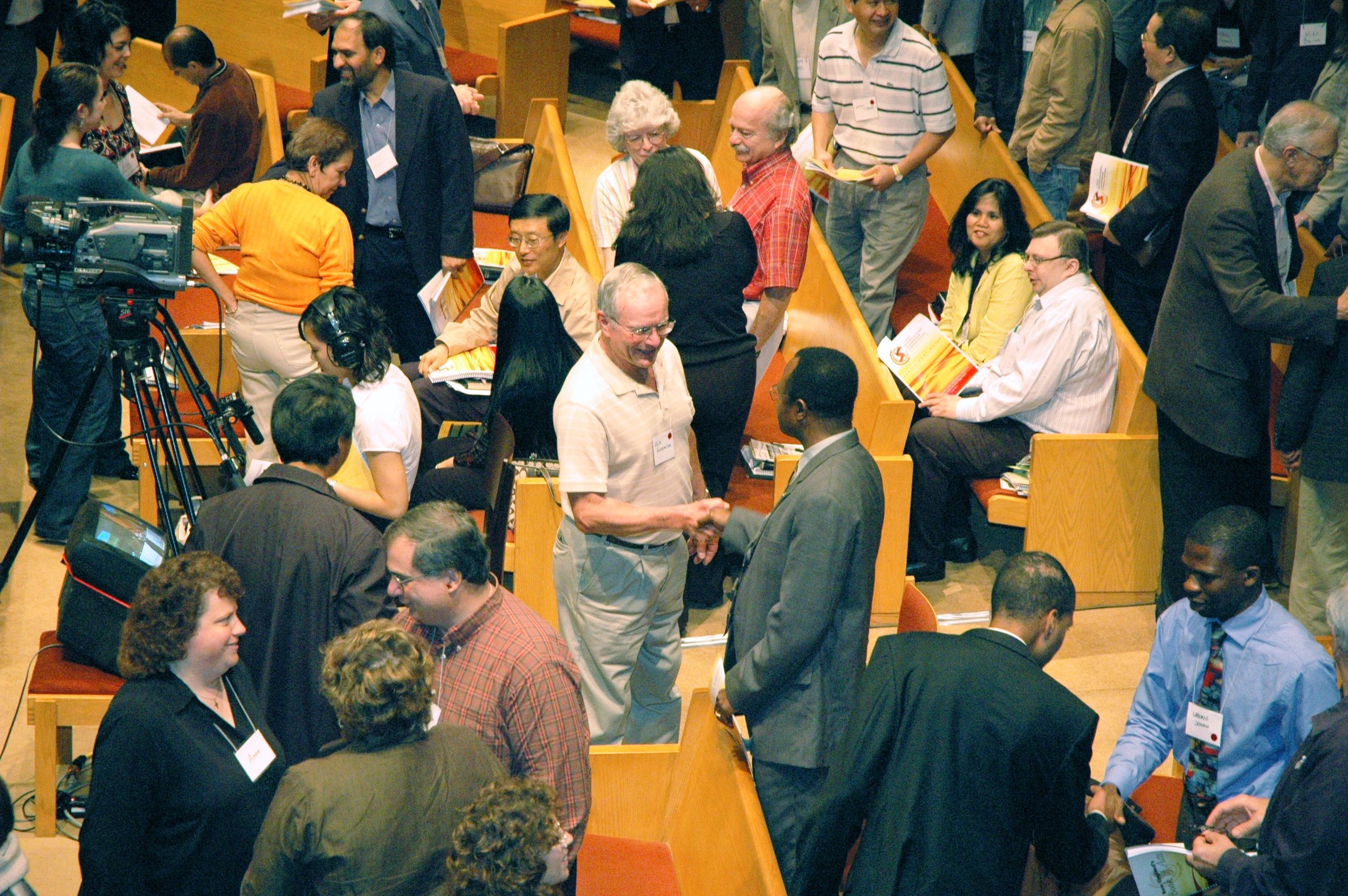
Between 2000 and 2007, EGC collaborated with various church groups and leaders to compile stories, articles, and resources that help tell the story of what God is doing in New England. Then on October 20, 2007, EGC convened the Intercultural Leadership Consultation, a one-day conference to share the stories captured in New England’s Book of Acts. Four hundred leaders from over 45 ethnic and people groups around New England gathered to learn and celebrate. These included Christian leaders who were Puerto Rican, Colombian, Haitian, Brazilian, Czech, Egyptian, Malawian, Ugandan, Ghanaian, Liberian, Indian, Bengali, Indonesian, Filipino, Cambodian, Chinese, Japanese, Korean, Mashpee Wampanoag, and Massachusett Natick Indian. Each participant was given a copy of the book.
What’s next?
Updates. In the ten years since publication, there has been some limited updating and editing to the material, and yet, as time goes by, these organic church systems continue to grow and change, so there are many more stories to be told. As these stories are updated, they will be made available here.
We are currently working on these updates, which will be posted soon. When they are posted, we will add the links:
What’s in the original book?
Section One
Section One provides an overview of some of the ways God has worked among people who came to Boston and New England and offers a framework to guide our thinking. Research on past revivals and the current Quiet Revival help us gain perspective and look forward to what God will continue to do here. Hopefully, these articles will expand our vision of the Kingdom of God here in New England.
Some of the topics covered in Section One are:
Seeing the Church with Kingdom Eyes
What is the Quiet Revival?
History of Revivalism in New England
Five Stages of Sustained Revival
Additional helpful resources along this line are:
The Quiet Revival: New Immigrants and the Transformation of Christianity in Greater Boston (2014). Basing much of her research on New England’s Book of Acts, Marilynn Johnson, professor of history at Boston College, has written a 28-page paper on the Quiet Revival which was published in Religion and American Culture, Summer 2014, Vol. 24, No. 2. To read it online, click here.
Section Two
Section Two gives examples of how God is at work among the churches of New England. Many of these 24 reports were written by leaders from within the various groups. Others were produced by the Applied Research staff at EGC. This section also includes reports on multicultural churches, international student ministry, and more. Of course not every church or ministry group has been mentioned in this publication. However, there is enough information for users to connect with many various streams, and inspiration to develop stories on those that are not mentioned here. We would love to hear from you if you pursue research on another group among New England’s church streams.
Section Three
Section Three offers a rich selection of articles on topics like leadership development, evangelism, church planting, youth and second generation ministry, diaspora ministry, and social ministries. Some of these selections describe models of ministry in these areas, while others give nuggets of wisdom from experienced leaders. We hope those who also face similar challenges in developing leadership, reaching youth, and meeting other needs, can use these ideas and models.
TAKE ACTION
Questions? If you have questions about New England’s Book of Acts, don’t hesitate to be in touch. Or if you would like to help us continue telling the story of God’s work through the various people streams in New England, we would love to hear from you.




![Christian Leadership Web Sites [Resource List]](https://images.squarespace-cdn.com/content/v1/57ff1c7ae58c62d6f84ba841/1505489399837-OVLHG7QQ7TJ6K8RIJBG7/pexels-photo-209151-website.jpeg)
Christian Leadership Web Sites [Resource List]
Web Resources For Christian Leadership
Christian Leadership Web Sites [Resource List]
by Rudy Mitchell
Offers new resources for pastors and church leaders, and contains the 145 issue archive of Christianity Today's Leadership Journal.
Seeks to foster innovation movements that activate THE CHURCH to greater impact for the Glory of God’s name. What began in 1984 with 20 leaders now serves over 200,000 leaders all over the world.
Many resource guides and book reviews on Christian leadership, especially relating to the church.
The Christian Leadership website of Claybury International offers articles on Christian leadership. In addition, their free Christian Leadership Academy online courses examine what it means to be a Christian Leader modeled on the character and teaching of Jesus. This international ministry is based in England.
You May Also Like
![Biblical Theology Of Leadership [Resource List]](https://images.squarespace-cdn.com/content/v1/57ff1c7ae58c62d6f84ba841/1503082312592-NX21D7QBK2IYCYEPM32I/pexels-church_Theology.jpg)
Biblical Theology Of Leadership [Resource List]
Resources On Biblical Theology Of Leadership
Biblical Theology Of Leadership [Resource List]
by Rudy Mitchell
Banks, Robert J., Bernice M. Ledbetter, and David C. Greenhalgh. Reviewing Leadership: A Christian Evaluation of Current Approaches. 2nd edition. Engaging Culture Series. Grand Rapids, Mich.: Baker Books Academic, 2016.
Branson, Mark Lau, and Juan F. Martinez. Churches, Cultures and Leadership: A Practical Theology of Congregations and Ethnicities. Downers Grove, IL: InterVarsity Press, 2011.
Carson, Donald A. The Cross and Christian Ministry: Leadership Lessons from 1 Corinthians. Grand Rapids, Mich.: Baker Books, 1993. (paperback edition 2004).
Howell, Don N., Jr. Servants of the Servant: A Biblical Theology of Leadership. Eugene, Oregon: Wipf & Stock Publishers, 2003.
Stott, John. Basic Christian Leadership: Biblical Models of Church, Gospel and Ministry. Downers Grove, Ill.: InterVarsity Press, 2002.
![Inner Life Of A Leader [Resource List]](https://images.squarespace-cdn.com/content/v1/57ff1c7ae58c62d6f84ba841/1503082360379-C5ZBYKU7T85I40JH5WMS/pexels-inner-life-airballoon.jpg)
Inner Life Of A Leader [Resource List]
Resources On The Inner Life Of A Leader
Inner Life Of A Leader [Resource List]
by Rudy Mitchell
Barton, Ruth Haley. Strengthening the Soul of Your Leadership: Seeking God in the Crucible of Ministry. Downers Grove, Ill.: InterVarsity Press, 2008.
Blanchard, Ken, and Phil Hodges. Lead Like Jesus: Lessons from the Greatest Leadership Role Model of All Time. Nashville, Tenn.: Thomas Nelson, 2005.
Clinton, J. Robert. The Making of a Leader: Recognizing the Lessons and Stages of Leadership Development. Revised and updated Edition. Colorado Springs, Col.: NavPress, 2012.
Detrick, Jodi. The Jesus-Hearted Woman: 10 Leadership Qualities for Enduring and Endearing Influence. Springfield, Missouri: Salubris Resources, 2015.
Fryling, Robert A. The Leadership Ellipse: Shaping How We Lead by Who We Are, Downers Grove, Ill.: InterVarsity Press, 2010.
Harney, Kevin G. Leadership from the Inside Out: Examining the Inner Life of a Healthy Church Leader. Grand Rapids, Mich.: Zondervan, 2007.
Howell, Don N., Jr. Servants of the Servant: A Biblical Theology of Leadership. Eugene, Oregon: Wipf & Stock Publishers, 2003.
Malphurs, Aubrey. Being Leaders: The Nature of Authentic Christian Leadership. Grand Rapids, Mich.: Baker Books, 2003.
Maxwell, John C. Developing the Leader Within You. Nashville, Tenn.: Thomas Nelson, 2000. Maxwell has also written many other books on leadership.
Sanders, J. Oswald. Spiritual Leadership: A Commitment to Excellence for Every Believer. Chicago: Moody Publishers, 2007.
Scazzero, Peter. The Emotionally Healthy Leader: How Transforming Your Inner Life Will Deeply Transform Your Church, Team, and the World. Grand Rapids, Mich.: Zondervan, 2015.
Stowell, Joseph M. Redefining Leadership: Character-Driven Habits of Effective Leaders. Grand Rapids, Mich.: Zondervan, 2014.
You May Also Like
![Intercultural Leadership [Resource List]](https://images.squarespace-cdn.com/content/v1/57ff1c7ae58c62d6f84ba841/1503082407845-5YCT4DLA93VIGHBSAN1R/pexels-intercultural.jpeg)
Intercultural Leadership [Resource List]
Resources On Intercultural Leadership
Intercultural Leadership [Resource List]
by Rudy Mitchell
Branson, Mark Lau, and Juan F. Martinez. Churches, Cultures and Leadership: A Practical Theology of Congregations and Ethnicities. Downers Grove, IL: InterVarsity Press, 2011.
DeYmaz, Mark, and Harry Li. Leading a Healthy Multi-Ethnic Church: Seven Common Challenges and How to Overcome Them. Grand Rapids, Mich.: Zondervan, 2013.
Plueddemann, Jim. Leading Across Cultures: Effective Ministry and Mission in the Global Church. Downers Grove, Ill.: InterVarsity Press Academic, 2009.
You May Also Like


![Hidden Treasures: Celebrating Refugee Stories [photojournal]](https://images.squarespace-cdn.com/content/v1/57ff1c7ae58c62d6f84ba841/1512579164575-AKNVCYX4Q5DW8IN2CNYP/P1070998.jpg)


![Modern Classics on Leadership [Resource List]](https://images.squarespace-cdn.com/content/v1/57ff1c7ae58c62d6f84ba841/1503082448262-DU5B4OH1ZP625DKJRZHH/pexels-modernclassics.jpeg)
Modern Classics on Leadership [Resource List]
Resources On Leadership - Modern Classics
Modern Classics on Leadership [Resource List]
by Rudy Mitchell
Leadership strategies can shift with culture. But some modern texts have withstood the test of time, and are still relevant a generation later. Below are some leadership books from before the year 2000 that I believe are worth a fresh look.
Damazio, Frank. The Making of a Leader. Portland, Ore.: City Christian Publishing, 1988.
Ford, Leighton. Transforming Leadership: Jesus' Way of Creating Vision, Shaping Values & Empowering Change. Downers Grove, Ill.: InterVarsity Press, 1991.
Nouwen, Henri J. M. In the Name of Jesus: Reflections on Christian Leadership. Chestnut Ridge, New York: The Crossroad Publishing Company, 1989.
Peterson, Eugene. Five Smooth Stones for Pastoral Work. Grand Rapids, Mich.: Eerdmans, 1992.
Peterson, Eugene. Working the Angles: The Shape of Pastoral Integrity. Grand Rapids, Mich.: Eerdmans, 1987.
Peterson, Eugene. Under the Unpredictable Plant: An Exploration in Vocational Holiness. Grand Rapids, Mich.: Eerdmans, 1992.
Peterson, Eugene. The Contemplative Pastor: Returning to the Art of Spiritual Direction. Grand Rapids, Mich.: Eerdmans, 1993.
White, John. Excellence in Leadership: Reaching Goals with Prayer, Courage and Determination. Downers Grove, Ill.: InterVarsity Press, 1986.
You May Also Like
![Women In Christian Leadership [Resource List]](https://images.squarespace-cdn.com/content/v1/57ff1c7ae58c62d6f84ba841/1503082489913-T7DT6XUHEQE5DLCQ91UP/pexels-womanleader.jpeg)
Women In Christian Leadership [Resource List]
Resources On Pastoral Leadership
Women In Christian Leadership [Resource List]
by Rudy Mitchell
Detrick, Jodi. The Jesus-Hearted Woman: 10 Leadership Qualities for Enduring and Endearing Influence. Springfield, Missouri: Salubris Resources, 2015.
Scott, Haylee Gray. Dare Mighty Things: Mapping the Challenges of Leadership for Christian Women. Grand Rapids, Mich.: Zondervan, 2014.
Surratt, Sherry, and Jenni Catron. Just Lead!: A No Whining, No Complaining, No Nonsense Practical Guide for Women Leaders in the Church. San Francisco: Jossey-Bass, 2013.
![Hard Steps Toward the Light: Meet Bonnie Gatchell [Interview]](https://images.squarespace-cdn.com/content/v1/57ff1c7ae58c62d6f84ba841/1524836375191-XIDDMMVWWA04WYY5D1L6/3+a.+Route+One-+Bonnie+Tedx.png)

![What Women Leaders "Shouldn't" Want [Infographics]](https://images.squarespace-cdn.com/content/v1/57ff1c7ae58c62d6f84ba841/1482182315765-UMIZ38Z5JK74HBSVE773/WOV2016_DSC_1839.jpg)


![2016 WOVEN CONSULTATION [Photojournal]](https://images.squarespace-cdn.com/content/v1/57ff1c7ae58c62d6f84ba841/1476666331174-5QUVROVZFAWEBDXCU15P/Screen+Shot+2016-10-16+at+6.05.15+PM.png)
![Pastoral Leadership [Resource List]](https://images.squarespace-cdn.com/content/v1/57ff1c7ae58c62d6f84ba841/1505489535138-EG2UJ0K00MI0BXPQTNZ5/pexels-pastor.jpg)
Pastoral Leadership [Resource List]
Resources On Pastoral Leadership
Pastoral Leadership [Resource List]
by Rudy Mitchell
Barton, Ruth Haley. Strengthening the Soul of Your Leadership: Seeking God in the Crucible of Ministry. Downers Grove, Ill.: InterVarsity Press, 2008.
Beeley, Christopher A. Leading God’s People: Wisdom from the Early Church for Today. Grand Rapids, Mich.: Eerdmans, 2012.
Blackaby, Henry, and Richard Blackaby. Spiritual Leadership: Moving People on to God's Agenda. Revised and Expanded edition. Nashville, Tenn.: B&H Books, 2011.
DeYmaz, Mark, and Harry Li. Leading a Healthy Multi-Ethnic Church: Seven Common Challenges and How to Overcome Them. Grand Rapids, Mich.: Zondervan, 2013.
Harney, Kevin G. Leadership from the Inside Out: Examining the Inner Life of a Healthy Church Leader. Grand Rapids, Mich.: Zondervan, 2007.
Hybels, Bill. Courageous Leadership: Field-Tested Strategy for the 360° Leader. Grand Rapids, Mich.: Zondervan, 2002.
Malphurs, Aubrey, and Will Mancini. Building Leaders: Blueprints for Developing Leadership at Every Level of Your Church. Grand Rapids, Mich.: Baker Books, 2004.
Plueddemann, Jim. Leading Across Cultures: Effective Ministry and Mission in the Global Church. Downers Grove, Ill.: InterVarsity Press Academic, 2009.
Scazzero, Peter. The Emotionally Healthy Leader: How Transforming Your Inner Life Will Deeply Transform Your Church, Team, and the World. Grand Rapids, Mich.: Zondervan, 2015.
Surratt, Sherry, and Jenni Catron. Just Lead!: A No Whining, No Complaining, No Nonsense Practical Guide for Women Leaders in the Church. San Francisco: Jossey-Bass, 2013.
You May Also Like
![Leadership Strategies & Models [Resource List]](https://images.squarespace-cdn.com/content/v1/57ff1c7ae58c62d6f84ba841/1505489580322-W3YPVU5W1AKQXXNOLFUM/pexels-strategyleadership.jpeg)
Leadership Strategies & Models [Resource List]
Resources On Leadership Strategies & Models
Leadership Strategies & Models [Resource List]
by Rudy Mitchell
Banks, Robert J., Bernice M. Ledbetter, and David C. Greenhalgh. Reviewing Leadership: A Christian Evaluation of Current Approaches. 2nd edition. Engaging Culture Series. Grand Rapids, Mich.: Baker Books Academic, 2016.
Beeley, Christopher A. Leading God’s People: Wisdom from the Early Church for Today. Grand Rapids, Mich.: Eerdmans, 2012.
Hybels, Bill. Courageous Leadership: Field-Tested Strategy for the 360° Leader. Grand Rapids, Mich.: Zondervan, 2002.
Malphurs, Aubrey, and Will Mancini. Building Leaders: Blueprints for Developing Leadership at Every Level of Your Church. Grand Rapids, Mich.: Baker Books, 2004.
Scott, Haylee Gray. Dare Mighty Things: Mapping the Challenges of Leadership for Christian Women. Grand Rapids, Mich.: Zondervan, 2014.
Stott, John. Basic Christian Leadership: Biblical Models of Church, Gospel and Ministry. Downers Grove, Ill.: InterVarsity Press, 2002.
You May Also Like

5 Entry Points for Churches to Address Homelessness
Addressing homelessness effectively can surprise our intuition. Learn about entry points from those who study homelessness as a system.
5 Entry Points for Churches to Address Homelessness
by EGC Starlight Ministries
Since 1990, Starlight Ministries has equipped individuals to build life-changing relationships with people affected by homelessness. Starlight trains individuals and groups in classroom settings as well as hands-on ministry venues. These opportunities provide the Church and those struggling with homelessness with effective tools for building communities where all can experience personal transformation through Jesus Christ.
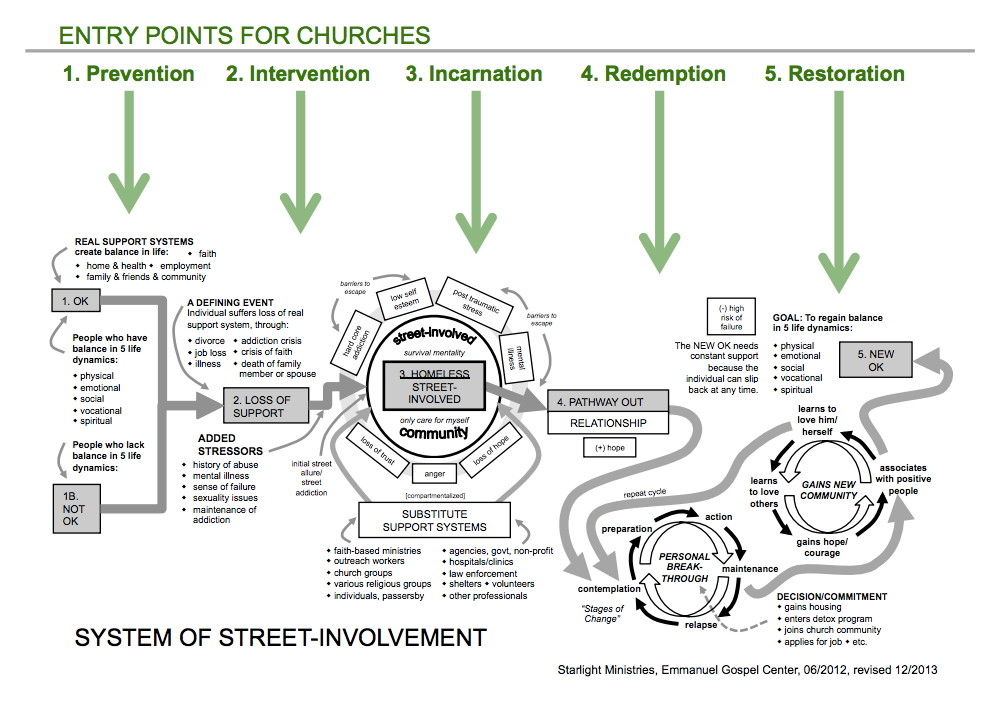
To learn more, click on the diagram to see the full document.

![Homelessness & Collaboration: Starlight Ministry [VIDEO]](https://images.squarespace-cdn.com/content/v1/57ff1c7ae58c62d6f84ba841/1523389821793-ZWG4LOT4ZTF83A6JKKS1/Cynthia+Starlight+Video+HiDef.png)


![Street Involvement As A System [infographic]](https://images.squarespace-cdn.com/content/v1/57ff1c7ae58c62d6f84ba841/1506610840159-GYRRV17PMQVSKQWTKDX8/street+involved.jpeg)
Street Involvement As A System [infographic]
Homelessness is a complex system. Learn about this system and how the church can engage.
Street Involvement as a System [infographic]

For the complete Starlight System Diagram and opportunities for churches to engage, click anywhere on the diagram. Source: Starlight Ministries, Emmanuel Gospel Center.

Choosing to Listen
EGC Executive Director Jeff Bass reflects on the greatest lesson from the recent meeting of the Greater Boston Interfaith Organization at the Boston Islamic Center, attended by Sen. Elizabeth Warren and Mayor Marty Walsh.

PERSPECTIVES
Jeff Bass, Executive Director, Emmanuel Gospel Center
Last night I attended a community meeting at the Boston Islamic Center in Roxbury Crossing. Over 2,600 people came together in my neighborhood to hear Mayor Walsh, Senator Warren, and assorted leaders and citizens from the Greater Boston Interfaith Organization challenge us to stand together against bigotry and for community.
“It would be arrogant and naïve for me to continue to ignore my own arrogance and naïveté as I process this. So what do I do now?”
Like many in Boston’s blue bubble, I was shocked and deeply disappointed by the results of the November election, and I’ve spent the last few weeks trying to get a handle on our new and emerging reality. I have been asking myself, “What was I missing?” It would be arrogant and naïve for me to continue to ignore my own arrogance and naïveté as I process this. So what do I do now?
As I heard speaker after speaker affirm last night, my first responsibility is to listen. As a White Evangelical male organizational leader, growing in listening is especially important for me.
I know many people who are angry, and many who are fearful—not just about the divisiveness in our country, but about the impact the election will have (and is having) on their families and neighborhoods. One friend wrote that she feels like someone is pointing a gun at her children saying, “Don’t worry, I won’t pull the trigger.” Even though the gun is not pointed at me in the same way, can I appreciate the danger that she and so many others are experiencing? Can I begin to understand the pain and betrayal they feel?
At the same time, I know people who are hopeful—even excited—about a change in leadership and the opportunity for the country to move in what they see as a new direction. They had a different set of “deal-breakers” in the election (change, the economy, the Supreme Court perhaps). Can I understand their views, and appreciate their decisions? Can I empathize with the pain they’ve felt these last eight years that would lead them to choose Donald Trump over Hillary Clinton? It’s unfathomable to me, yet look at what happened.
“Even though the gun is not pointed at me in the same way, can I appreciate the danger that she and so many others are experiencing? Can I begin to understand the pain and betrayal they feel?”
So I have a lot to learn, and I’m going to start by doubling down on listening. Well. And a lot. This means taking the time for more conversations, more reading, and more pressing into new relationships. And when I do, I want to seek first to understand, feel, relate as best I can, before I say or do anything else.
“I want to first seek to understand, feel, relate as best I can, before I say or do anything else.”
As we create space at EGC staff members to speak up with our perspectives on what we are learning and seeing in the church in Greater Boston, and as we weigh in on issues that affect us, I hope that we can stay grounded in listening.
If you’d like to talk about any of this, please let me know. I’d love to listen.
Jeff Bass and his wife Ellen live in Roxbury Crossing, about a mile from the Islamic Center.
Dominance in Leadership: What I'm Learning
Dominance in leadership is common in America today. But is it healthy for Christian leaders? Jess Mason shares personal experience and reflections on biblical perspectives of dominance in leadership.
Dominance in Leadership: What I'm Learning
by Jessica Mason
“I’m just not cut out to be a leader.”
My pastor at the time grinned with a twinkle in his eye and asked, “Why do you say that?”
I argued, “Because I’m not good at cutting people off at the knees to stay the center of attention.” He tried to tell me, That dubious “skill” is not what godly leadership is about. I’ve tried to believe him.
As part of our series on conflicting cultural ideals, I'm investigating what the Bible has to say about common ideals that society imposes on leaders and on women. In this post I spotlight the often unspoken cultural ideal that effective leaders are dominant.
My search begins with a well-known passage where Jesus coaches his disciples that, while Gentile rulers “lord it over” others, it should not be so with them. Following the trail of the Greek word for “lord it over” (katakurieuw and kurieuw) around the Bible, I discovered the first mention of “lording over” at the fall of Adam and Eve. A relationship of dominance is apparently part of the Curse—a consequence of sin—not part of God’s beautiful design.
Accordingly, Jesus, Paul, and Peter each taught against leading through dominance. Whenever the Bible mentions humans taking it upon themselves to lord over other humans, the context is never positive.
“I’ve been conflicted about my occasional ability to dominate—it feels wrong when it happens, but when I can’t make it happen I see it as evidence that I am not cut out to lead.”
Recently I encountered a rather narcissistic individual. Narcissists have a pathological need for constant positive attention and adulation. I became increasingly agitated with this individual’s persistence in dominating the conversation and keeping themselves and their accomplishments in focus, to the detriment of meaningful action or decision making.
Reflecting on the experience, I flashed back to leadership roles in my past and came to a startling revelation—in many of my leadership experiences, I managed to center the situation around my thoughts or initiative, hold people in thrall, or get away with doing 75% of the talking. I'd confused leadership with narcissistic behaviors!
I’ve been conflicted about my occasional ability to dominate—it feels wrong when it happens, but when I can’t make it happen I see it as evidence that I'm not cut out to lead. I've repeatedly been disappointed with how my leadership eventually ends up feeling like The Jess Mason Show.
I’m waking up to the realization that, if godly leadership has nothing to do with the ability to dominate, apparently I've failed to understand in my bones what leading others well truly looks like. In my observation, dominance can co-occur with real leadership. Furthermore, people can mistake dominance for leadership and will follow dominators—even to their own detriment—in the absence of a true leader. But I now believe that a dominant personality is actually irrelevant to healthy leadership.
I’m not in a leadership role at the moment. That buys me some time to learn. How can I hope to discern whether I’m called to lead others again until I understand what leadership is? I’d like to share with you what I’m learning, from the Bible and from living example.
“People can mistake dominance for leadership and will follow dominators—even to their own detriment—in the absence of a true leader.”
I’d like to return to the starting point of my search—Jesus and his disciples. This humble master clarifies that leaders should think of themselves as the servant of those they lead.
I take this to mean that while we usually think of leaders as “having” followers, Jesus turns this on its head. Instead he says that leaders should devote themselves to a vigilance for the good of those they lead, the way servants attend to their master’s good.
“Leaders should devote themselves to a vigilance for the good of those they lead.”
When Paul rejects dominance in leadership, he advocates that leaders instead should “work alongside others for their joy.” In contrast to the narcissist’s goal of using followers to supply them with positive attention, the true leader’s goal is to prompt others to deeper joy in God as a result of the leader’s partnership with them.
Peter also wrote to church leaders that instead of dominating their flocks, they should lead by example. This implies that an effective leader prioritizes personal obedience and discipleship over reprimand and force. In other words, she puts the lion’s share of her fervor into practicing what she preaches.
What strikes me about these biblical qualities for leadership is that they’re not inherently competitive. There can be more than one person in a group that exhibits these qualities. Not so with dominance, where There Can Be Only One. Biblical leadership includes. It collaborates.
“In contrast to the narcissist’s goal of using followers to supply them with positive attention, the true leader’s goal is to prompt others to deeper joy in God as a result of the leader’s partnership with them.”
I would like to give a shout-out to my supervisor, Stacie Mickelson, for the ways she models godly leadership to me. As my supervisor, she regularly and concretely protects the interests of my healthy functioning on the Woven team. She listens well and dislodges obstacles. She balances my commitments and attends to my professional development. She also follows through on details like making sure my office chair isn’t hurting my back.
In the team setting, Stacie leads meetings as though she’s working with friends and partners, not enemies to conquer or schlubs to drag along. In meetings she leads, even if she brings a clear agenda, I don’t get the sense she's forcing or dominating. Instead I find each of us heard and valued, as she shepherds the conversation towards healthy action.
RESPOND
Meet Your Obstacles
In your leadership context today, identify what if any obstacles you would have to overcome to (a) think of yourself as a servant, (b) lead by example, or (c) throw your lot in as a fellow worker with those you lead.
Share your obstacles with a fellow leader. What is the Holy Spirit saying to you through your conversation, the Scriptures, or your prayer? What step of faith is the Holy Spirit inviting you to take next?
Encourage a Woman Leader
Think of a Christian woman leader that you know who leads by (a) positive example, (b) a servant’s heart, or (c) working alongside others for their joy.
Tell her today in person, in a note, or in a text, what you appreciate about her example of Christian leadership. If you have the platform, with her permission, share publicly what you appreciate about her leadership that others might learn from. Pray for her continued effectiveness as a leader in her setting.
Pray for Our Leaders
Think of a leader—either someone you know or a public figure—who seems to lead primarily by dominance.
First, see that person as a human being, created in the image of God. Pray that the Holy Spirit would work in her/his heart to create in them a desire to serve others and work alongside them for the good of all.
Jessica Mason is a licensed minister, spiritual director, and research associate in Applied Research & Consulting at EGC. Her passion is to see God’s goodness revealed to and through Christian leaders and pillars in the Boston area.
The Awkward Dance: Christian Women Leaders Find Footing Amid Conflicts of Ideals
When you think good Christian woman, to what extent do you think effective leader? In this post we explore six conflicts-of-ideals reported by participants at the Woven Consultation on Christian women in leadership in March 2016.
The Awkward Dance: Christian Women Leaders Find Footing Amid Conflicts of Ideals
by Jess Mason
When you think, “good Christian woman,” to what extent do you think, “effective leader?”
According to our research, Christian women leaders face conflicting ideals for women and for leaders in their communities, such that traits of effective leaders can contradict traits of admirable Christian women.
I believe that if these cultural ideals go unexamined, capable women may falsely doubt their fitness for leadership. They may also betray their leadership strengths—as well as their authentic selves—in order to conform to their culture’s image of a skilled leader.
In this post we explore six conflicts-of-ideals reported by participants at the Woven Consultation on Christian women in leadership in March 2016. In a series of follow-up posts in the coming months, we’ll look at these conflicts and consider: Where are these cultural ideals challenged by Scripture? Where do biblical examples shift—or broaden—the picture of what healthy leadership and/or healthy womanhood can look like?
THE LEADER-WOMAN DANCE
Conflicting ideals for leaders and women seem to begin in many cases with masculinized norms for leadership. One woman shared this challenge in terms of available role models: “Being shaped by male dominated fields, I don’t know [how] to lead being [a] woman.” Another woman reported, “In ministry, I’ve experienced that I had to be or act different than my true self as a woman because I had to act as a man.”
The Bible challenges the assumption that effective leaders must be men. Women in formal leadership roles include Deborah the judge, Junia the apostle, and Phoebe the deacon, among others. Women of extraordinary influence without official leadership roles include Esther, who planned and made an appeal to prevent an Israelite genocide, and Abigail, who confronted a battalion to lead David back to God’s word and will, setting the tone (and providing the land base) for David’s unparalleled reign over Israel.
To lead wholeheartedly, women leaders need to be set free from contradictory standards. As one Woven participant put it, “We need to be able to lead as women, not be shoehorned into leading like men.” Here are the cultural contradictions women leaders report navigating in their leadership settings.
SIX CONFLICTING IDEALS FOR LEADERS VS. WOMEN

1. Should I be dominant/aggressive or accommodating?
American culture can prize dominance in male leaders, sometimes to a blinding degree. One woman mentioned a “dominating male” ideal for leadership. Another observed, “Women need to be more aggressive…to compete with their male counterparts in business.”
But leaders must change their tune to be considered admirable women: “Being an alpha female is…too manly.” One woman shared that, “Women can’t be aggressive in advocating for themselves.” Multiple leaders reported that the more common expectation on women is that they “be available” and “meet everyone’s expectations.”
2. Should I be direct/assertive or agreeable?
One minister shared that over her years in leadership she has had to force herself to be more “direct” than she feels comfortable being as a woman. Others affirmed this tension: “Women aren’t assertive.” “It is hard to confront people.” “It's not feminine to disagree.”
3. Should I be confident or self-effacing?
Many women reported feeling that leaders are supposed to appear strong and put-together at all times, and not show weakness or vulnerability. The expected appearance of strength led one leader to lament, a “leader must be always confident. I’m not always confident.” In fact, the very opposite of confidence may be expected of women: “I must present myself as ‘less-than’ to be liked.”
4. Should I be hard or nice?
Like the 19th century children’s nursery rhyme—sugar and spice and everything nice, that’s what little girls are made of—women are expected to be “always happy and positive all the time.” Bottom line: “Women should be nice.”
But one woman shared the expectation that as a leader, “it’s better to be hard than vulnerable.” Another shared that she felt the need to come across as “hard” to be effective in her leadership context, even though “that’s not my true self.”
5. Should I be decisive or consensus-building?
While women agreed there are different types of leadership, some felt forced to choose between false opposites. One wrote that leadership tends to be narrowly defined by those already in power, with principles like, “good leaders are decisive, not consensus building.”
One leader felt she had to decide between being a “good decision-maker” and being a “follower, as expected [of women] from a cultural and social perspective.”
6. Should I be unemotional or emotional?
A common tension for women in leadership is the scope and extent to which emotions and emotional expression have a role in effective leadership. One woman shared that she hears the message that women are supposed to be “giving and emotional.” Another wrote, “women are the weaker/emotional/vulnerable gender.” But, as previously stated, leaders are expected not to show vulnerability.
Without the acknowledgement of emotions as a potential source of insight, the expected emotionality in women would appear to do nothing more than cripple effective leadership.
RESPOND
Tell Us What You Think
We hope this article fosters discussion, reflection, and greater awareness of your leadership choices in your various work and life settings. Please join the Facebook discussion to add your thoughts and experiences.
Share Your Story
Have you experienced any part of this awkward dance in your community? Or does your community have some wisdom you’d like to share? If you have a fuller story to share, contact Jess Mason at jmason [at] egc.org about contributing a personal reflection blog post.
What Else Should WOVEN Be Discussing?
Is there a part of the leader-woman dance that was not mentioned that you would like to bring to our attention? Contact Jess Mason at jmason [at] egc.org to share your insights.
Jess Mason is a licensed minister, spiritual director, and research associate in ARC@EGC. Her passion is to see God’s goodness revealed to and through Christian leaders and pillars in the Boston area.


Keywords
- #ChurchToo
- 365 Campaign
- ARC Highlights
- ARC Services
- AbNet
- Abolition Network
- Action Guides
- Activism
- Administration
- Adoption
- Aggressive Procedures
- Andrew Tsou
- Annual Report
- Anti-Gun
- Anti-racism education
- Applied Research
- Applied Research and Consulting
- Asking for help
- Ayn DuVoisin
- Balance
- Battered Women
- Berlin
- Bianca Duemling
- Bias
- Biblical Leadership
- Biblical leadership
- Black Church
- Black Church Vitality Project
- Book Recommendations
- Book Reviews
- Book reviews
- Books
- Boston
- Boston 2030
- Boston Church Directory
- Boston Churches
- Boston Education Collaborative
- Boston General
- Boston Globe
- Boston History
- Boston Islamic Center
- Boston Neighborhoods
- Boston Public Schools
- Boston-Berlin
- Brainstorming
- Brazil
- Brazilian
- COVID-19
- CUME
- Cambodian









We need to more clearly identify the prophets in current-day Boston and enlist their participation as we seek to expand Jesus-permeated, Kingdom-of-God-on-earth-permeated, church-planting movements