
BLOG: APPLIED RESEARCH OF EMMANUEL GOSPEL CENTER

Exploring Church Spaces: Breaking the Silence
Church closures often happen quietly — not because leaders failed, but because shame and isolation kept them from asking for help. This piece explores why a culture of transparency, not silence, may be the biggest factor in whether a struggling church survives.
Photo credit: Geoff Duncan via Lightstock
Exploring Church Spaces: Breaking the Silence
How Asking for Help Can Save Church Spaces
by Saranya Sathananthan, Researcher in Residence
In the past few years, I’ve heard a growing number of stories about churches closing their doors, especially during or after the most severe years of the COVID pandemic. What’s striking to me is not necessarily that they closed, but how they closed.
It happened quietly. By the time anyone outside noticed, it was already over.
Behind many of these stories are leaders carrying immense burdens alone: financial strain, building issues, complicated leases, deferred maintenance, declining giving, all managed privately and endured for as long as possible.
By the time the situation surfaced, there were few options left.
“One of the biggest determinants of whether a church survives or closes is whether it has a culture of asking for help.”
What I have seen time and time again in my research is that the churches that are willing to share transparently about what they are going through and ask for help are the churches that have made it through crises and hardships with the most creativity, openness, and resilience.
I’ve come to believe that one of the biggest determinants of whether a church survives or closes is whether it has a culture of asking for help.
This pattern raises deeper questions about what gets in the way of asking for help and the kind of mutual support churches need if they are going to survive and serve their communities well.
A Silent Closure Close to Home
About a year ago, my pastor reached out to me about a church in our neighborhood. She had heard that it might be facing foreclosure.
I hadn’t heard anything about it. In fact, the last time I encountered someone from that church, they were still opening their doors for community drop-in hours, a space for people to process trauma and navigate the challenges in their lives with a listening ear and connection to other forms of support. It came as a shock to hear that they might be at risk of closing.
My pastor shared that she had been trying to reach the church’s pastor to see how she, our congregation, or our broader network could help, but the pastor had gone radio silent. She called me to ask if I knew another way to get in touch or had any insight into what might be happening.
What was even more surprising was that she had recently spoken with a member of that church’s community outreach team and that person had no idea about a pending foreclosure either.
A couple of weeks later, we did some research online and discovered that the church’s property had already been foreclosed and sold at auction to a developer, an entity that didn’t typically operate in our neighborhood and, according to their website, specialized in luxury properties.
When we checked the church’s website, we found a brief statement under the history section that stated the church was transitioning to a temporary worship space in another neighborhood and was excited about experiencing growth in the coming years. No mention of foreclosure.
“When a church closes or relocates, it often loses more than just a building. It loses a tangible stake in that place, a rootedness that comes with stewarding property and relationships over time.”
It’s been a year now since the church closed its operations at that location, and I was surprised to see the church’s former property address show up on the agenda for our neighborhood community meeting, where the developer was slated to propose a development of about a dozen units on the parcel where the former church building currently sits.
I don’t think church closures are always a bad thing. For some churches, it is simply a matter of time, and the transition can open the door to new life in ways that are generative and beautiful.
But in this case, I felt a mixture of sadness and frustration.
A church closing in a rapidly gentrifying neighborhood is something to be mourned, especially when that church has a long history of faithfully serving the surrounding community. When a church closes or relocates, it often loses more than just a building. It loses a tangible stake in that place, a rootedness that comes with stewarding property and relationships over time. And in a gentrifying neighborhood, it is very difficult to retain that stake through property ownership once it is gone.
So many questions have continued to swirl in my mind about this situation.
Why didn’t the pastor respond to my pastor—a peer reaching out with a desire to help, and potentially with access to support or partnership?
How was it that a member of their own congregation didn’t know what was happening?
Were there conversations happening behind the scenes that we didn’t know about, or were they carrying the burden mostly alone?
Did they feel they had no options? Were they too overwhelmed to reach out? Had they tried to seek help and not found it? Or had help simply come too late?
A Counterproductive Pattern Beyond the Church
What struck me was how familiar this felt. Around the same time, I was participating in neighborhood focus groups on displacement and began hearing similar stories from residents.
One neighbor shared her experience of losing her home to foreclosure. She hadn’t asked anyone for help. She was afraid people wouldn’t care or wouldn’t come through for her. As she told the story, something that had happened 30 or 40 years earlier, she still carried a sense of pride in having purchased the home on her own.
But that same pride had also meant carrying the full burden alone: managing the property, paying the mortgage, and navigating hardship without support. She didn’t feel she could ask anyone for help, even when things became difficult because it was her responsibility to take care of it.

Photo credit: Laurentiu Iordache via Lightstock
Others in the group shared that they often don’t realize someone has sold their home or moved away until a new neighbor moves in. Silent exits no one sees coming because nothing was ever said. And these were neighbors they knew and talked to.
I wanted to dig deeper into why this pattern seemed to show up again and again in stories of foreclosure and displacement.
I found myself wondering:
What keeps people from sharing the reality of what they are facing?
What makes support feel so hard to ask for or receive?
And if these struggles had been shared earlier, could new ideas, resources, or relationships have surfaced?
Could there have been a way for them to stay?
The Culture We Don’t Talk About
As the focus group conversation unfolded, one theme emerged clearly: shame.
People shared how much shame surrounds difficult circumstances, especially when those struggles involve money, housing, property, or the fear of losing what they have worked hard to gain. That shame often keeps people from telling others what they are going through, which also keeps them from receiving help in times of need.
Around the room, people nodded in agreement. They knew this feeling.
Shame is pervasive in communities experiencing poverty. It tells people they should have it all together, even when they are navigating circumstances far beyond their control or shaped by inequities tied to race, gender, class, language, ability, immigration status, and more.
There was a painful irony in realizing that the church that had closed had been creating space for neighbors to process their struggles by offering care, presence, and support, meanwhile seemingly carrying its own challenges in isolation.
Had they found people they could trust? Did they have a community to walk with them through what they were facing? Or were they, too, carrying it alone?
The truth is that this unspoken culture of silence can apply to our churches as well.
This can show up in subtle ways with significant impact:
Shame and fear of being seen as failing or judged as being poor stewards of God’s resources
The pressure for leaders to “have it all together” and “fake it ‘til you make it”
A “mind your own business” mentality: I’ll handle mine, you handle yours
Avoidance of vulnerability, confession, and transparency
The belief that struggles shouldn’t be shared outside the church or sometimes even within it (this also breeds a culture where individuals suffer in silence rather than seek help, counseling, or support)
Spiritualized pressure: the idea that if we just pray harder and have faith, God will provide without needing to involve others, and that by involving others, we are proving that we don’t have enough faith
A lack of accountability structures, especially in churches where decision-making is concentrated in a small number of leaders
The expectation that church leaders should know how to manage finances and make real estate decisions, even when traditional vocational training has not equipped them with that knowledge
In these high-pressure environments, even asking basic questions about the church’s finances can feel like a threat. Financial concerns go unspoken for fear of being accused of being someone who is critical and wanting to rock the boat or someone who lacks faith. Leaders hesitate to admit uncertainty because they need to be seen as knowing what they are doing to ensure the trust of the people. The congregation senses something is wrong, but no one names it directly.
There’s often an unspoken rule: It’s shameful to share the church’s struggles with others. We need to handle this on our own. God will make a way.
But what if part of the way God makes a way is through his people? Through the willingness to name, out loud and to each other, what is actually going on?
The instinct to protect the church by hiding its struggles can slowly become the very thing that harms it.
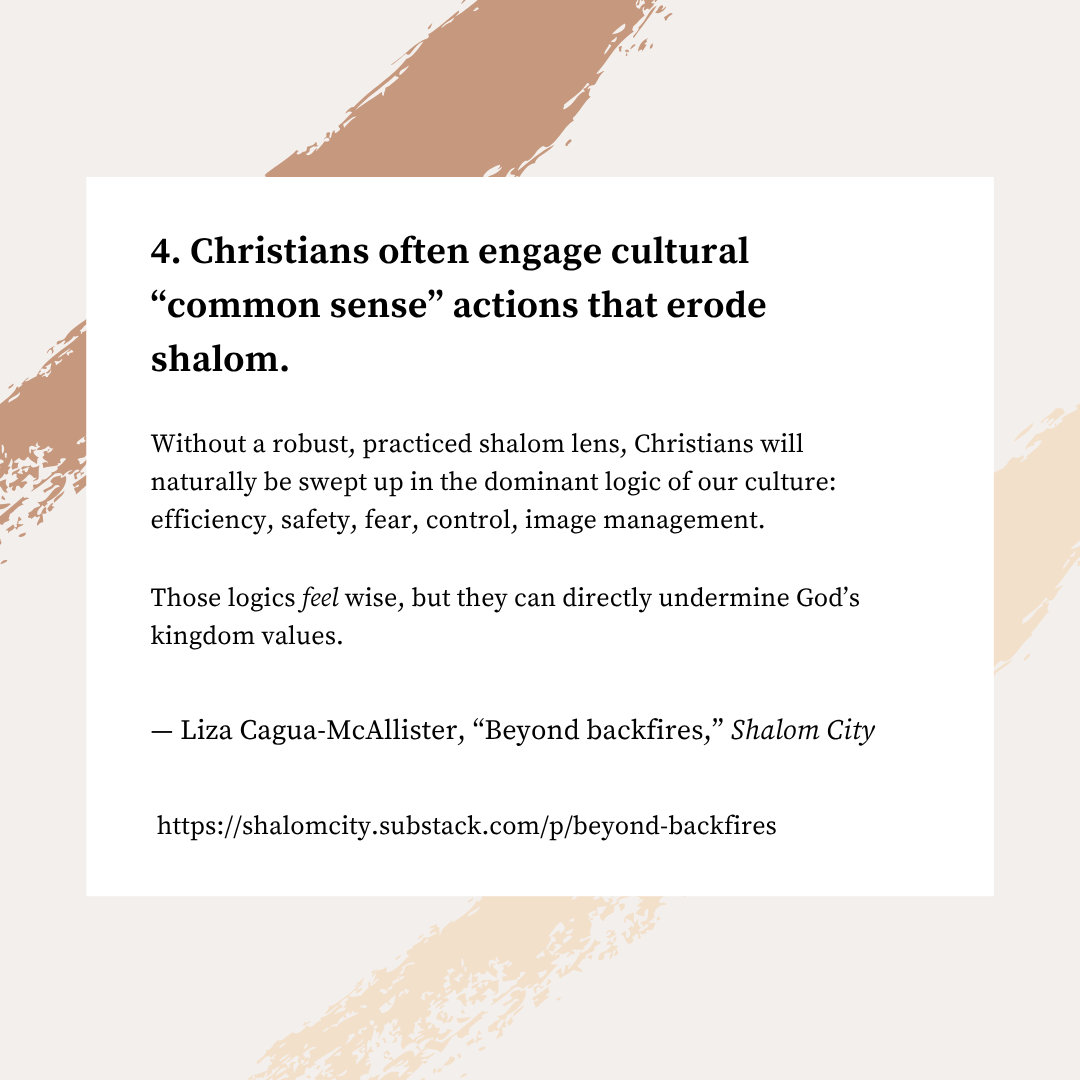
Christian communities are not immune to falling into patterns that seem like common sense, but ultimately become counterproductive. As Liza Cagua-McCallister writes in Shalom City’s Beyond Backfires Substack:
Without a robust, practiced shalom lens, Christians will naturally be swept up in the dominant logic of our culture: efficiency, safety, fear, control, image management.
Those logics feel wise, but they can directly undermine God’s kingdom values.
Scripture calls us to bring our needs into the light (Ephesians 5:14). To share in one another’s burdens (Galatians 6:2). To allow space for God’s power to be made visible, not in our strength, but in our weakness (2 Corinthians 12:9).
Thus transparency is not a failure of faith, but an expression of it. When we name our needs, we create the possibility for others to respond: to offer wisdom, resources, and compassion. And even if help doesn’t come, we can still say we did everything we could.
The Reality: You Are Not Alone
I remember talking to a pastor in 2023 whose church owned its property outright. He said their saving grace during the COVID pandemic was not having a mortgage to pay. But he also lamented that this was not the case for several of his peers, pastors of churches in the neighborhood that rented space or had mortgages to pay.
When COVID disrupted in-person gathering and decreased the consistent giving needed to sustain rent or mortgage payments, some of those churches had to leave their locations. Some reopened farther from the city. Others closed outright. Sadly, some churches were unaware of federal, state, or local relief resources that could have helped them during that time.
The truth is that this was not a unique phenomenon. Many churches struggled during the COVID pandemic, and many are still struggling, not because they are failing, but because they are navigating realities leaders were never trained for:
The long tail of COVID disruptions
Decreased or inconsistent giving, especially as individuals and families face high housing costs, living expenses, and an unpredictable job market
Rising costs of utilities, insurance, and repairs
Inheriting challenging buildings with unknown deferred maintenance issues
Increasing complexity around loans, leases, and other regulations that require special attention and expertise
The list goes on. The financial and operational pressures can be overwhelming. If you are a church leader, you know this firsthand!
And yet many leaders are expected to carry this without formal training, without sufficient support, and often without formal or even informal spaces to process what’s happening with others without fear of judgment.
Photo Credit: Shana via Lightstock
If you are a church leader, I hope there can be some lifting of the burden in recognizing that you are not the only one experiencing these difficulties. It goes without saying that no one wants to be in the difficult situation they may find themselves in, and by sharing, you are more likely than not to find that others resonate with your experience.
It is easy to judge from the outside when things fall apart. But what would any of us do in the same circumstances? There are many ways to analyze a situation after the fact, but the truth is: carrying these pressures is enormously hard.
I remember our church supporting another church during the pandemic. At the time, we were meeting over Zoom and then transitioned to meeting in a public park. Because we were not carrying the same level of building-related expenses, we had a little more margin to help another congregation that was struggling at that time.
I’m not exactly sure how that church got connected to ours, but I do remember that they were willing to bring their needs before our congregation. And because they did, people were able to respond.
But how many churches went without support during that time who might have really benefited from it? The effects of COVID, rising costs, and other financial pressures are still unfolding for many churches. But one thing feels clear: isolation makes the burden heavier.
The Cost of Not Asking for Help
The cost of not asking for help is not only financial crisis or closure, though those are often the more visible outcomes.
There is the cost of missed opportunities: grants not applied for, resources not accessed, and creative solutions that never surface because no one outside the immediate circle knew there was a need.
Poor decision-making in isolation is costly. When leaders feel like they have to carry the weight alone, they are more prone to making decisions out of urgency, fear, exhaustion, or limited information. Those decisions can cost the church money, strain relationships, and weaken its ability to do ministry well over the long run.
There can also be the cost of personnel. Leaders can feel immense pressure to hold everything together and keep pressing through. Oftentimes they are holding responsibilities one person was never meant to carry. Over time, that pressure can lead to exhaustion, resentment, and burnout.
Photo credit: Rachel via Lightstock
And when things finally do become more visible, there is the cost of trust. Congregants, partners, and neighbors may feel confused, hurt, or blindsided not only because the situation was difficult, but because they were never invited into the truth of what was going on.
Compare that with the cost of asking for help: humility. Asking for help means being willing to admit we don’t know how to figure this out on our own. It means risking the possibility of judgment, while also creating the possibility of being met with mercy, care, wisdom, and support.
And in doing so, leaders help set a different kind of culture: one where vulnerability is not punished, but welcomed; where honesty becomes a freeing invitation for others to share transparently about their struggles too.
The truth is, while humility can be uncomfortable, silence can be far more expensive.
For churches seeking more concrete steps, our resource “Managing Church Buildings, Property Assets” offers additional strategies for avoiding some of these risks.
Reframing: Asking for Help as a Spiritual Practice
Because our faith is built on grace, not performance, our theological understanding ought to lead us to share our burdens, confess our struggles, seek wisdom, and receive care from one another.
And yet, like in the garden, our instinct is often to hide.
When things go wrong, we can feel ashamed to admit what is happening. A natural response is to manage appearances or pull away from the very people who might be able to help. Sometimes we fear that what we have will be taken from us because others will perceive us as having failed to manage it well. Or simply our feeling is that it’s not okay to be honest about the difficulties we’re shouldering and that people will perceive it as complaining or being critical. Sometimes we are embarrassed by what we do not know, what we could not prevent, or what has gotten beyond our control.
However, the Lord is glad to be with us through the hardships, even when we have made mistakes, miscalculations, or decisions we wish we could take back. That does not mean the path forward will be easy. There may still be difficult conversations, hard choices, and real consequences to navigate. Yet even then, God remains present and willing to help, especially through his people.
The gift of being part of the body of Christ is that when we truthfully admit what we are carrying, we are often met with far more grace than we expect or deserve. And even when that is not the case, there is something profoundly liberating about finally speaking aloud what you have been carrying alone for so long.
This is where we are. This is what we are facing. We do not know how to carry this by ourselves.

Photo credit: Inbetween via Lightstock
Confession isn’t a practice meant to deepen our shame; it is a practice that is intended to free us from the burden of carrying it alone.
Scripture tells us, "Confess your sins to one another and pray for one another, so that you may be healed" (James 5:16). The healing is not always that the situation goes away. Sometimes the healing is that we no longer have to hold everything on our own. We receive support, wisdom, encouragement, and companions for the journey.
Scripture points us again and again toward this posture of asking, receiving, and relying on one another.
Ask, seek, and knock. "Ask and it will be given to you; seek and you will find; knock and the door will be opened to you" (Matthew 7:7). This is not only about private prayer, but having an earnest posture of humility, openness, and receptivity. It means bringing our needs before God and also being willing to share them with others. The more we ask, the more we learn, the more connections we make, and the more likely we are to discover the people, resources, and opportunities we need.
Seek wisdom from many counselors. "Plans fail for lack of counsel, but with many advisers they succeed" (Proverbs 15:22). Given the complexity of church property decisions, it is unwise to make major decisions without the input of trusted individuals who have the church’s best interests at heart and are aligned with the church’s vision. Churches also benefit from trusted advisors who can offer financial, legal, operational, and spiritual wisdom. These advisors may not always agree with every decision, but they can help leaders see blind spots and make more informed choices.
Persist in asking. In the parable of the persistent widow, Jesus honors the woman who keeps returning to ask for justice (Luke 18:1–8). Sometimes asking once is not enough. Sometimes faithfulness looks like continuing to ask, continuing to knock, and refusing to give up even when the answer is not immediate or a door has not yet opened.
Share resources across communities. Paul writes to the Corinthians about mutual care, explaining that one community's abundance can supply another's need, so that later the reverse may also be true (2 Corinthians 8:13–15). Receiving help in one season does not make a church weak. It makes the church part of a larger body, where resources, gifts, and support flow back and forth as needs arise.
Recovering a Culture of Mutual Support
Churches have historically been places of social support. In many ways, this is woven directly into the fabric of the Christian story.
We see it in the early church after Pentecost:
All the believers were one in heart and mind. No one claimed that any of their possessions was their own, but they shared everything they had... there were no needy persons among them (Acts 4:32–35).
The church was a group of individuals who worshiped together, and simultaneously became a community where burdens, resources, and responsibilities were shared collectively through mutual care and sacrifice.
This reality extended beyond individual congregations too. We see several examples of churches supporting one another across cities and regions:
Financial relief for struggling churches (2 Corinthians 8–9)
Organizing aid before impending crises (Acts 11:27–30)
Sharing teaching, theology, and encouragement (Colossians 4:16)
Sharing leaders, personnel, and mentorship (Romans 16:1–2)
Sadly, this kind of mutual support sometimes feels distant or radical in our present-day context. Part of it is that we live within a broader American culture shaped by individualism: the belief that every person must pull themselves up by their own bootstraps, that survival and success rest primarily on the individual, and that needing help signals weakness or failure. We can also get so wrapped up in the details of our own situations that we forget to lift our heads and see who else is around us, who might be able to help, advise, connect, or walk with us.
By contrast, many societies around the world continue to maintain strong built-in systems of social support: assistance for families, unemployment, healthcare, housing, childcare, and in moments of crisis. These systems exist because hardship is understood to be part of life, not evidence of personal failure.
Financial strain, rising costs, housing instability, burnout, displacement, and declining giving are part of broader systemic pressures impacting residents, families, small businesses, and community organizations across cities everywhere. The struggles churches experience are not happening in isolation.
This moment, when society as a whole is navigating significant unpredictability, feels prime for a revival of koinonia—deep fellowship, partnership, and mutual participation.
Can we respond to one another with compassion rather than judgment, recognizing the broader conditions shaping our realities? Can we rebuild cultures where churches, leaders, and neighbors' first line of response is, “How can we help each other survive and contribute to one another’s mutual thriving?”
There is a long history of communities creating collective strategies for survival.
One example is the tradition of rent parties: gatherings organized in Black communities during the Harlem Renaissance when families could not afford rent. Neighbors would come together, contribute what they could, share food and music, and collectively help keep someone housed.
Today, versions of this practice are re-emerging through social media campaigns, such as communities rallying around struggling small businesses, GoFundMe campaigns for neighbors facing medical emergencies, or efforts to secure housing for families at risk of displacement.
These practices reflect a simple truth: People survive hardship together.
I pray churches recover this practice, not only within congregations but between churches as well.
Imagine whole neighborhoods benefiting because churches were able to stay rooted in their communities by openly sharing resources, expertise, relationships, funding opportunities, or even temporary space with one another. Imagine a culture where asking for help was normalized and welcomed, and where churches and their leaders knew they were not in it alone.
The truth is that asking for help creates space for unexpected possibilities to emerge. This is part of the beauty of community: God can move powerfully through our limitations in creative and surprising ways, opening new paths and possibilities where none seemed to exist before.
What Asking for Help Looks Like
So what does asking for help actually look like?
Name financial or operational challenges early. Time is not on your side. Waiting until the point of desperation can limit your options and make it harder to make wise, grounded decisions. It will likely feel uncomfortable and often means asking before you feel ready. It may mean doing things you would not have imagined, not because you are going outside your values, but because new solutions require humility, flexibility, and change.
Invite advisors with legal, financial, grant writing, real estate, or operational expertise. Many churches are making decisions about buildings, leases, loans, repairs, fundraising, and partnerships without the technical knowledge those decisions require. You do not need to know everything. But you do need people around you who can help you ask better questions and understand what is at stake.
Be transparent with the congregation about needs and realities. This does not mean creating panic or sharing information irresponsibly. It means giving people a truthful picture of where things stand and inviting them to participate in discernment, prayer, giving, problem-solving, and support.
Maintain mutual relationships with other organizations or churches. Relationships built over time can become pathways for wisdom, referrals, shared resources, space, and support. These connections are much harder to build when a church has already reached the point of closure.

Photo credit: Pearl via Lightstock
Apply for funding, grants, or public resources. There are a significant number of federal, state, city, and private funding sources that churches may be eligible to apply for, especially if the program or building serves the broader community. They might include preservation funds, community programming grants, energy-efficiency programs, etc, depending on the church’s use of space. Even if leaders do not have the capacity to research these opportunities themselves, they can ask someone in the congregation or a trusted partner to help look into what may be available.
Ask and continue to ask! It’s worth repeating this again. One discouraging response does not mean every door is closed. Sometimes asking once is not enough. Sometimes you have to keep talking with people until the right connection, resource, or opportunity emerges. You might be surprised how many times a “yes” can come in the middle of rejection.
Share honestly with a peer or peers who can journey with you. Sometimes the first step is not a formal request or public announcement. Sometimes it is simply telling another pastor, leader, or trusted friend: This is what we are facing, and I do not know what to do.
Asking for help also requires a shift in posture:
It means admitting you do not have all the answers. Letting others see areas of weakness. Asking for support even when you are not sure what the response will be. Being humble enough to receive help when it comes, and patient enough to learn how to work with others in the process.
When Churches Ask for Help
Besides the stories of churches closing, I have also heard powerful stories that remind me of the creative and beautiful outcomes that can emerge when churches are willing to name their needs and invite others in:
In one case, a church needed funds to move forward with constructing the worship space they needed. It was difficult for them to obtain a loan from a bank or other lender, so they asked their congregation to help by providing loans from individuals. People contributed what they could, with the understanding that they would be repaid. Many of these members were new immigrants and had little to give, which made their contributions even more meaningful. It reminded me of the widow who offered her two coins. The sacrifice, the trust, and the faith they had in giving were significant. Through that shared investment, the church received what it needed and was able to establish their worship space in the heart of their community.
In another story, a church leader shared honestly with a peer about the difficulty their church was facing after deciding to leave their denomination. They had a loan tied to the denomination that needed to be repaid, and they were not sure how they were going to manage it. But because the leader shared the burden, the peer pastor was able to respond with a large financial gift that helped them pay off the loan. What had felt impossible became possible through a relationship.
I have also heard of pastors who prayed for years for the right partner to come into their building. After years of waiting, the ministry partner they had talked to nearly a decade earlier eventually moved into the space. That partnership brought new life into the building, helped sustain the church’s operations, and opened the door to new resources, relationships, and expertise.
In a similar story, one small church could no longer manage its space on its own since the size of their congregation was dwindling. Rather than closing quietly, the pastor persistently sought conversations with another church about the possibility of merging. It took years of conversation and pursuit. During that time, several other churches came knocking on their doors, but they discerned that those were not the right fit and continued seeking out this neighboring church. Eventually, the lead pastor of that church became open to the idea. One by one, the doors they thought would hinder the merger began to open, and both churches discerned that it was the right move. Now they are one congregation, reviving the building and creating a renewed presence there together.
“If you or your church are carrying a burden quietly, consider this an invitation: tell someone.”
And in my own journey of missional homeownership, when my co-owner and I ran into an obstacle with our closing costs, we asked the friends and family that had journeyed with us for help. We were beyond blessed by the response and received more than we needed, which created margin for other needs after we moved in.
None of these solutions were obvious when the churches first faced their challenges. But none of them would have happened if the need had remained hidden.
Asking for help does not guarantee that every outcome will be what we hoped. It does not remove difficulty, loss, or uncertainty. But it does create the possibility that God might work through people, relationships, resources, and creative solutions we could not have imagined on our own.
So if you or your church are carrying a burden quietly, consider this an invitation: tell someone. Pray for discernment about who to tell: a trusted peer, advisor, staff member, denominational leader, or ministry partner. And ask before the options disappear. Ask before the burden becomes too heavy to carry. Ask because this could be one of the ways God wants to show your church his power and grace.
Do you have a story of what happened when a church asked for help? What fruit came out of it? We would love to hear it.


Exploring Church Spaces: Managing Church Buildings, Property Assets
Ten practical, hard-earned lessons from church leaders on avoiding costly property mistakes: from hiring the right professionals and building strong financial systems to reviewing leases and protecting core ministry assets from over-leverage.
Photo credit: design-beast via Lightstock
Exploring Church Spaces: Managing Church Buildings, Property Assets
Ten practical tips for avoiding key pitfalls.
by Saranya Sathananthan, Researcher in Residence
Church leaders often talk about property in terms of mission: how a building can serve its neighbors, support new ministries, and generate revenue that sustains operations. Those possibilities are exciting to dream about and discuss. But across our interviews, some of the most important lessons leaders shared about protecting that mission were not grand or pie-in-the-sky. They were far more practical.
In the Exploring Church Spaces project, we asked church leaders what they wish they had done differently in managing their church buildings and property assets. Their answers were honest and sobering, advice intended to help other churches avoid the painful and often demoralizing challenges that their churches experienced. Many of these hard-earned lessons came from decisions, agreements, or systems that became costly over time, sometimes affecting a church’s financial health and constraining its ministry capacity for years. Churches talked about leases that locked them into decades of financial loss, unclear agreements that strained relationships, maintenance issues that threatened their ability to host and leverage their space, and financial systems that were not strong enough for the complexity of grants, rentals, renovations, and capital projects.
Though they aren’t the strategies that are primarily about innovation, creative programming, or bold new uses of space, they may be some of the most important for keeping churches stable and running effectively for the long haul. They are preventative in nature, focusing on the systems and safeguards that keep churches from losing money, trust, and mission capacity.
At their core, these practices are about stewardship: how churches care for what God has entrusted to them. A church building is often one of the most valuable and generative assets a congregation holds, yet when churches lack strong legal, financial, administrative, and facilities systems, they can unintentionally harm themselves, their tenants, their partners, and the mission they are trying to serve. The good news is that many costly mistakes can be prevented by putting some of these basic practices in place early, before signing contracts, making rental agreements, receiving grants for new initiatives, or entering into large capital projects.
1. Hire professionals for work that must be done professionally.
Many churches operate relationally and rely heavily on volunteers to get things done. A church member may have professional experience, or someone may know a professional who is willing to help at a reduced rate. This can be a real gift to churches, but it can also create confusion if expectations are not set clearly.
“We were so spiritually minded, we were business-foolish and managerially incompetent, and we suffered for that.”
Some church work can be done by volunteers. But some work is just too important, too technical, or too risky to depend on a volunteer-work structure. When churches are managing multiple or large grant-funded projects, major renovations, historic preservation, leases, property acquisitions or sales, tax questions, and other high-stakes processes, informal volunteer systems can quickly become inadequate. In these cases, the issue is not whether volunteers are trustworthy or capable. The issue is that volunteer help often happens around other jobs, family responsibilities, ministry commitments, and limited time. When the stakes are high, the church needs reliability, accountability, and clear responsibility.
Without that structure, churches can miss important deadlines that keep projects moving forward; communicate poorly with funders, contractors, or other partners who expect follow-through; delay important decisions; keep financial records that are not strong enough for audits or grants; sign contracts that expose the church to long-term liability; or damage trust with partners, tenants, and public agencies. These mistakes can cost the church money, support from others, and public credibility, closing the doors for future opportunities.
One church leader put it bluntly: “We were so spiritually minded, we were business-foolish and managerially incompetent, and we suffered for that. We failed to secure appropriate resources like finding a lawyer to help us and an accountant. We should have done that a long time ago. It would have saved us a lot of mess.”
This does not mean churches cannot receive help from volunteers or members with professional expertise. It means the church should be clear about what kind of help it is offering. Is the person giving informal advice? Occasional volunteer help? Discounted professional services? Or taking full professional responsibility for a critical piece of work? The more responsibility required, the more a church should consider creating a written agreement or memorandum of understanding that names the scope of work, timeline, deliverables, communication expectations, decision-making authority, compensation, and what happens if the work is delayed or incomplete.
Churches sometimes feel guilty holding people accountable, especially when they are helping for free or at a reduced rate. But if the work matters, the expectations need to be clear regardless.
When to hire?
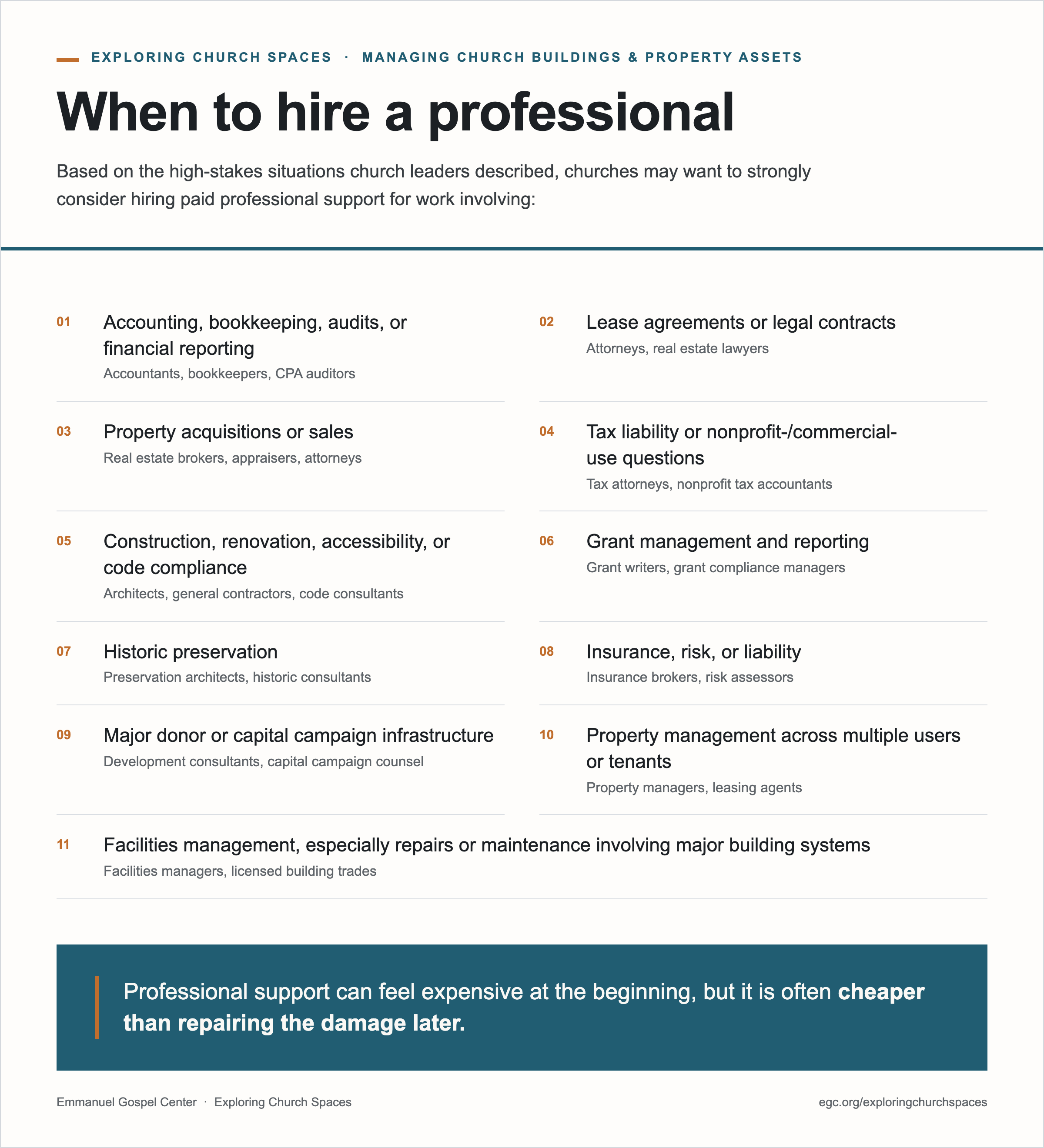
Based on the high-stakes situations church leaders described, churches may want to strongly consider hiring paid professional support for work involving:
accounting, bookkeeping, audits, or financial reporting
lease agreements or legal contracts
property acquisitions or sales
tax liability or nonprofit-/commercial-use questions
construction, renovation, accessibility, or code compliance
grant management and reporting
historic preservation
insurance, risk, or liability
major donor or capital campaign infrastructure
property management across multiple users or tenants
facilities management, especially repairs or maintenance involving major building systems
Professional support can feel expensive at the beginning, but it is often cheaper than repairing the damage later. One leader emphasized that churches should not be afraid to invest in consultants and coaches. Their organization had spent significant money on outside expertise, but saw it as part of what made larger funding opportunities possible. For example, securing a major multimillion-dollar project required substantial upfront consulting costs, some of which were structured to be paid through the project rather than directly by the church.
Churches should also account for paying people for work that requires professional skill and responsibility. If the church needs the work done well, on time, and with accountability, it should be treated as a professional service, even when the provider cares about the church or offers a reduced rate. A discount can be a gift, but it should not replace fair compensation, clear expectations, or professional standards.
2. Build strong accounting and financial reporting systems.
If a church wants to receive grants, manage multiple revenue sources outside of tithing, or take on building projects, it needs financial systems that can withstand outside scrutiny. Good financial systems are not just for internal decision-making; they also matter when funders, lenders, auditors, partners and investors, tenants, contractors, or public agencies need to understand how money is being managed.
Separate operating funds, building funds (including rental income and building expenses), restricted grants, and capital project funds. When accounts are mixed together, it becomes difficult to know what money belongs where, what funds are restricted, and how to report expenses accurately. Some funders may also require restricted project funds to be kept in a separate account from church operating funds or other grant-funded projects. Churches should decide what belongs in each budget or account and apply those categories consistently.
Require regular financial reports. A church should be able to provide a clear financial report when needed for internal review, funder reporting, grant applications, or major project planning. Profit and loss statements, project budgets, grant reports, and, when relevant, 990s for a separate nonprofit entity should be clear and easy to interpret. Line items should be specific enough that outside reviewers do not have to guess what they mean or wonder whether expenses are being categorized appropriately.
Use bookkeeping software consistently. Several churches described situations in which software had been purchased but was not used consistently, or in which financial information was tracked in multiple places and in different ways. That makes it much harder to reconcile accounts, prepare reports, or understand the church’s actual financial position. It is worth the time to set up the system properly, get professional help if needed, provide training on how to use it, and maintain it regularly.
“If I could do it all over again, my first hire would be an accountant before a personal assistant.”
One church leader described a situation in which different financial systems had developed over time: one for treasury, another for operations, and another for investments, without enough oversight between them. The problem became clear when a grantmaker requested a financial report, and the church had to confront the need for stronger accountability and an integrated, unified financial system.
Build in checks and balances. Financial management should not depend on only one person. Even when a church has a trusted treasurer, bookkeeper, or operations director, there should be regular reviews by a finance team, board, or outside accountant. Clear roles, shared reporting, and periodic review help prevent confusion, accidental mismanagement, and the appearance of impropriety. They also protect the person handling the finances by ensuring they are not carrying responsibility alone.
Pay for bookkeeping or accounting help before finances become too complex. Many churches have volunteer treasurers or members who help manage the books, and that may work for a simple church operating budget. But it is usually not enough when a church is managing major capital projects, multiple grants, rental income, property expenses, restricted funds, or several accounts. As one church leader reflected, “If I could do it all over again, my first hire would be an accountant before a personal assistant. They would have saved us so many headaches.”
Paying for bookkeeping or accounting support can prevent confusion, accidental mismanagement, delays, and reporting problems that could jeopardize thousands of dollars in funding. A few hundred dollars a month for reliable bookkeeping may save the church from losing far more in missed opportunities or broken trust with funders.
Prepare for funder expectations, even if churches are not legally required to file the same reports as nonprofits. Some funders ask for audits, financial statements, or 990s, even if churches are exempt from certain filing requirements. In some cases, the ability to provide strong financial documentation can make the difference between receiving or missing out on significant funding. Financial transparency should not be something churches fear. Accountability, integrity, and clear stewardship are part of the witness of the church.
3. Bring legal counsel in before signing agreements.
Several churches we interviewed experienced significant challenges with long-term lease agreements, especially cell tower leases. When churches were first approached by cell companies, many leases locked in churches for 30 or 40 years. For churches that needed cash for repairs or building improvements, the upfront revenue was appealing. However, when the tax laws changed during the life of the lease, the commercial use of church property triggered property tax liability.
Because the contracts did not clearly protect the church, that liability fell back on the congregation. Though churches received upfront revenue through those deals, it ultimately ended up costing churches thousands of dollars a year, and for some who were not able to work their way out of that liability, it cost them hundreds of thousands over the life of the lease. In those cases, the long-term costs outweighed the income the church received when it first signed the agreement.
“The factor that has hindered us most is ignorance. In our system, we are driven from a religious perspective based on a religious organization, and we were not oriented around business or management.”
Do not sign major agreements without legal review. Churches should have a lawyer review long-term leases, cell tower agreements, tenant leases, construction contracts, purchase and sale agreements, easements, financing documents, and any agreement that could affect the church’s property, tax status, liability, or long-term control. Legal review is essential, but it does not replace ongoing oversight.
In one church, a lease had been reviewed by a legal team, but when the leasing company reduced its payments, no one caught the change for ten months. The church only discovered it when preparing the annual budget. By then, the monthly payment had dropped by nearly $1,000, resulting in significant lost income. As the leader reflected, “I didn’t know what I needed to know. And other people didn’t catch it either.”
Be especially careful when negotiating with corporations or entities that have far more legal experience than the church. Corporations have attorneys drafting agreements to protect their own interests. If churches enter business arrangements, they need legal counsel to help them understand the risks and negotiate terms that protect the church.
One church leader reflected on how costly that learning curve can be: “The factor that has hindered us most is ignorance. In our system, we are driven from a religious perspective based on a religious organization, and we were not oriented around business or management.”
Another leader described the mindset shift churches need when entering more complex property arrangements: “If we want to play in the big leagues, then we need to elevate our level of gameplay. We are going to make mistakes, but we have to step our game up, or else they are going to run right over us. We have to be ready to elevate to that level of operating. Not every pastor is capable of that. So you need to have the right people.”
Together, these reflections point to the same lesson: churches do not need to abandon their spiritual mission, but they do need the right legal, financial, and managerial support when making high-stakes property decisions.
Build protections into the agreement. Where appropriate, agreements should include review points, rent escalators, termination clauses, clear tax responsibility, insurance requirements, maintenance responsibilities, and remedies for breach. These protections are aimed at mitigating changes that may occur over the life of a lease and make the difference between an agreement that supports the church and one that creates a long-term financial burden.
Do not assume a standard contract protects the church. Every agreement should be reviewed and revised for the specific circumstances being negotiated. The longer the agreement, the more important this becomes. A few thousand dollars in legal review at the beginning may save the church from decades of financial loss later.
4. Clarify tax liability.
A tenant’s business should not become the church’s tax burden. This was mentioned in the previous strategy, but it is important enough to be named separately.
In every lease agreement, churches should clarify who is responsible for any property tax triggered by commercial, for-profit, or non-exempt use of the space. One-time use of the building will usually not trigger this kind of liability, but even short-term space-use agreements should include basic language about responsibility for fees related to the user’s activities.
For more information on tax liability, read our Tax-Exemption Issues for Massachusetts Churches resource.
For longer-term leases, include language that addresses changes in tax law or municipal interpretation. If the arrangement depends on a tenant’s nonprofit status, require documentation of that status and update it as needed. Churches should also review whether uses such as cell towers, childcare centers, schools, offices, commercial kitchens, housing, or other income-generating activities could affect their property-tax exemption.
5. Know what your space costs.
Many churches want to be generous with their space. They may offer below-market rent to a nonprofit partner whose work aligns with the church’s mission, allow another congregation to rent at low cost, or let a community group use the building for free. Churches may also feel pressure not to charge market rates because of the pervasive perception that “churches are not in the business of making money.” While generosity can be a faithful witness, it needs to be balanced with what the church can realistically sustain, and it should be a decision the church makes intentionally, not on a whim or by default.
Sharing space creates real costs. Churches still have to pay for utilities, cleaning, staff time, administrative coordination, insurance, trash removal, repairs, security, supplies, wear and tear, snow removal, and future maintenance. When a group pays little or nothing, the church is subsidizing that use.
Calculate the real cost of building use. Churches should make an effort to obtain a basic understanding of what it costs to operate the building each month and what additional costs are connected to outside use. This helps leaders make informed decisions about rental rates, how much to discount or subsidize, and what they are willing to offer for free.
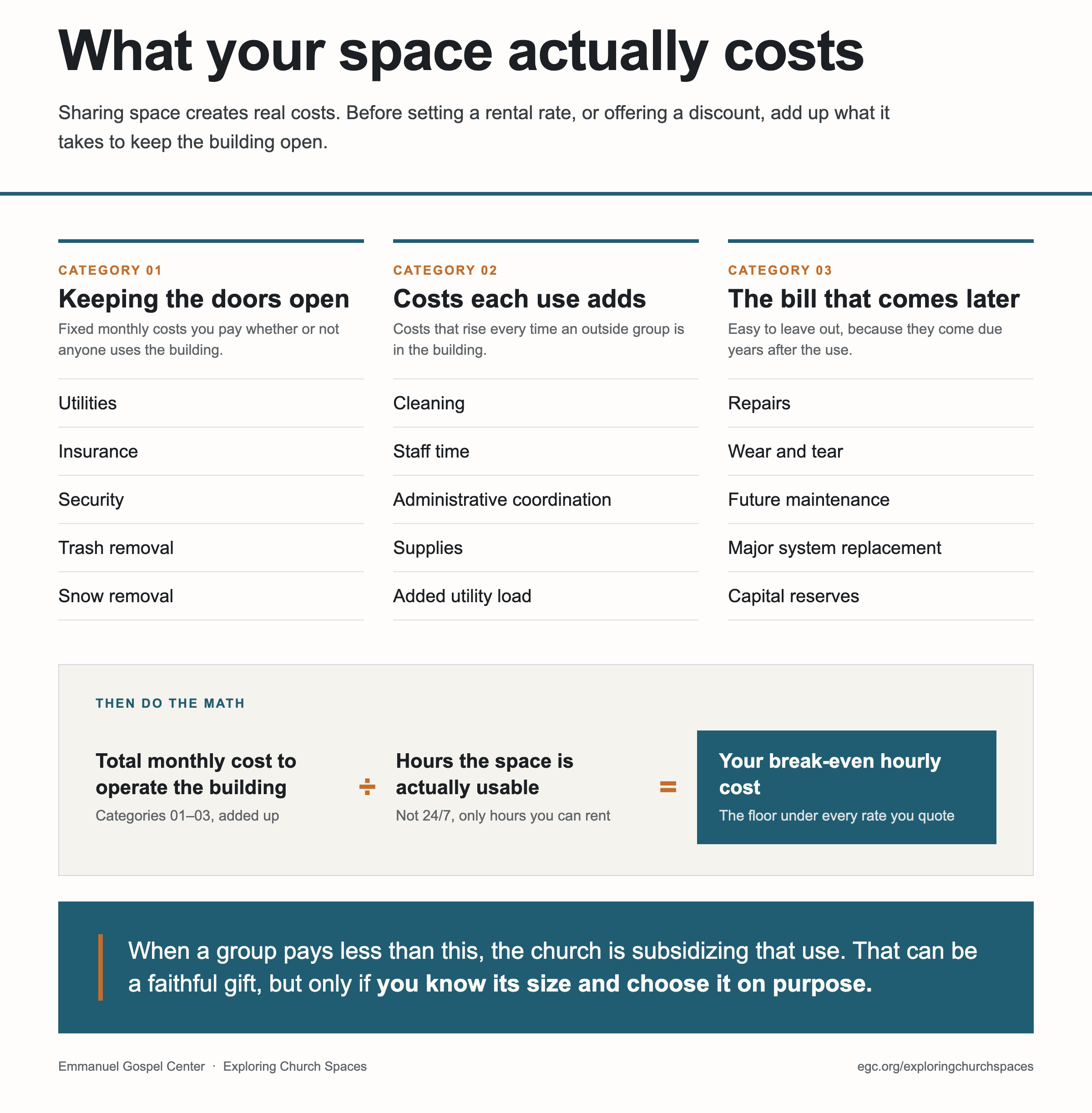
One church we interviewed takes this seriously by naming the actual rental price up front. If a group begins by asking for a discount, the church sees that as a sign that the group may not yet understand the value or cost of the space. The church may still choose to offer a discount later, but it first wants to know that the group understands the space’s value and is prepared to contribute fairly.
Decide intentionally which groups receive reduced rent or free use. Not every group that needs space can or should receive the same subsidy. Churches should decide which uses align most closely with their mission and what level of support they can realistically offer. This makes generosity intentional rather than accidental.
Name the subsidy as part of the church’s mission. If the church is offering space below cost, name that clearly. For example: “We are choosing to subsidize this use because it serves our neighborhood, supports another congregation, or aligns with our mission.” Naming the gift helps others understand that the reduced rent means the church is covering the remaining cost as a ministry investment.
Make sure generosity is sustainable. A church can be generous and still be honest about its limits. If below-market rent prevents the church from maintaining the building, paying staff, or covering basic costs, the arrangement may eventually harm both the church and the people it is trying to serve. Sustainable generosity requires knowing what the church can afford to give.
6. Monitor rental income, lease terms, and contract changes.
A signed lease is not a system. Someone still has to monitor whether both parties are following the agreement.
Once an agreement is signed, it can be easy to assume everything is settled. But leases and rental agreements need ongoing attention. Tenants may fall behind on payments, pay less than agreed, use more space than originally included, or allow terms to shift informally over time. If no one is assigned to track these details, the church may lose income, miss opportunities to address concerns early, or allow resentment to build around unspoken changes to the agreement.
Track whether tenants are paying what was agreed. Churches should have a simple system for tracking rental payments, due dates, late payments, and outstanding balances. This should not depend on memory or informal check-ins. If a tenant is paying less than agreed, paying late, or missing payments, someone should know quickly and follow up. Rental income should be monitored regularly, not only when it is time to build the annual budget.
“If no one is assigned to track the details of a contract, the church may lose income, miss opportunities to address concerns early, or allow resentment to build around unspoken changes to the agreement.”
Review leases and rental agreements annually. Church leaders should know what each agreement actually says: which spaces are included, the rent, the tenant’s responsibilities, and the responsibilities that remain with the church. Reviewing agreements annually helps the church catch places where actual practice has drifted from what was originally agreed and decide whether any terms need to be clarified or renegotiated. It can also be helpful to hold a mid-year check-in with tenants to discuss how things are going and whether any adjustments are needed.
Assign responsibility for lease compliance. Whether it is a building manager, treasurer, property committee, or administrator, one person or team should be responsible for monitoring rental income, lease terms, and tenant responsibilities. Regular oversight helps churches catch problems early, communicate clearly, maintain good relationships with tenants, and protect the building’s financial health.
7. Create clear space-use agreements.
Every use of church space carries some level of responsibility and liability. A clear agreement protects both the church and the person or group using the space by defining the terms of use before problems arise. It helps everyone understand what is allowed, what is expected, who is responsible for what, and what happens if something goes wrong.
For one-time use, the agreement may be simple, but it should still be clear. It should include the date, time, rooms being used, purpose of the event, expected number of people, setup and cleanup responsibilities, insurance requirements (if any), food or equipment use, security expectations, and who is responsible for damage or incidents.

Photo credit: Chalermphon via Lightstock
For short- or long-term leases, the agreement needs to be more detailed. It should define which spaces are included, days and times of use, storage, keys or building access, shared areas, cleaning, trash, insurance, repairs, security, payment terms, and whether the group can invite outside groups, sublet, use the church’s mailing address, or access other parts of the building.
Longer-term agreements should also be reviewed regularly. Over time, a group may begin using more space, storing more materials, staying later, inviting additional users, or relying on building access in ways not part of the original agreement. When that happens, churches should address it directly, document the conversation in writing, and update the agreement if needed.
8. Build basic administrative systems for scheduling, keys, storage, and communication.
Shared space breaks down when the right information does not reach the right people at the right time.
“Our biggest challenge is keeping things organized,” as one church leader described the problem plainly. “The apartments next door were going to host an annual meeting in our building. It wasn’t on our calendar, and they didn’t have our contact, so they couldn’t get in for their meeting.”
As more people and groups use a church building, informal communication is usually not enough. Without clear systems, churches can end up with double bookings; people entering the building without approval; confusion about who will open it when a group needs access; or frustration over setup, cleanup, and storage.
Almost every church we interviewed had a master calendar that tracked all building use, including worship services, internal ministries, tenant use, one-time events, maintenance appointments, and community use. There should also be a clear process for requesting space, whether for a one-time event or recurring use. People should know who approves requests, how far in advance they need to ask, and when their use is officially confirmed.
“These systems do not need to be complicated, but they do need to be clear.”
It is also important to have clear points of contact. Each user group should have one primary contact, and the church should have one primary contact to communicate with that group. Backup contacts should also be listed in case of emergencies, last-minute changes, or building issues.
Churches should create written policies for keys, codes, storage, setup, breakdown, cleaning, parking, and locking up. If groups are allowed to store materials, assign specific storage areas and make sure everyone knows what belongs where. If something breaks, goes missing, or an incident happens, there should be a simple process for reporting it.
These systems do not need to be complicated, but they do need to be clear. The more a church shares its space, the more it needs basic administrative infrastructure to protect the building, reduce confusion, and maintain good relationships with everyone using it.
For more information on ways to make decisions about space use and creating management systems, read our Church-Space Decisions resource.
9. Do not over-leverage property and protect core ministry assets.
Property can be a powerful tool for mission, but it can also create serious risk when churches borrow against their most important assets without a strong repayment plan. Some churches take on debt to renovate, acquire property, or launch new projects. Others borrow against one property to cover shortfalls somewhere else. Debt is not always the problem. The danger comes when a church takes on debt without understanding what is at stake if the project does not go as planned.
In one case we learned about, a church with strong membership had taken on significant debt for a capital project. On the outside, the church looked stable and still had lots of money in the bank. But after a leadership transition, the congregation lost a large portion of its membership, leaving the church in a difficult financial position. Even after reaching out to another church for help, the church ultimately had to sell its building and use its remaining funds to pay off debts, forcing it to close. The leader who was asked to help that church described it as:
They were taking on debt to pay another debt until they folded like a deck of cards when they couldn’t pay it anymore. They lost everything. A lot of churches use their equity to cover their operating budget. They take money out of their properties to fill budget gaps or pay salaries, and that is a huge, huge mistake. You are basically spending your children’s inheritance. I understand why churches do it, but at that point, they are almost giving their church a death date.
That same leader described their church’s approach: using investment income carefully while preserving property proceeds for future property needs.
We have cash that is invested, and a percentage of the interest from that investment goes into our budget. We can use some of it, but not all of it. Some of it supports building needs, and some may support day-to-day operations, but we are careful with it. When we sell a property or take out a line of equity, we do not touch that money until we are ready to buy another property with it.
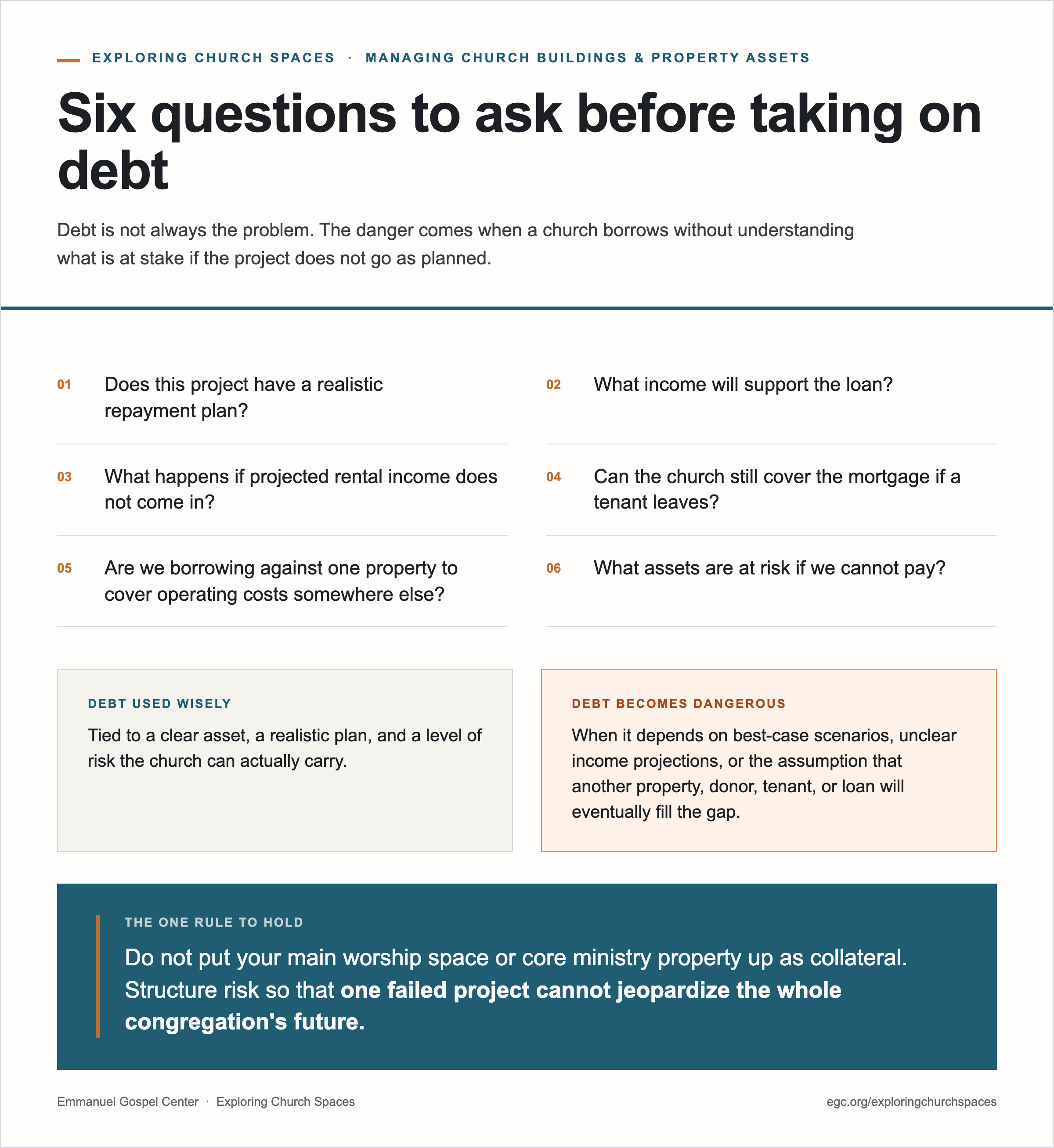
Churches should be especially careful about using their main worship space or core ministry property as collateral for new projects. If a new venture fails, a tenant leaves, interest rates rise, major repairs hit, giving drops, or leadership changes destabilize the congregation, the church should not be at risk of losing the property that anchors its worship and community life.
One church leader explained how they manage risk by protecting their core worship property:
None of our loans have our main worship and retreat center as collateral. For some reason, if the market went to zero, nobody rented from us, and interest rates all went to 30%, we could give up all the properties, but we would still have our main worship center. We just can’t over-leverage.
Before taking on debt, churches should ask hard questions: Does this project have a realistic repayment plan? What income will support the loan? What happens if projected rental income does not come in? Can the church still cover the mortgage if a tenant leaves? Are we using debt from one property to cover unrelated operating deficits? What assets are at risk if we cannot pay?
Secured debt can be used wisely when it is tied to a clear asset, a realistic plan, and a level of risk the church can actually carry. But debt becomes dangerous when it depends on best-case scenarios, unclear income projections, or the assumption that another property, donor, tenant, or loan will eventually fill the gap.
Protecting core ministry assets is an act of stewardship. Churches can take thoughtful risks, but they should structure those risks so that one failed project does not jeopardize the whole congregation’s future.
10. Plan and budget for deferred maintenance.
Many churches live with building issues for years because the list feels overwhelming, and the money is not immediately available. But roofs, HVAC systems, plumbing, electrical systems, water leaks, accessibility barriers, and code issues do not simply stay the same. When they are ignored, they often become more expensive, more urgent, and more disruptive over time.
A building assessment is a good place to start when churches do not know where to begin. An assessment by an architecture or engineering firm can help leaders understand the condition of the property, identify urgent safety concerns, estimate costs, and prioritize what needs to happen first. These assessments should be updated every five years, especially if the church plans to apply for preservation grants or other forms of capital funding, as funders often want current information on the condition of the building and the proposed scope of work.
“Planning for maintenance is not just about preserving a building; it is about protecting the ministries that depend on it.”
Churches should also create a capital maintenance reserve, even if they can only start small. Setting aside money regularly for major repairs helps prevent every building issue from becoming a crisis. Maintenance costs should also be built into annual budgets and rental rates. If tenants and community groups are using the building, the cost of keeping that building safe, accessible, heated, and functional needs to be part of the financial picture.
A dream without a plan is just a wish [as one church leader reflected]. This church is good at dreaming and wishing, but how do we get to a place of planning to get these things to happen? Not just flying by the seat of our pants. Flexibility is great, but also a challenge. Now that we are acquiring assets and budgets are increasing, we are entering into a new level which requires a different approach.”
When prioritizing repairs, churches should focus first on safety, accessibility, roof, HVAC, plumbing, electrical, water intrusion, and code issues. These are the kinds of problems that can quickly shut down worship, programming, community use, tenants, and rental income. It can also help to keep updated quotes for major projects, even if the church cannot complete them right away. Quotes change, but they give leaders a realistic sense of the project’s scale and better prepare the church when funding opportunities arise.
Deferred maintenance can quietly threaten every other property strategy. A church may have tenants, partners, programs, or rental income, but one major building failure can put all of that at risk. Planning for maintenance is not just about preserving a building; it is about protecting the ministries that depend on it.
Stewardship that Sustains Mission
All of these practices can feel tedious. Tracking leases, reviewing agreements, maintaining calendars, working with professionals, building reserves, planning for repairs, and communicating consistently with funders, community partners, and tenants can sometimes feel like drudgery.
However, these leaders have learned personally that it is worth it. Good systems protect more than the building. They protect relationships with tenants and partners. They protect trust with funders, neighbors, and public agencies. They protect the congregation from avoidable financial strain, stress, and burnout. And they protect the church’s ability to use its property for mission over the long term.
A church does not need to do everything perfectly all at once. But every step toward clearer agreements, stronger financial systems, better communication, and more intentional stewardship puts the church in a stronger position for the future. These practices are not separate from ministry; they are a critical part of what allows ministry to flourish and last.

History of Theological Education and Ministry Training in New England
From Harvard College to Bible institutes meeting in churches, Boston and New England have a long history of innovation in theological education and ministry training. The successes and failures of schools in the past can help shape and inspire a new vision for training men and women for gospel ministry.
Emmanuel Gospel Center
New Beginnings: A History of Innovations in Protestant Theological Education and Ministry Training in New England
by Rudy Mitchell, Senior Researcher, Applied Research
Boston and New England have long pioneered innovative models for training pastors, Christian workers, and missionaries, exerting national and international influence on theological education. While some trends in this region have followed cultural and philosophical influences away from biblical orthodoxy, others have strongly supported world evangelism and church growth. By examining the enduring strengths of New England’s innovative approaches, one can discern key principles to guide the future of theological education in Greater Boston, ensuring it remains both adaptive and impactful.
The Days Before Harvard: Theological Education of Boston’s Early Pastors
Understanding the educational background of Boston’s early church leaders offers insight into their approach to differing views and how they designed Harvard College’s program. All first-generation Puritan pastors in Boston attended English universities, and most of the first-generation Boston-area pastors studied at Cambridge University, followed by some pastoral experience in England. (See the Appendix for a list of early Boston-area church leaders along with the education and ministerial training they received.)
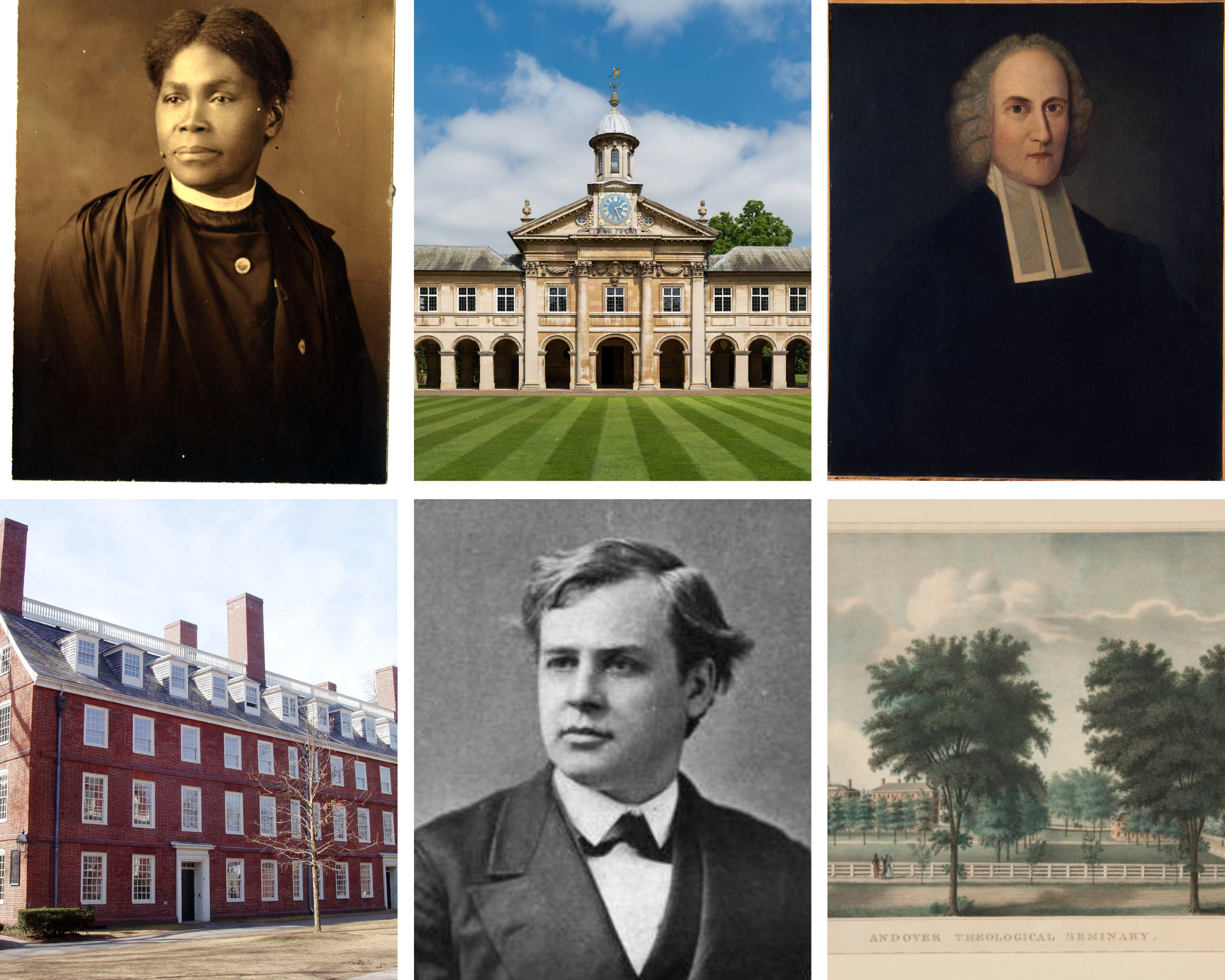
The first three leaders of Harvard all attended colleges at Cambridge University. Nathaniel Eaton and Charles Chauncey attended Trinity College, and Henry Dunster attended Magdalene College. Although Boston-area pastors attended several colleges at Cambridge University, a number of influential leaders, including John Wilson, John Cotton, Thomas Hooker, and John Harvard, attended Emmanuel College, founded in 1584 to train young men for the Protestant ministry. It had become an influential center of Puritan education. Cambridge University, therefore, became a fertile seedbed for the growth and education of a large cohort of future New England pastors and leaders.
Laurence Chaderton, a key figure in the Puritan movement, was the Master of Emmanuel College from 1584 to 1622, during which time almost all of the Boston-area graduates of Emmanuel attended. The pastors of the First Churches of Boston, Cambridge, and Charlestown all studied at Emmanuel College. A few pastors, namely the early pastors of the First Church of Dorchester, studied at Oxford University, which was quite similar to Cambridge University at this time. Typically, these early clergy also held a Master of Arts degree, which was conferred on holders of the Bachelor of Arts degree from Cambridge and Oxford after a period of three years, without any further prescribed coursework. Although students, such as John Cotton, spent additional time studying or teaching at the university, others mostly pursued independent study while serving in a parish, since there was no strict residential requirement.
“Boston and New England have long pioneered innovative models for training pastors, Christian workers, and missionaries, exerting national and international influence on theological education.”
The methods of learning at Cambridge were later followed by Harvard. These included lectures, recitations, disputations, declamations, formal sermons, meetings with tutors, and private study. All the formal parts of this education took place in Latin. Students also learned Greek and sometimes Hebrew for Old Testament study.
At Cambridge University, the lectures were organized around questions and articles, with topics and subtopics arranged in a hierarchy of ideas. Public lectures were delivered in the Old Schools,1 and private lectures were given in the colleges. Lecturers were expected to give four lectures a week (although some seemed to be negligent in this).2 The public lectures included theology, medicine, and civil law, among other subjects. Biblical studies, Greek and Latin classics, and mathematics were emphasized. “Lecturers in language, philosophy, dialectics, and rhetoric were held to five lectures per week.”3
Student recitations were oral exercises in which students recited memorized material from texts or previous lectures, translated texts, or explained and defended interpretations. Disputations were informal and formal debates between students. The formal debate sessions lasted four hours, Monday through Friday, during Lent, and were full of ritual, rules, and traditions. Each student was required to participate in four formal debates for the B.A. degree. Students also had to give “declamations” or set speeches in Latin. It was expected that these would exhibit good style and draw quotations from the Greek and Latin classics.

Emmanuel College, Cambridge, England (DAVID ILIFF via Wikimedia Commons. License: https://creativecommons.org/licenses/by-sa/3.0/)
Students would keep notebooks called “Commonplace Books” with their selection of quotations and information on various subjects. Ministerial students would also deliver “Clerums,” formal sermons preached to the clergy on set days. Tutors played an important role in the educational system, providing academic and moral guidance and oversight.
A Cambridge education in this period “was dialectical, Aristotelian, and highly systematized. It was concerned with logic, logical formulations, and disputations.”4 This led to an eagerness “to divide truth from error” and to win debates with adversaries.5
One can see how the elements and tendencies of this educational background carried over to Boston, where disputations on doctrine and Christian practice were common. This educational experience also shaped Puritan leaders’ planning when they developed Harvard College. Some of the strengths of this education were its preparation of students to study the Bible in the original languages, to engage in clear and effective reasoning, and to speak in public.
A Theological School for the Commonwealth: Harvard College (later Harvard Divinity School)
Harvard was established to make sure New England had a well-educated clergy. In 1636, Harvard was founded to “advance learning and perpetuate it to posterity: dreading to leave an illiterate ministry to the churches, when our present ministers shall lie in the dust.”6
Henry Dunster, a graduate of Emmanuel College, Cambridge University, became president in 1640 and developed a course of study adapted from his alma mater. Since instruction and discourse were in Latin, students were required to know Latin before admission. They could prepare for college through private tutoring or at one of the early Latin schools: Boston Latin School (1635), Charlestown School (1636), Mather School in Dorchester (1639), Roxbury Latin School (1645), or Cambridge Latin School (1648).
Greek and Hebrew studies were emphasized in the first two years by daily classes. The purpose of this rigorous language study was to enable students to study the classics and exegete Scripture. The overall curriculum was still centered on the Trivium (grammar, logic, rhetoric) and the Quadrivium (arithmetic, geometry, music theory, astronomy), along with a focus on biblical studies and theology (using The Marrow of Theology by William Ames as a text).

Massachusetts Hall, Harvard University, built in 1720 (Daderot via Wikimedia Commons)
In the first two years, students studied basic mathematics and ethics, as well as logic, using the textbook The Dialectics by Peter Ramus, and rhetoric, using examples from Cicero and Quintilian, to prepare for “declamations” (set speeches in Latin). As they advanced to their third and fourth years, students studied Calvinistic theology, natural philosophy, moral philosophy, and metaphysics. They engaged in weekly “disputations” (debates), prepared sermons, and studied some practical theology.7
Once the first college building was completed, teachers and students lived together, sharing meals, prayers, and recreation. Although there were fewer tutors or teachers, the teaching methods were similar to those at Cambridge University, with disputations, lectures, daily recitations, declamations, and discussions with tutors. Students were expected to engage in daily prayers and devotions, and to learn the catechism.
“After God had carried us safe to New England and we had builded our houses, provided necessaries for our livelihood, reared convenient places for God’s worship, and settled the civil government: One of the next things we longed for and looked after was to advance learning and perpetuate it to posterity; dreading to leave an illiterate ministry to the churches, when our present ministers shall lie in the dust.”
By 1654, Harvard had 50 students. Further ministerial preparation took place after students received their Bachelor’s degrees. “A few students remained at Harvard to read for the Master’s degree, while most apprenticed with local ministers,” and continued independent study. “About half of Harvard students entered the ministry until about 1720.”8
In 1805, Henry Ware was chosen as the Hollis Professor of Theology, signaling a shift toward Unitarianism and theologically liberal views at Harvard. Since the Hollis Professorship of Theology was a key influential position, this was a watershed moment. This change played a role in the founding of Andover Theological Seminary and in the establishment of other later seminaries. In 1816, Harvard Divinity School became a separate school of the university.
Carrying the Torch: Yale College
In 1701 the Collegiate School, known as Yale College after 1718, in Connecticut was founded with a clear purpose: “The founding, suitably endowing & ordering of a Collegiate School within his Majesties Colony of Connecticut wherein Youth may be instructed in the Arts & Sciences who through the blessing of Almighty God may be fitted for Publick employment in both Church and Civil State.”9
.jpg)
Divinity College at Yale before 1870 (Wikimedia Commons)
Ten ministers, led by James Pierpont, took the initiative in bringing the plan to found Yale to the general assembly of Connecticut. They were given funding and the authority to direct its affairs. All but one of these ten founders of Yale were Harvard graduates. During the first several years under the leadership of the Rev. Abraham Pierson, students met together at his church, and instruction was not unlike pastoral mentoring taking place elsewhere during the eighteenth century.
Once the school was firmly established, the early curriculum followed Harvard’s curriculum of the latter 1600s and emphasized theology, the biblical languages, and Bible study. In its early years, Yale was largely focused on training ministers, and even later, when it broadened its focus, the school still trained many influential pastors and theologians: “Whereas almost three-quarters of the early graduates entered the ministry, that proportion fell to around one-half from the 1720s onward.”10
“By examining the enduring strengths of New England’s innovative approaches, one can discern key principles to guide the future of theological education in Greater Boston, ensuring it remains both adaptive and impactful. ”
Those influencing the founding of the college were interested in maintaining the pure Calvinism of the earlier Puritans, since some believed Harvard was becoming liberal in its theology. However, in the decades to follow, Yale would be influenced by revivals and new intellectual currents from England and elsewhere. Jonathan Edwards, a very influential graduate (1720), was a key leader in the First Great Awakening, and Lyman Beecher (1797) was a leader in later revivals in Boston. Jonathan Edwards’ grandson, Timothy Dwight, served as President from 1797 to 1817. His talented and spiritual leadership led to major growth of the college, curriculum improvements, spiritual revival, and influential theological movements, such as the New Divinity and New England Theology under Nathanael Taylor.
A separate Theology Department, which later became Yale Divinity School, was founded in 1822, and Nathaniel Taylor became the professor of theology.
A Broader Table: Brown University
In 1764, Brown University was founded as Rhode Island College. Although the school was open to students of any religious belief, the Philadelphia Association of Baptist Churches had appointed Baptist minister the Rev. James Manning to be President, and Baptist leaders revised the Rev. Ezra Stiles’ draft of the charter for Rhode Island College to ensure Baptists had majority control of the school’s governing bodies.
_2.jpg)
University Hall at Brown University (Wikimedia Commons)
While the college was not designed specifically to train ministers, 43 of its early graduates did become pastors.11 In the early decades, Latin was the common language in most classes and discussions. While theology was not specifically taught, future ministers benefited from Brown’s emphasis on public speaking, orations, and composition. Other parts of the curriculum relevant to their ministerial preparation included logic, Greek and New Testament study, moral philosophy, rhetoric, and general philosophy.12 The educational methods included recitations from texts, lectures, preparing and delivering orations, and disputations (debates) on various theses. Most of the students ate and lived together in the college hall with the tutors and were required to attend morning and evening prayers in the chapel. This learning environment contributed to a sense of community.
A More Personal School: Pastoral Mentoring in New England
Although some mentoring of young prospective pastors occurred throughout New England’s history, this mode of ministerial training seemed to flourish especially after these early colleges were founded and before the establishment of graduate seminary programs such as Andover Theological Seminary.
New England Christian leaders, such as Jonathan Edwards, provided a model of mentoring young graduates in their homes and churches. Typically, when students who felt called to ministry graduated from college, they would seek to study personally with a prominent pastor who would take in a few students to mentor and guide in their further training for the ministry. For example, in 1736, Joseph Bellamy came to study theology with Edwards and live in the family household. Other students followed Bellamy in the Edwards’ household, including Samuel Hopkins in late 1741. Through their study of theology under Edwards, both Bellamy and Hopkins would later become very influential in New England.
.jpg)
Jonathan Edwards by Henry Augustus Loop (1831-1895) after Joseph Badger (Princeton University Art Museum, Public Domain)
This method of study also enabled the students to grow spiritually and learn from the example of their mentor and his wife in handling family life and practical church concerns. When Hopkins was spiritually dejected, Mrs. Sarah Edwards encouraged him, and her “counsel and example in his early spiritual formation had a lasting impact… Hopkins also admired her ‘excellent way of governing her children,’ bringing them to obey cheerfully… Jonathan also showed the greatest calmness as well as the greatest firmness in his discipline, and as ‘a consequence of this, they revered, esteemed, and loved him.’”13 This personal interaction and observation of mature Christians in daily life could be invaluable.
Students mentored in this holistic way received much more than academic information. The Rev. Joseph Bellamy, after settling into a pastorate in Bethlehem, Connecticut, in turn started mentoring many future pastors using questions on theology, evening discussions, and talks. His students would write papers on the questions, and he would respond with corrections or critiques. He had his students give sermons, and they would receive feedback on how to improve. Bellamy strongly encouraged the spiritual life of his students and discussed the joys and trials of ministry with them. Students could observe the pastor in his pastoral duties and could help perform various services in the church. Bellamy served in this way in the latter 1700s and likely had the second-largest number of students of any pastor.14
“This method of study also enabled the students to grow spiritually and learn from the example of their mentor and his wife in handling family life and practical church concerns.”
Others, like the Rev. Smalley, one of Bellamy’s students, followed a similar pattern of ministerial training. One of the Rev. Smalley’s 30 students was Nathanael Emmons, who became an influential proponent of the New Divinity system of theology and mentored nearly 90 students over the years in Franklin, Massachusetts.15 Several of the other prominent pastoral mentors of the period from 1750 to 1810 included the Rev. Samuel Hopkins, the Rev. Timothy Dwight, the Rev. Titus Barton, the Rev. Joseph Lathrop, Dr. Charles Backus, and Dr. Asahel Hooker.16
The pastoral mentoring process had some limitations, including time constraints due to the teacher’s pastoral responsibilities, limited access to books, and the limits of the pastor’s teaching ability and educational background. Nevertheless, this method of ministry training was very important during the period discussed, and has some very valuable elements for any time period.
The Beginnings of the Modern Seminary: Andover Theological Seminary
As Unitarianism gained increasing influence at Harvard and in New England churches in the early 1800s, orthodox Congregationalist leaders grew concerned about the future of sound ministerial training. The appointment of Henry Ware, a Unitarian, as Hollis Professor of Theology at Harvard in 1805 proved to be a watershed moment, prompting several prominent church leaders to pursue the founding of a new school committed to Calvinistic, biblical orthodoxy. Just as Harvard, Yale, and Brown had each been founded in response to a perceived need for faithful Christian education, so this new institution would arise from a similar conviction, and would go on to become the prototype for scores of seminaries founded across America over the next two centuries.
In Andover, Massachusetts, in association with Phillips Academy, the kind of pastoral training that had been flourishing under ministers such as Jonathan Edwards was supported by a scholarship fund. The Rev. Jonathan French mentored groups of students from 1797 to 1808. The Phillips family, who founded Phillips Academy in 1778, planned for the school to teach orthodox Christian doctrine and promote piety and virtue. Although the academy was only a preparatory school, its campus would, in a few decades, become host to Andover Theological Seminary.
The Academy’s first principal was Dr. Eliphalet Pearson. He later became Professor of Hebrew and then interim President of Harvard in the early 1800s. He was opposed to the growing liberal theological and Unitarian movement; therefore, when Henry Ware, a Unitarian, was appointed Professor of Theology at Harvard, Pearson resigned. He returned to Andover and helped spearhead a group seeking to establish a new Calvinistic, orthodox school to train ministers. This Founders Group working in Andover included the Rev. Jedidah Morse, a Charlestown pastor; Mr. Samuel Abbot, a wealthy potential donor; Mrs. Phoebe Phillips and her son, John Phillips, who committed to fund two buildings; Samuel Farrar, a lawyer; the Rev. Jonathan French; and several others.

Andover Theological Seminary by J. Kidder (1813-1823) (Yale University Art Gallery, Public Domain)
Meanwhile, a second group, led by Dr. Samuel Spring of the North Congregational Church in Newburyport, had developed a vision for an orthodox ministry training school. Dr. Spring and potential theology professor, Leonard Woods, had gathered the support of three wealthy “Associate Donors”: Moses Brown, William Bartlett, and John Norris. After lengthy negotiations involving theological differences, financial arrangements, and authority structures to ensure doctrinal fidelity, the two groups merged their vision into one new school at the Phillips Academy campus—the Andover Theological Seminary. Dr. Woods, who was friends with both Dr. Spring and his former teacher, Dr. Pearson, served as a bridge-builder, bringing the two groups to agreement, and was appointed to the important post of Professor of Theology.17
Founded in 1807, this was the first Protestant graduate-level seminary in America, and it became the prototype for scores of seminaries founded over the next 200 years.
Andover’s approach was a three-year curriculum for college graduates who would live on campus and learn from highly qualified professors in residence. Initially, donors even sponsored and built houses for specific professorships. Early professors besides Dr. Leonard Woods included Moses Stuart (Biblical studies, languages, and exegesis), Dr. Edward Dorr Griffin (rhetoric and preaching), the Rev. Ebenezer Porter (preaching), and Dr. Pearson (natural theology). Students studied Hebrew and Greek, hermeneutics, and the principles of exegesis under Dr. Moses Stuart, who “had a powerful influence in promoting in our country the study of the Scriptures in their original languages.”18 Other subjects included church history, theology, preaching, rhetoric, and pastoral duties.
“Just as Harvard, Yale, and Brown had each been founded in response to a perceived need for faithful Christian education, so this new institution would arise from a similar conviction, and would go on to become the prototype for scores of seminaries founded across America over the next two centuries.”
Professors experimented with various teaching methods, including recitations followed by the teacher’s explanations, lectures with free discussions and questions, and writing papers.19 However, Dr. Woods believed the most valuable learning time was the weekly Wednesday evening discussion. These were open discussions on theology and “all matters relating to Christian experience, duty, and comfort.” Moses Stuart led these with Dr. Woods, who said, “We poured out the feelings of our hearts to our beloved students.”20
Professors met with students one-on-one to talk about their spiritual lives, encouraged them to read devotional works, and, in general, placed a high priority on their spiritual growth. Once each term, the seminary would hold a fast with prayer and discussions. Professors such as Dr. Woods would take walks with students, or take groups of six at a time home to a social meal with their families after prayers in the chapel. The professors’ homes were on or near the campus and thus accessible. Andover’s new three-year training process provided extended time for deeper study, access to library resources, housing, and classrooms, while still facilitating personal interaction with the best teachers, who could now devote nearly full-time to their students.
Over the school’s first 38 years, it admitted 1,500 students, and its graduates became pastors, missionaries, and educators, some of whom became presidents, leaders, or founders of other colleges.21 During those early years, the faculty and students played a central role in the founding of the pioneering American Board of Commissioners for Foreign Missions (ABCFM) and in the growing American missionary movement. America’s first foreign missionaries were ordained at Tabernacle Congregational Church in Salem, Massachusetts, on February 16, 1812. Those five pioneering missionaries—Adoniram Judson, Gordon Hall, Luther Rice, Samuel Nott, and Samuel Newell—were all graduates of Andover Theological Seminary, which had nurtured their missionary zeal and supported their efforts to establish the ABCFM.
The First Baptist Seminary: Newton Theological Institute
Under the leadership of Dr. Thomas Baldwin, pastor of the Second Baptist Church of Boston, area Baptists founded the Massachusetts Baptist Education Society in 1814 to help financially support students called to the ministry. This organization advanced the idea that Baptist pastors would benefit from more education.
By May 1825, the Society’s executive committee and Baptist ministers were ready to found a theological school “where the combined powers of two or three or more men of experience, and men of God, can be employed in instructing and forming the manners and habits and character of pious young men for the work of the ministry.”22 From this statement, one can discern the important goal of students’ spiritual formation, not just intellectual instruction.
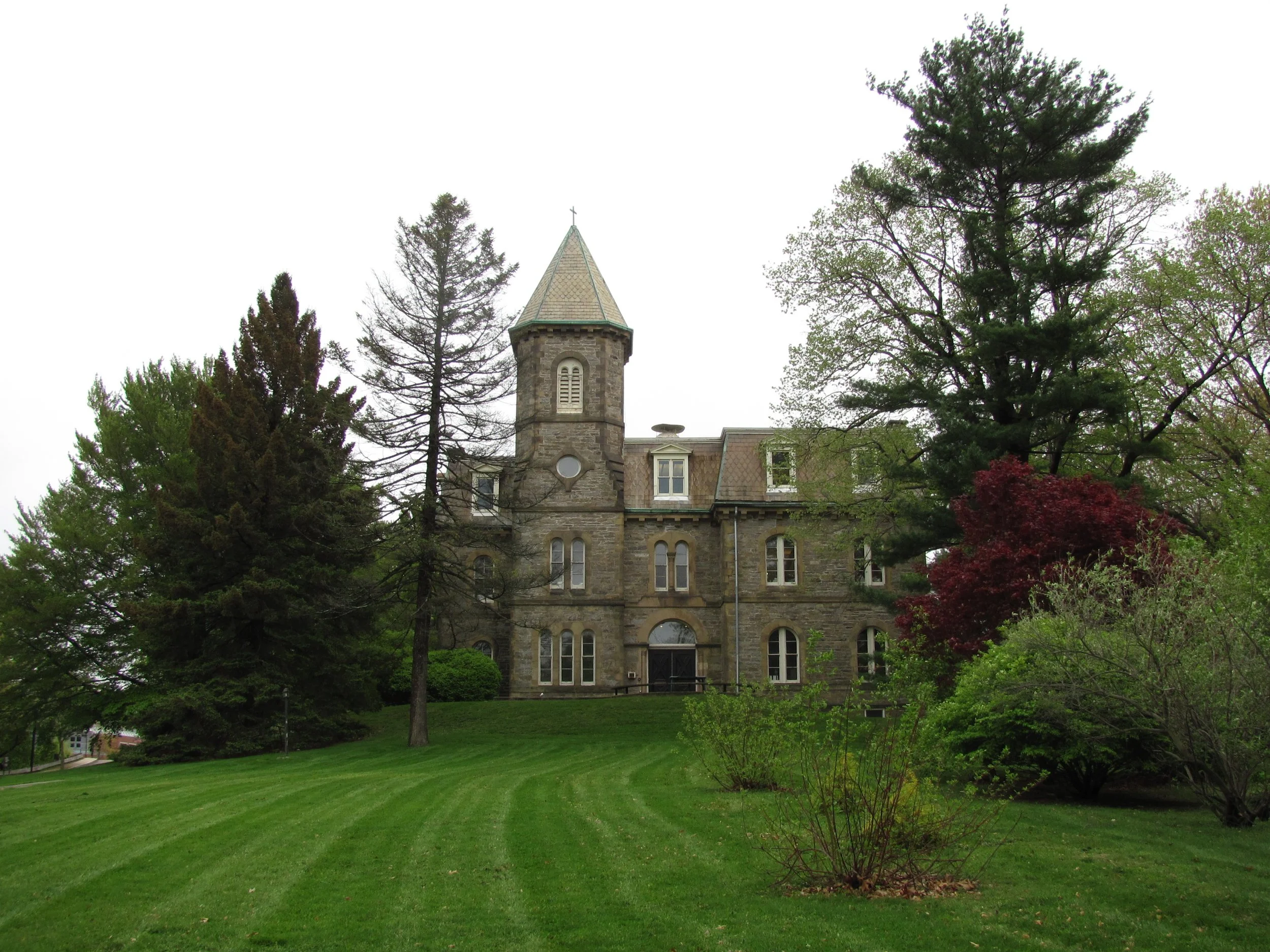
Colby Hall, Newton Theological Institute (John Phelan, 2011, via Wikimedia Commons)
The planning committees moved rapidly, purchasing the 85-acre Peck Estate on a hill in Newton for the campus and hiring the Rev. Irah Chase as Professor of Biblical Theology. The Rev. Chase, who was a graduate of Andover Theological Seminary, began teaching in November at the new Newton Theological Institute.23 The following year, Dr. Henry J. Ripley, also an Andover graduate (1819), became Professor of Biblical Literature and Pastoral Duties. Since both professors were products of Andover, it is not surprising that this new school developed a three-year curriculum and educational process somewhat like that of their alma mater.
The students took courses in Biblical literature, church history, Biblical theology, and pastoral duties. One of the central goals for students was to understand the Bible clearly and teach its lessons effectively. “Newton became the first freestanding post-graduate Baptist seminary to be established in North America, the first Baptist graduate school of any kind.”24 In 1849, Dr. Alvah Hovey began his long and influential career as a professor and later as President of Newton. He continued to defend orthodox theology throughout the last half of the nineteenth century.
A New School for Congregationalists: Hartford Theological Seminary
As the New England Theology was gaining ground, an opposing Pastoral Union group of “Old Calvinist” pastors in Connecticut founded the Theological Institute of Connecticut in East Windsor in 1834. This seminary would later move to Hartford and change its name to Hartford Theological Seminary.
_(14784222972).jpg)
Hosmer Hall, Hartford Theological Seminary (1889) (Wikimedia Commons)
Like Andover, the new seminary, led by Dr. Bennet Tyler, offered a three-year course of study for college graduates. They came from several different states, but were often graduates of Amherst College, Williams College, and Yale College. Tuition, rooms, and the library were free, and by 1843, the school building had rooms for 52 students. By that year, 62 students had graduated and gone on to become pastors or missionaries.25 Although students studied several subjects each year, including church history, the first year emphasized Biblical interpretation, the second year systematic theology, and the third year sacred rhetoric and pastoral theology.26
Ministry Training for Methodists: Boston University School of Theology
In the late eighteenth and early nineteenth centuries, most Methodist pastors did not attend a college or seminary for ministerial training. They basically learned on the job with some guidance from the presiding elder, or district superintendent, and in some places, a list of books to read.
Although Wesleyan College (later University) of Middletown, Connecticut, was originally Methodist, it was not founded to specifically train pastors: “From 1831 to 1870 Wesleyan was a local evangelical enterprise promoted by a town that provided land and buildings and by a few Methodist clergy and laymen who extracted very limited support from a denomination having only a nascent interest in higher education.”27 The school did have Christian objectives, and undoubtedly some Methodist leaders did receive a general college education there, although not specialized ministerial training.
After several years of debate, Methodist leaders at a convention in Boston in 1839 were ready to propose the establishment of a theological school. This group approved the establishment of a seminary and decided to work with and support a new program to be part of a school in Newbury, Vermont. Under the leadership of Osmon C. Baker, the program, called the Newbury Theological Institute, trained pastors until 1847.
“It is intended that the student shall do something more than merely memorize text-books. Whenever a branch of science or a portion of a branch, can be best taught by a fresh original handling...the professors will not shrink from the additional labor which such methods necessarily involve.”
At that time, the students, finances, and library were moved to Concord, New Hampshire, and under a new charter, the school became independent with the new name, Methodist General Biblical Institute (also called the Concord Biblical Institute). John Dempster, a former missionary, became the President, while Osman Baker moved and continued to teach.28 Even in this early period, the seminary had some emphasis on missionary work.29 With the rapid growth of Methodism and the development of a more robust program, the Institute flourished in Concord over the next 20 years.
In 1867, the school relocated to Boston and reorganized as the Boston Theological Seminary. Meanwhile, over the next few years, Methodist leaders were working to establish Boston University, with plans to create four professional and graduate schools. In 1871, the seminary became part of the new university as its first professional school.
The school was designed to have a regular three-year ministerial course and also a three-year course in missionary work. The curriculum had four major sections: exegetical theology, historical theology, systematic theology, and practical theology. Exegetical theology included the study of Hebrew, Greek, exegesis, and archaeology. Special studies were offered in various other languages—including Spanish and Asian languages for missions—plus music, German theology, and medical topics for missions.

Boston University Marsh Chapel (John Phelan, 2011, via Wikimedia Commons)
Teachers were encouraged to use fresh and varied methods of instruction: “It is intended that the student shall do something more than merely memorize text-books. Whenever a branch of science [knowledge] or a portion of a branch, can be best taught by a fresh original handling in the way of written lectures, or by free exposition, or by black-board exercise, or by a Socratic method, or by a combination of any or all of these, the professors will not shrink from the additional labor which such methods necessarily involve.”30
Spiritual life was encouraged by three prayer meetings each week and morning and evening devotions. Missions was generally emphasized, and students were encouraged to attend the meetings of the Missionary Association. The school was a pioneer among seminaries in admitting women. Anna Howard Shaw and Helen Magill White were among the early graduates in the 1870s.
The school was innovative in setting up two divisions. The First Division would only accept students who had earned a B.A. degree. After three years of coursework and passing an examination, they would receive a Bachelor of Divinity degree. The Second Division opened access to students who had completed a secondary education but, for various reasons or due to age, had not been able to earn a B.A. degree. These students could receive a diploma after completing the course of study.
While the Boston University School of Theology followed the basic pattern of other three-year residential seminaries, it introduced several innovative policies and was the first theological seminary of the Methodist Episcopal Church. By 1871, it was the largest seminary in New England. Much later in the 1930s, the seminary, along with the university, moved from Beacon Hill to a new campus along the Charles River.
Ministry Beyond the Pulpit: New England Deaconess Training School
In 1889, the Methodists initiated another training effort, the New England Deaconess Training School (and Deaconess House), located at 45 East Chester Park in Boston’s South End. This was part of a larger movement, beginning in Europe, to revive the formal lay ministry of deaconesses. The program was designed to educate young women for missionary and service work, especially in the city. Mary E. Lunn, the first superintendent, also advocated for a hospital, and in 1896, she founded New England Deaconess Hospital in a South End brownstone.
“Anna E. Hall, circa 1900”. Anna E. Hall Collection. Atlanta University Center Robert W. Woodruff Library. http://hdl.handle.net/20.500.12322/auc.119:0077.
The training school offered courses in theology, church history, and other subjects, including sociology in cooperation with Simmons College after 1900. The school’s first African American graduate, Anna E. Hall, became a missionary educator in Liberia, serving for 24 years as director of a girls’ school and home.31 Other deaconesses went on to study at the nursing school associated with the hospital.
In 1918, the Deaconess Training School became a part of Boston University and was renamed the School of Religious Education and Social Service.
An Episcopal School for the Commonwealth: Episcopal Theological School (later Episcopal Divinity School)
In the early nineteenth century, New England Episcopalians who felt called to ministry would often go to New York City to study at the General Theological Seminary. However, a significant number of these students stayed in the New York area after graduation rather than returning to serve in New England. This situation led church leaders in Boston to start planning an Episcopal seminary in Massachusetts. Beginning with a resolution passed at the 1831 Massachusetts Episcopal Convention, several efforts were made over the years to found a theological school in the Boston area.
These efforts failed to bear fruit due to a lack of finances until, finally, in 1867, Benjamin Tyler Reed, a wealthy Boston businessman, committed $100,000 to endow what soon became the Episcopal Theological School.32 He did not want the school to become embroiled in controversies that might arise within the denomination, and so he sought to make it independent of the diocese, its conventions, and its bishop, in part by establishing its trustees as laymen only. They would control temporal matters, while the faculty would have some oversight of theological and academic matters.
Reed called on Dr. Francis W. Wharton, rector of St. Paul’s Church of Brookline, who was a brilliant legal expert, to draw up the school’s constitution, develop its organization, and help gather the first group of faculty. Wharton is thus often considered the founder of the Episcopal Theological School. With his legal background, he emphasized apologetics and Christian evidences in the curriculum. He also taught liturgics, polity, canon law, homiletics, and pastoral care.

Episcopal Theological School, Cambridge, Massachusetts (Wikimedia Commons)
The Rev. John Seeley Stone, a leader among evangelicals and one of the great preachers of the time, became the dean and professor of systematic divinity (theology). Other courses in the three-year curriculum included Hebrew, Greek, Biblical interpretation, and church history.33 Dean Stone “opposed what he called the ‘rationalistic tendencies of our time,’ and meant the school to stand as a bulwark of evangelicalism.”34
At the end of the school year, professors conducted oral public examinations of students in all classes. During the first 10 years, a chapel and other buildings were completed at the Brattle Street campus in Cambridge. The student body at that time averaged only about 12 to 15 students. The school followed the general pattern of other seminaries in establishing a three-year, post-college course on a residential campus, but its governing structure was innovative for a seminary serving a specific denomination but outside its power structure.
To the Ends of the Earth: The Bible School and Missionary Training Institute Movement
After experiencing urban revivals in 1842, 1857-58, and 1877-78, Boston contributed to other growing Christian movements, including the Foreign Missions movement, the Holiness or Higher Life movement, and the Faith Cure or Divine Healing movement. Involvement in these movements led to the founding of other training schools. In addition to Boston University School of Theology, other schools with an emphasis on foreign missions included the Faith Training College and the Boston Missionary Training Institute (eventually named Gordon College after its founder).

Charles Cullis (Wikimedia Commons)
One major new development in Christian ministry training was the Bible School and Missionary Training Institute Movement. These schools offered a shorter course of study, emphasizing Bible study, practical ministry training, and spiritual life to prepare men and women for home and foreign missionary work. Although short-lived, the Boston Faith Training College could be considered the pioneering American institution in what became the Bible College Movement (followed by A.B. Simpson’s Missionary Training Institute [Nyack College] in 1882; Moody Bible Institute in 1886-7; and the Boston Missionary Training Institute [Gordon College] in 1889). A. B. Simpson and his institute became very influential in the Bible College Movement and in missions. Simpson, in turn, was greatly influenced by Charles Cullis. “Probably the American educator with the greatest influence upon A. B. Simpson was Dr. Charles Cullis…. Cullis’ Faith Training College convinced Simpson that he could successfully launch a missionary training college.”35 D. L. Moody was also influenced by his Boston contacts and background.
Faith Training College
Dr. Charles Cullis, the leader of a large network of ministries in Boston, the U.S., India, and China, founded the Faith Training College on Beacon Hill in 1875. The Faith Training College described its efforts as “…to train for Christian work such consecrated men and women as are unable to pursue an extended and thorough course of theological study in the various denominational seminaries, but are desirous of fitting themselves for the highest efficiency in the widening fields of lay activity, which the Head of the Church is wonderfully opening in our age, such as Sunday School instruction, Christian Association work, Bible exposition, exhortation, lay preaching, lay evangelism, home and foreign missionary labor” (1875 Annual Report, p. 90).
The Bible college model emphasized a shorter course of study, a focus on the Bible, practical ministry, witness, and missions. Faith Training College was co-educational and tuition-free.
Dr. Cullis, the founder, had also founded the Boston Consumptives (tuberculosis) Home, the Spinal Home, and the Cancer Home, and he was the most prominent national leader of the Divine Healing Movement. Among the college’s teachers was William Boardman, Professor of Christian Life. He ministered throughout Europe and England, spreading the Higher Life Movement and, along with Robert Pearsall Smith, inspiring the Keswick Conference movement. Boardman was a graduate of Yale University and Lane Theological Seminary. Daniel Steele, a graduate of Wesleyan University, was professor of systematic theology, and A. B. Earle was professor of revivalism, a position that was probably unique to Faith Training College. Another professor was Charles Wesley Emerson, the founder of Emerson College.
Boston Missionary Training Institute: Gordon College and Gordon Divinity School (later Gordon-Conwell Theological Seminary)
In 1889, Dr. A. J. Gordon, pastor of the Clarendon Street Baptist Church in Boston, founded the Boston Missionary Training Institute to help train Christian men and women for missionary work. Pastor Gordon had been inspired by Dwight L. Moody’s months-long evangelistic campaign next door to his church in 1877 and by the great London conference on foreign missions in 1888.
In 1884, Dr. and Mrs. Grattan Guinness, the directors of the Livingstone Inland Mission in the Congo, had offered the mission to the American Baptist Missionary Union. The Rev. A. J. Gordon became the Chairman of the Executive Committee of the Missionary Union and, therefore, was concerned with the Congo mission’s great need for funds and missionary candidates in the late 1880s.36 This was one of the major motives for starting a missionary training school with a short course of studies. Dr. Guinness and the Rev. M. R. Deming of the Bowdoin Square Tabernacle church were also involved in founding the school. Dr. Gordon’s work with Dr. Guinness also would have familiarized him with the details and model of the East London Missionary Training Institute that Guinness had founded in 1873.
“Although many students came from the Boston area, some came from as far away as Kansas, Indiana, and New York.”
Pastor Gordon, like Dr. Cullis at the Faith Training College, saw a need to provide access to ministry training for those who could not follow the rigorous academic path of four years of college and three years of seminary. The school charged no tuition, admitted both men and women, and did not require a high school or college education to enroll. The normal course of study was two years, with classes during the day, but the school also began offering public evening lectures and Bible courses taught by Dr. James M. Gray and Rev. F. L. Chapell. These were attended by hundreds of people.37 Dr. Gray became one of the best-known Bible teachers in the country and later served as President of Moody Bible Institute. Dr. Chapell taught the majority of the core courses during the school’s first ten years.
In some of the early years, women students were in the majority in the daytime classes. Women were also serving as teachers and administrators. Mrs. Maria Gordon served as secretary, treasurer, and a teacher at the school. Other women teachers were Dr. Julia Morton Plummer, Mrs. Susan G. Gray, Mrs. Chapell, and Miss Blanche Tilton.
Adoniram Judson Gordon (Library Company of Philadelphia)
The school emphasized the consecrated spiritual life of the students with daily devotional periods, including testimonies and singing. The classes included theology, missions, comprehensive Bible study, music, and Christian Life and Service. Students engaged in extensive practice in Christian work at Clarendon Street Baptist Church, in their own churches, or in the city.
Although many students came from the Boston area, some came from as far away as Kansas, Indiana, and New York. In the first ten years, 500 students attended day classes, 1,000 to 1,500 benefited from evening classes, and about 50 students, both men and women, went on to serve in foreign missions. Also, 50 students became pastors, and at least 200 went into other Christian work.38
The school went through a number of name changes, but the most noteworthy was when it became the Gordon Bible and Missionary Training School after the death of Dr. A. J. Gordon in 1895. In 1927, the state legislature granted the school the authority to award graduate degrees, and, in 1931, the graduate theological course became the Divinity School of Gordon College. After a number of years in the Fenway area of Boston, the divinity school, followed by the college, moved to Wenham, Massachusetts, in the 1950s.
Multiplying Leaders: Boston Young Men’s Christian Association
In 1851, Boston leaders founded the first YMCA in America following the model of the London YMCA. Although this pioneering organization was never a formal ministry training school, it did have classes and, in various ways, trained young men in biblical study and practical ministries.
In its early decades, the Boston YMCA was clearly Christian and trained young leaders to go out to other towns and cities in Massachusetts and New England to start or support other YMCAs. An 1870 report states, “About 118 of the Associations [local YMCAs] in this country are in Massachusetts. Many calls are made for our young men to address public meetings, conventions, etc.”39 In this process, they also did evangelism, and the Boston YMCA was involved in many evangelistic activities and conventions.

YMCA, Berkeley St., Boston (Wikimedia Commons)
After the Civil War, the work was characterized by spiritual fervor, overflowing prayer meetings, and “quite a number of its members were reported as studying for the ministry.”40 Also, in 1885, a YMCA School for Christian Workers was started in Springfield, Massachusetts. It emphasized training YMCA leaders who would lead programs that nurtured the spirit, mind, and body. The school was also notable as the birthplace of basketball. In 1890-91, the name was changed to the International YMCA Training School, which later became Springfield College.
The education department in Boston also grew significantly in the late nineteenth century. Although many of the classes at the Boston YMCA were on practical subjects related to vocations and avocations, there were some Bible classes. By 1896-1898, the education department under Frank Palmer Speare became highly organized into an Evening Institute. The school grew rapidly and evolved, with state approval, in 1916, into Northeastern College, and, in 1922, into Northeastern University, which eventually became independent of the YMCA.
Holiness Unto the Lord: Eastern Nazarene College
Founded as part of the holiness movement in 1900, Eastern Nazarene College was initially called the Pentecostal Collegiate Institute and was located in Saratoga, New York. Lyman C. Pettit served as its first president. Within two years, it moved to North Scituate, Rhode Island. The original plan was to provide a liberal education and ministry training through a preparatory academy, a four-year college, and a seminary.
In the early years, the school was connected to the Association of Pentecostal Churches of America (APCA), a network of Wesleyan-holiness churches. When the APCA merged into the Church of the Nazarene denomination in 1907, the institute became affiliated with the Nazarenes. In 1918, the school was chartered with degree-granting authority in Rhode Island and was renamed Eastern Nazarene College. The following year, it moved to Quincy, Massachusetts, to be near Boston and Harvard University.

Gardner Hall, Eastern Nazarene College (Wikimedia Commons)
The school sought to integrate Christian perspectives across its liberal arts and business curriculum. Although the original plan included a seminary, it was not until 1938 that the school started a graduate program in theology. In 1946, the school was offering 30 courses in Bible and Theology.41 In 1964, the theology program was replaced by a master's degree program in religion.
The college closed in May 2025 due to financial challenges and a declining student body.
Providence Bible Institute / Barrington College
The roots of Barrington College trace back to Bethel Bible Training School in Spencer, Massachusetts, founded in 1900 by the Baptist pastor, Essex W. Kenyon, who “wanted to train young Christians in the Bible and Christian service.”42 Some students went on to be missionaries overseas.
In 1923, the school moved to Dudley, Massachusetts, and was renamed the Dudley Bible Institute. The following year, after Kenyon resigned, Howard W. Ferrin became president (Ferrin’s mentor, Paul Rader, was nominal president in absentia). In 1929, under his leadership, the school moved to Capitol Hill, Providence, Rhode Island, and was renamed Providence Bible Institute.

Barrington College, Barrington, Rhode Island (Kenneth C. Zirkel via Wikimedia Commons)
Ferrin came to the school after serving in a multifaceted ministry with Paul Rader at the Chicago Gospel Tabernacle. He had experience in urban ministry, evangelism, and using radio. Thus, Providence Bible Institute became an urban school within a sphere of multiple ministries that Ferrin developed. In addition to a radio ministry, traveling student music groups, conferences, and evangelistic outreach events, he developed evening Bible schools in Boston, New York City, and Providence.
In 1950, the school purchased a 150-acre campus in Barrington, Rhode Island, for $331,001, winning the bid by one dollar. From 1950 to 1960, the school operated two campuses in Providence and Barrington, but then consolidated its work at Barrington and was renamed Barrington College. In 1985, the college merged with Gordon College and sold the campus to Zion Bible Institute.
Pentecostal Fire: Zion Bible Institute / North Point Bible College
In 1924, the Rev. Christine A. Gibson founded a Pentecostal missionary training school in East Providence, Rhode Island. In its early years, the school was called The School of the Prophets, but in 1936, it was renamed Zion Bible Institute. The school has had an emphasis on studying the Bible and preparing young people for Pentecostal ministry.
Northpoint Bible College
When Barrington College merged with Gordon College in 1985, Zion bought their former campus. Then, in the summer of 2008, the school relocated to the former campus of Bradford College in Haverhill, Massachusetts. David Green, a wealthy Christian businessman, had purchased the campus the year before and gave it to the college for $1.00, along with funds for renovations.43
Bradford College, founded as Bradford Academy in 1803, helped educate a number of missionaries in the nineteenth century, including Ann Hasseltine Judson (Burma), John Taylor Jones (Thailand), and Lucy Goodale Thurston (Hawaii). In 2011, after the move to the Bradford campus, the school received approval to offer a Master of Arts in Practical Theology program that focuses on church planting and revitalization, as well as spiritual formation.44 Later, in 2013, Zion officially changed its name to Northpoint Bible College and Graduate School.
Rooted in the City: Theological Training for the People
Boston also developed models for training lay leaders of city churches. Two of these models were the Boston Evening School of the Bible and the Center for Urban Ministerial Education, which has trained both lay leaders and pastors. In addition, many smaller Bible Institutes have been held in local churches, offering courses in Spanish or English.
Boston Evening School of the Bible
In the fall of 1942, Harold J. Ockenga, Pastor of Park Street Church, and Howard W. Ferrin of Providence Bible Institute established the Boston Evening School of the Bible. “It was their desire to help Christian people in all churches, irrespective of denomination, to secure a thorough and systematic knowledge of the Bible and practical training for various kinds of Christian work.”45
Classes were held at Park Street Church from November to April, and classes followed a six-year curriculum. Classes thoroughly covered the Bible and also included Christian doctrine, church history, archaeology, evangelism, teacher training, and other ministry topics. The first dean was Dr. Morton C. Campbell, a former professor at Harvard Law School.46 Major goals of the School of the Bible were to address biblical and theological illiteracy and to prepare laypeople for church ministry. The average pastor was overburdened and could not provide the depth and range of training needed.47 This was not just an enhanced Sunday School, but a major educational program involving hundreds of students and excellent teachers. The successor to this was called the Boston Center for Christian Studies.
“The principles of Theological Education by Extension were developed and adapted in some programs during this period.”
During the period from the 1960s through the 1980s, American cities were experiencing many changes and challenges, and Christians responded with new models of theological education. Cities were going through racial transition, facing many problems, and receiving an influx of new immigrants from Latin America, the Caribbean, and Asia. Theological education needed to be contextualized to address urban issues, scheduling constraints of bi-vocational leaders, language needs, and other concerns.
The principles of Theological Education by Extension (TEE)48 were developed and adapted in some programs during this period. Several urban training efforts used experiential, action-reflection, or action-training models of urban education. Some examples of urban ministry training programs of that time were the Urban Training Center for Christian Mission (UTC, Chicago), New York Theological Seminary programs led by Bill Webber, Seminary Consortium for Pastoral Education (SCUPE, Chicago), the Center for Urban Theological Studies (CUTS, Philadelphia), and the Center for Urban Ministerial Education (CUME, Boston).
Center for Urban Ministerial Education (CUME): The Boston Campus of Gordon-Conwell Theological Seminary
Following a 1969 merger of Gordon Divinity School and Conwell School of Theology, the merged school sought ways to train leaders for urban ministry. In the early 1970s, the Rev. Michael Haynes of Twelfth Baptist Church, Doug Hall of the Emmanuel Gospel Center (EGC), and Dr. Stephen Mott of Gordon-Conwell helped establish an Urban Middler Year program enabling residential students to spend their middle year in the city of Boston with classes at EGC and field education in various city churches or ministries. However, this effort was not meeting the need for in-service training of Black and Hispanic leaders already in ministry.
Therefore, when Eldin Villafane was hired in 1976, he began developing what became the Center for Urban Ministerial Education (CUME). CUME was a new model for linking with a seminary rather than a college, and for its many methods of contextualizing theological education for urban leaders. As Villafane studied various programs, he incorporated ideas from action-reflection biblical models, urban Bible institutes, and Theological Education by Extension.49 “Extension education,” Villafane said, “is not merely a matter of conducting the same classes with the same educational methods and the same teachers in a different location.”50
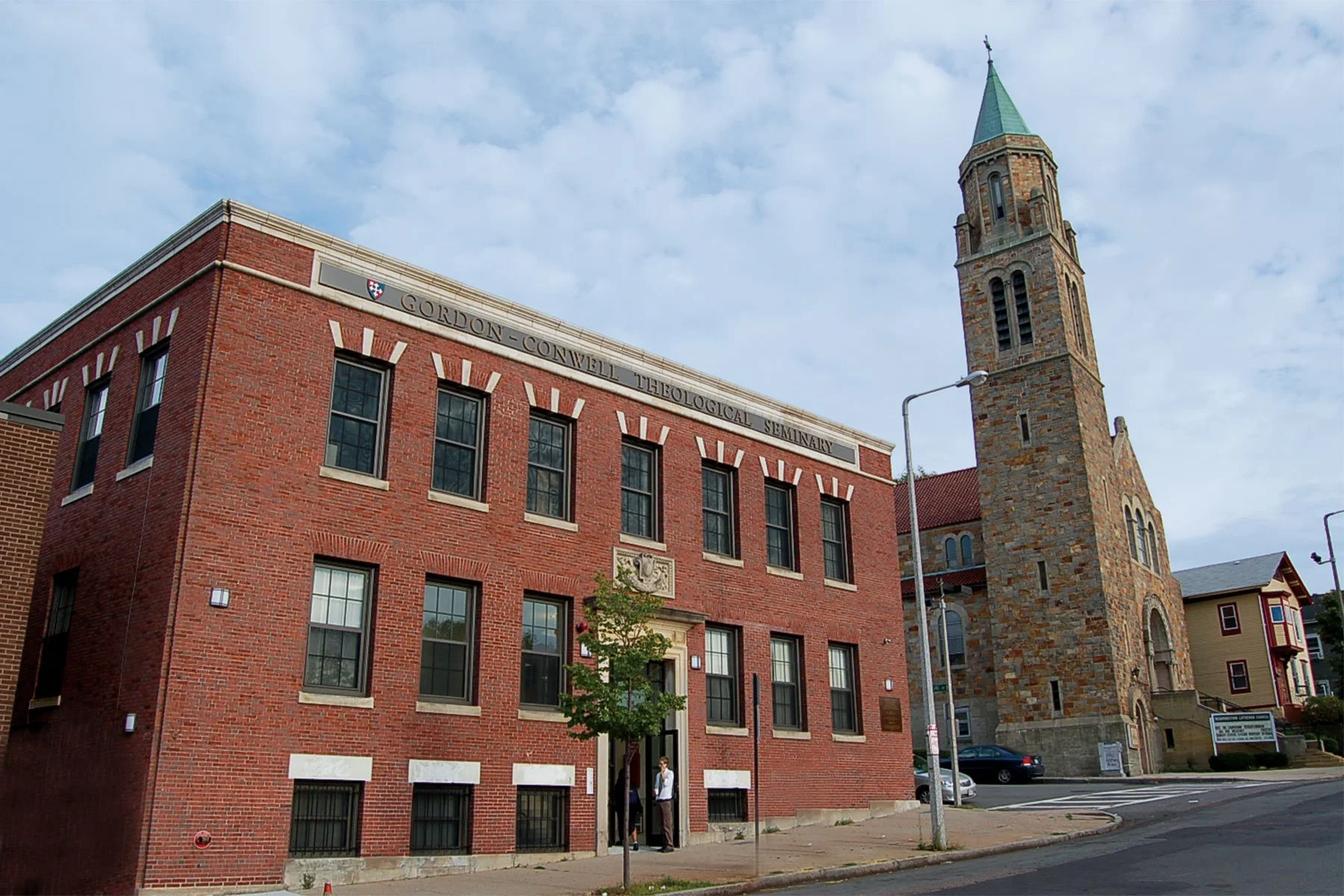
Center for Urban Ministerial Education, Roxbury, Massachusetts
The CUME program provided access to an accredited seminary education for Christian pastors and lay leaders who were called, gifted, and experienced in ministry, but, for socio-economic and other reasons, had been excluded from a residential program. Even if they could have attended a traditional seminary program, it would not have been contextualized to the needs of their urban and immigrant church ministries. The CUME program was located in the heart of the city,51 with a diverse administration and faculty, and offered contextualized coursework in Spanish, Portuguese, French (for Haitians), and English. All classes were held in the evenings and on weekends when bi-vocational leaders could attend. To reduce economic barriers, tuition was reduced, and scholarships were available. The student body included leaders from many backgrounds, including Hispanic, Black, Brazilian, Haitian, Chinese, Korean, and Anglo churches of many denominations. This had the added benefit of promoting interchurch fellowship and ministry collaboration.
By 1983, the program had 177 students from 104 churches, and in subsequent years it more than doubled in size. Over the years, CUME has offered certificate and diploma programs, as well as M.A., M.R.E., and Master of Divinity programs, along with Mentored Ministry for the practical application of coursework. The program has declined greatly in recent years, but much can be learned from the ideals and principles of this model of theological education.
Conclusion: A Legacy of Innovation
These individual stories of the beginnings of new schools and training programs for Christian leaders reveal educational innovations and adaptations that can inspire current theological education initiatives. In founding Harvard University in 1636, Boston-area leaders used the curricula and learning methods they were familiar with from Cambridge and Oxford Universities. However, as they developed the first institution of higher education in North America, they pioneered adaptations to the new environment and their limited resources. They also paved the way for other early colleges. The strengths of the English and early American collegiate forms of ministry training included active learning of effective reasoning, rhetoric, and logic; an emphasis on biblical study with training in Greek and Hebrew; and residential community life with tutors and devotional practices.
Especially in the eighteenth and early nineteenth centuries, pastoral mentoring was a vital form of ministerial education. This method had some limits tied to the pastor’s limited time, library, breadth and depth of knowledge, and teaching ability. However, pastoral mentoring had strengths, including personal interaction with the pastor and the opportunity to observe how he handled the trials and joys of life and ministry. Students also received practical instruction and opportunities to preach and serve in ministry with coaching and feedback. This personalized education was also well-suited to encourage personal spiritual growth.
The founders of Andover Theological Seminary (1807) sought to maintain traditional Reformed theology and biblical views in their training. However, Andover was innovative in establishing the first American model of a three-year, graduate-level residential seminary. This model was the prototype for scores of later theological seminaries. The strengths of this form of training, at least ideally, included providing distinguished professors with a depth of knowledge who could teach general and specialized courses and interact with students in class and out of class. In this type of residential seminary, students and faculty could focus much of their time on studies with less distraction. A residential seminary could provide a good library, residences, classrooms, and community life to encourage spiritual growth.
“These individual stories of the beginnings of new schools and training programs for Christian leaders reveal educational innovations and adaptations that can inspire current theological education initiatives.”
In the late nineteenth century, cities and their churches were rapidly growing, and the need for foreign missionaries increased as that movement expanded. These factors led to a need for new forms of accessible ministry training for those who couldn’t afford a full college and graduate seminary program. In response, Boston-area leaders founded some of the early Bible and missionary training institutes and schools. These were the early prototypes of the Bible School Movement. Faith Training College and the Boston Missionary Training Institute (later called Gordon College) offered shorter courses of study, with the advantage of preparing lay leaders and missionaries with free tuition, with low entry requirements, and with more practical, Bible-centered courses. Courses were offered for both men and women and were sometimes available in the evening. Several other area schools started as similar Bible institutes and, over the years, evolved into Christian colleges.
More recently, Boston-area leaders have developed ministry training programs contextualized to the changing city with its various social needs and growing immigrant populations. Gordon-Conwell Theological Seminary developed the Center for Urban Ministerial Education. Among its strengths were accredited classes in several languages, held in the evenings and on weekends to accommodate lay leaders and bi-vocational pastors, and reduced tuition costs. The model drew on principles of Theological Education by Extension and action-reflection learning to integrate ministry preparation with ongoing involvement in the students’ own churches. Course content and topics were designed to address the needs of the urban context. This innovative program also became a model for other cities.
While other models could be cited, these examples demonstrate how Boston and New England schools have built on the past and created new innovations in theological education. These efforts in training pastors, lay leaders, and missionaries have had a worldwide impact and paved the way for the founding of many other ministry training schools.
Appendix
The following list identifies the education and ministerial training of early Boston-area church leaders.
-
John Wilson, pastor at First Church of Boston, studied at Kings College at Cambridge (BA, 1610) and Emmanuel College at Cambridge (MA, 1613). Wilson served as a chaplain to prominent families, was a pastor in Sudbury, England, and also studied law.
John Cotton, teacher at First Church of Boston, studied at Trinity College at Cambridge (BA, 1603) and Emmanuel College at Cambridge (MA, 1606). Cotton studied another five years at Cambridge after 1606 and received a BD in 1613. He studied under William Perkins, was pastor of St. Botolph’s in Boston, England, and was a friend of Thomas Hooker at Emmanuel College.John Wheelwright studied at Sidney Sussex College at Cambridge (BA, 1614/1615; MA, 1618). Wheelwright served as vicar of Bilsby, England, and was a friend of John Cotton and Oliver Cromwell. In 1636, Wheelwright came to Boston but was later banished, along with his sister-in-law, Anne Hutchinson, in the Antinomian Controversy. He preached at the First Church of Boston on occasion but was not the pastor. He served in Wollaston/Quincy; Exeter, New Hampshire; and Wells, Maine.
-
John Maverick, pastor at First Church of Dorchester, studied at Exeter College at Oxford (BA, 1599; MA, 1603). Maverick served as a curate to his uncle Radford Maverick and then as rector of the church at Beaworthy, both in Devonshire, England.
John Warham (or Wareham), pastor at First Church of Dorchester, studied at St. Mary Hall at Oxford (BA, 1614; MA, 1618). He pastored churches in Crewkerne and later at St. Sidwell's, Exeter, England. In 1635, he led many of his Dorchester congregation to Windsor, Connecticut.
Richard Mather, pastor at First Church of Dorchester, studied at Braesnose College at Oxford. Mather attended Oxford but did not graduate. He served as a master of two English schools and preached at Toxteth, Liverpool. He was the father of Increase and grandfather of Cotton Mather. -
Thomas Welde, pastor at First Church of Roxbury, studied at Trinity College at Cambridge (BA, 1613-1614; MA, 1618). Welde served as a minister in Terling, Essex, England, and as the first pastor at Roxbury from 1632 to 1641. He was an overseer of Harvard College and helped produce the Bay Psalm Book. He later returned to England.
John Eliot, pastor and teacher at First Church of Roxbury, studied at Jesus College at Cambridge (BA, 1622). Eliot served as a teacher with Thomas Hooker in England. Known as the “Apostle to the Indians,” he came to Boston in 1631. -
Thomas Hooker, pastor at First Church of Cambridge (Newton), studied at Emmanuel College at Cambridge (BA, 1608; MA, 1611). Hooker held the Dixie Fellowship at Cambridge until 1619. He served in St. George’s Church in Escher and St. Mary’s Church in Chelmsford, England. In 1636, he led a group to found Hartford, Connecticut.
-
Thomas James, Sr., pastor at First Church of Charlestown (1632-1634), studied at Emmanuel College at Cambridge (BA, 1615; MA, 1618). James served in Charlestown from 1632 to 1634 and then pastored in New Haven, Connecticut, before returning to England.
Zechariah Symmes, pastor at First Church of Charlestown (1634-1671), studied at Emmanuel College at Cambridge (BA, 1620/1621; MA, 1624). Symmes served as a teacher at St. Antholin, London, and as rector of Dunstable, Bedfordshire, before emigrating to Boston in 1634.
John Harvard, assistant minister at First Church of Charlestown, studied at Emmanuel College at Cambridge (BA, 1631/1632; MA, 1635). Harvard arrived in Charlestown in 1637, where he became a teacher and assistant pastor. He donated his library and half his estate to the college that was later named for him.
-
George Phillips, pastor at First Church of Watertown, studied at Caius College at Cambridge (BA, 1613; MA, 1617). Phillips served as vicar of Boxted, Essex, England. He came with Saltonstall to found Watertown in 1630, and later became an overseer of Harvard.
-
John Allin, pastor at First Church of Dedham, studied at Caius College at Cambridge (BA, 1615; MA, 1619). Allin served as curate of the parish church at Wrentham, England. He came to Dedham in 1637 and founded the First Church of Dedham.
-
Roger Williams, pastor at Church at Plymouth and First Church of Salem, studied at Pembroke College at Cambridge (BA, 1627). After he was banished from Massachusetts in late 1635, Williams began Providence Plantations in 1636. In 1638, he formed the First Baptist Church in America. He was first a Puritan and then a Separatist.
-
Nathaniel Eaton, first master and teacher at Harvard, studied at Trinity College at Cambridge (BA), the University of Franeker, and the University of Padua (MD, PhD, 1647). Eaton studied under the Puritan theologian, William Ames, at the University of Franeker. He was (Head)Master at Harvard after its founding from ~1637 to 1639.
Henry Dunster, president of Harvard and interim pastor of First Church of Cambridge, studied at Magdalene College at Cambridge (BA, 1631; MA, 1634). Dunster served as curate at the Church of St. Mary the Virgin, Bury, England. He was the first president of Harvard (1640-1654) and pastored the First Church of Scituate, Massachusetts.
Charles Chauncy, second president of Harvard and pastor at Plymouth and Scituate, Massachusetts, studied at Trinity College at Cambridge (BA, 1614; MA, 1617). Chauncy served vicar of St. Mary’s Church, Ware, and vicar of Marston St. Lawrence, Northamptonshire, England. He served as president of Harvard from 1654 to 1672.
Footnotes
- The “Old Schools” were groups of older buildings used for university-wide lectures, disputations, libraries, and administration. They were distinct from the colleges where students and tutors lived, ate, and listened to what were called private lectures.↩︎
- William T. Costello, The Scholastic Curriculum at Early Seventeenth Century Cambridge (Cambridge, Mass.: Harvard Univ. Press, 1958), 12.↩︎
- Ibid., 13.↩︎
- Ibid., 8.↩︎
- Ibid.↩︎
- New England’s First Fruits (London: R.O. and G.D. for Henry Overton, 1643).↩︎
- New England’s First Fruits., for the 1642 Statutes of Harvard, and see also the 1655 “Lawes of the Colledge published publiquely before the Students of Harvard Colledge,” Colonial Society of Massachusetts, accessed 9 Dec. 2025, https://www.colonialsociety.org/node/429. These statutes give more details than the above summary about the studies and requirements in the early years of Harvard.↩︎
- Roger Geiger, “The First Century of the American College: 1636-1740,” in The History of American Higher Education: Learning and Culture from the Founding to World War II (Princeton, N.J.: Princeton University Press, 2016), 7.↩︎
- Preamble to the Collegiate School’s First Charter, approved by the General Court of the Colony of Connecticut (the Connecticut legislature), 1701.↩︎
- Geiger, 11.↩︎
- Walter C. Bronson, The History of Brown University 1764-1914 (Providence, R.I.: Brown University, 1914), 129.↩︎
- Ibid., 103.↩︎
- George M. Marsden, Jonathan Edwards: A Life (New Haven, Conn.: Yale University Press, 2003), 250-51.↩︎
- Leonard Woods, History of the Andover Theological Seminary (Boston: James R. Good, & Company, 1885), 19-20.↩︎
- Ibid., 21-22.↩︎
- Ibid., 19-24.↩︎
- Leonard Woods, History of the Andover Theological Seminary (Boston: James R. Good, & Company, 1885).↩︎
- Ibid., 153.↩︎
- Ibid., 160-161.↩︎
- Ibid.↩︎
- Ibid., 137.↩︎
- Board of Trustees, Newton Theological Institute: A Sketch of Its History (Boston: Gould and Lincoln, 1866), 6-7.↩︎
- Ibid., 11.↩︎
- Margaret Bendroth, A School of the Church: Andover Newton across Two Centuries (Grand Rapids, Mich.: Eerdmans, 2008), 29.↩︎
- General Catalogue of the Theological Institute of Connecticut at East-Windsor, 1843 (Hartford: Elihu Geer, 1843), 14.↩︎
- Ibid., 15.↩︎
- David B. Potts, Wesleyan University: 1831-1910 (Middletown, Conn.: Wesleyan University Press, 1992), xv.↩︎
- “A People’s History of the School of Theology,” Boston University website, https://www.bu.edu/sth-history/graduates/concord-students/.↩︎
- Ibid., https://www.bu.edu/sth-history/alphabetical-index/albert-l-long-1857/. (For example, Albert L. Long, class of 1857, became a missionary to Bulgaria.)↩︎
- Annual Report of the School of Theology of Boston University, 1873. (Cambridge, Mass.: Riverside Press, 1873), 18.↩︎
- “Anna E. Hall, (1870-1964): Long-Time African-American Missionary Educator In Liberia,” Boston University School of Theology, History of Missiology, March 2020, https://www.bu.edu/missiology/2020/03/02/hall-anna-e-1870-1964/.↩︎
- James Arthur Muller, The Episcopal Theological School: 1867-1943 (Cambridge, Mass.: Episcopal Theological School, 1943), 8.↩︎
- Ibid., 31-32.↩︎
- Ibid., 45.↩︎
- Phillip Douglas Chapman, “The Whole Gospel for the Whole World: A History of the Bible School Movement within American Pentecostalism, 1880-1920” (Ph. D. thesis, Michigan State University, 2008), 105-6.↩︎
- Nathan R. Wood, A School of Christ (Boston: Halliday Lithograph, 1953), 11-12.↩︎
- Ibid., 25.↩︎
- Ibid., 27. (Only about 150 students completed the full two-year course of study.)↩︎
- L. L. Doggett, History of the Boston Young Men’s Christian Association (Boston: Young Men’s Christian Association, 1901), 43.↩︎
- Ibid.↩︎
- Donald Dewart, Educational Institutions of New England (Boston: Bellman Publishing Company, 1946), 127.↩︎
- Gordon College, “The History of Barrington College,” https://www.gordon.edu/about/history/barrington-history, accessed 14 Jan. 2026.↩︎
- “Northpoint History,” Northpoint College Student Handbook (2020-2021), 5. https://northpoint.edu/wp-content/uploads/2021/01/2020-2021-Student-Handbook.pdf.↩︎
- Currently this degree program offers concentration on pastoral leadership, preaching and spiritual formation.↩︎
- Garth M. Rosell, Boston’s Historic Park Street Church (Grand Rapids, Mich.: Kregel Publications, 2009), 142.↩︎
- Ibid., 42-43.↩︎
- Ibid., 44.↩︎
- These principles were illustrated with the analogy of a fence: (1) local weekly group meetings served as the fence posts; (2) independent self-study often using programmed texts between group meetings served as one fence rail; and (3) immediate practical ministry application served as the second fence rail.↩︎
- Eldin Villafane and Rudy Mitchell, “The Center for Urban Ministerial Education,” Urban Mission 2, no.2 (Nov. 1984):32.↩︎
- Ibid., 35.↩︎
- Some classes were also held in Lawrence, Springfield and New Bedford, Massachusetts.↩︎
Bibliography
“Anna E. Hall, (1870-1964): Long-Time African-American Missionary Educator in Liberia,” Boston University School of Theology, History of Missiology, March 2020, https://www.bu.edu/missiology/2020/03/02/hall-anna-e-1870-1964/.
Annual Report of the School of Theology of Boston University, 1873. Cambridge, Mass.: Riverside Press, 1873.
Bendroth, Margaret. A School of the Church: Andover Newton across Two Centuries. Grand Rapids, Mich.: Eerdmans, 2008.
Board of Trustees. Newton Theological Institute: A Sketch of Its History. Boston: Gould and Lincoln, 1866.
Bronson, Walter C. The History of Brown University: 1764-1914. Providence, R.I.: Brown University, 1914.
Chapman, Phillip Douglas. “The Whole Gospel for the Whole World: A History of the Bible School Movement within American Pentecostalism, 1880-1920.” Ph. D. thesis, Michigan State University, 2008.
Costello, William T. The Scholastic Curriculum at Early Seventeenth Century Cambridge. Cambridge, Mass.: Harvard Univ. Press, 1958.
Dewart, Donald. Educational Institutions of New England. Boston: Bellman Publishing Company, 1946.
Doggett, L. L. History of the Boston Young Men’s Christian Association. Boston: Young Men’s Christian Association, 1901.
Geiger, Roger. ”The First Century of the American College: 1636 -1740,” in The History of American Higher Education: Learning and Culture from the Founding to World War II. Princeton, N.J.: Princeton University Press, 2016.
General Catalogue of the Theological Institute of Connecticut at East-Windsor, 1843. Hartford: Elihu Geer, 1843.
Gordon College. “The History of Barrington College.” https://www.gordon.edu/about/history/barrington- history, accessed 14 Jan. 2026.
“Lawes of the Colledge published publiquely before the Students of Harvard Colledge,” 1655. Colonial Society of Massachusetts, accessed 9 Dec. 2025, https://www.colonialsociety.org/node/429.
Marsden, George M. Jonathan Edwards: A Life. New Haven, Conn.: Yale University Press, 2003.
Morison, Samuel Eliot. The Founding of Harvard College. Cambridge, Mass.: Harvard University Press, 1935.
Muller, James Arthur. The Episcopal Theological School: 1867-1943. Cambridge, Mass.: Episcopal Theological School, 1943.
New England’s First Fruits. London: R.O. and G.D. for Henry Overton, 1643.
“Northpoint History,” Northpoint College Student Handbook: 2020-2021. https://northpoint.edu/wp-content/uploads/2021/01/2020-2021-Student-Handbook.pdf
“A People’s History of the School of Theology, Boston University website, https://www.bu.edu/sth-history/graduates/concord-students/.
Potts, David B. Wesleyan University: 1831-1910. Middletown, Conn.: Wesleyan University Press, 1992.
Preamble to the Collegiate School’s First Charter, approved by the General Court of the Colony of Connecticut (the Connecticut legislature), 1701.
Rosell, Garth M. Boston’s Historic Park Street Church. Grand Rapids, Mich.: Kregel Publications, 2009.
Villafane, Eldin, and Rudy Mitchell. “The Center for Urban Ministerial Education,” Urban Mission 2, no.2 (Nov. 1984):32.
Wood, Nathan R. A School of Christ. Boston: Halliday Lithograph, 1953.
Woods, Leonard. History of the Andover Theological Seminary. Boston: James R. Good, & Company, 1885.

Calzados con el Evangelio de la Paz
Cuando una parte del cuerpo sufre, todas las demás sufren con ella. ¿Cómo se ve el hecho de presentarnos con esperanza junto a las personas migrantes en un tiempo de miedo y desconexión?
(En el sentido de las agujas del reloj desde la parte superior izquierda: Welcomia, Denis Tangney Jr, captain_galaxy, YT, todos vía Getty Images)
Calzados con el Evangelio de la Paz
Una caminata de oración, un sueño profético y un llamado a solidarizarse con nuestros hermanos y hermanas migrantes
por Sarah Blumenshine, Directora de Ministerios Interculturales
Una de las bellezas de mi trabajo es conectar profundamente con comunidades migrantes en Boston y sus alrededores. Este verano, he estado participando en llamadas regulares de oración matutina dirigidas por el equipo de Agencia ALPHA a través de Zoom. En una de esas llamadas, el Pastor Sergio Pérez de Harvest Ministries en Weymouth nos invitó a una próxima caminata de oración en la ciudad de Lynn. El sábado siguiente, unas doce personas nos reunimos. Pastores se unieron con familias y personas mayores. Todos estábamos allí con un solo propósito: orar por protección y bendición sobre la ciudad.
Antes de dividirnos en grupos y comenzar a caminar, el Pastor Sergio compartió un sueño que había tenido hace más de 15 años. El sueño se desarrollaba en una esquina específica de Lynn. Exactamente lo que está sucediendo ahora en todo el país estaba ocurriendo en su sueño. Agentes estaban deteniendo a migrantes y subiéndolos a un autobús. Las familias estaban aterrorizadas, tratando de escapar. En el sueño, el Pastor Sergio se acercaba a los agentes y les decía que tuvieran cuidado. Les afirmaba que los migrantes tienen dignidad y humanidad, y merecen ser tratados con decencia. Los agentes parecían hacer una pausa y mostraban cierta conmoción, y entonces el Pastor Sergio despertó. El sueño se sintió tan real que se le quedó grabado.
Cuando nos emparejamos y elegimos una ruta para caminar, el Pastor Sergio se dirigió hacia la esquina que había visto en su sueño. Yo caminé junto a Patricia Sobalvarro, Directora Ejecutiva de Agencia ALPHA, y la Pastora Ramonita Mulero de la Iglesia Hispana de la Comunidad. Juntas comenzamos a caminar hacia el supermercado Market Basket cercano, donde muchos migrantes encuentran empleo. Oramos en base a lo que dice Efesios 6:10-18, de ponernos la armadura de Dios, pidiendo verdad, fe y protección que no proviene de nuestro propio esfuerzo, sino de la asombrosa bondad de Dios.
Algo me impactó y no lo había visto antes. Siempre había asociado este pasaje con la defensa espiritual. Pero esta vez, la instrucción de estar firmes “con los pies calzados con la disposición de proclamar el evangelio de la paz” me llegó de una manera fresca. ¡Incluso en la batalla contra la oscuridad espiritual, se nos dice que usemos un calzado que nos lleve rápidamente a compartir las buenas nuevas de la paz! Tal esperanza, incluso certeza.
Mientras caminábamos, pasamos por tiendas de inmigrantes, casas y apartamentos. Recordamos el pasaje en Éxodo donde Dios les dice a los israelitas que pinten con la sangre de un cordero los marcos de sus puertas como señal para que el ángel de la muerte pasara de largo, perdonando así a sus primogénitos. Cubrimos hogares, negocios, aceras e iglesias con ruegos por protección física, orando para que la violencia pasara de largo.
Patricia compartió una reflexión sobre la historia de los israelitas finalmente expulsados de Egipto, solo para que el faraón cambiara de opinión. Envió carros y soldados para perseguirlos y esclavizarlos de nuevo. Mientras tanto, los israelitas se acercaban al Mar Rojo sin ningún lugar a dónde ir. Patricia comentó que a menudo se ha preguntado cómo se habría sentido en ese momento. Cada paso hacia ese cuerpo de agua infranqueable habría parecido una sentencia de muerte. Y entonces, Dios abrió un camino completamente impensable a través del mar. Oramos por ese tipo de milagros, reconociendo que no veíamos salida, pero sabiendo que Dios ciertamente sí.
“Pónganse toda la armadura de Dios, para que cuando llegue el día malo, puedan resistir hasta el fin con firmeza. Manténganse firmes, ceñidos con el cinturón de la verdad, protegidos por la coraza de justicia, y calzados con la disposición de proclamar el evangelio de la paz.”
Al regresar al estacionamiento de la iglesia, cada grupo compartió algunas palabras sobre su experiencia. Otro pastor presente comenzó a compartir, primero con todo el grupo, y luego se dirigió específicamente a mí. Como todavía estoy aprendiendo español, solo entendí una fracción de su testimonio, pero sé que nuestros corazones se entendieron. Habló con tanta pasión que comenzó a llorar.
Cuando el pastor terminó de hablar, el Pastor Sergio me preguntó cuánto había entendido. Al ver mi incertidumbre, amablemente tradujo sus palabras. Explicó que mi presencia—y lo que represento como ciudadana nacida en Estados Unidos—tenía un peso particular. Contó cómo muchos migrantes se sienten aislados e invisibles para los demás. Se sienten invisibles para sus hermanos y hermanas cristianos en este país. El hecho de que alguien de ese contexto viera su sufrimiento y caminara junto a ellos fue abrumador para el pastor que compartió. El Pastor Sergio lo comparó con la historia del político británico William Wilberforce, quien, a pesar de sus privilegios y comodidades, se identificó con la lucha de las personas esclavizadas y se convirtió en un defensor en contra de la esclavitud.
Me quedé atónita. No había hecho nada extraordinario; simplemente me había presentado para orar, lado a lado con mis hermanos y hermanas. La verdad es que se sintió como lo mínimo que mis hermanos espirituales deberían esperar. Jesús nos dijo que nos amáramos los unos a los otros como a nosotros mismos. La geografía, las fronteras internacionales, las leyes humanas—todas son importantes. Pero ninguna de ellas nos impide ser parte de la misma familia, del mismo cuerpo.
“Los miembros del cuerpo no deben dividirse,” escribe Pablo en 1 Corintios 12:25-26. “Todos deben preocuparse los unos por los otros. Si un miembro sufre, todos los demás comparten su sufrimiento. Si un miembro es honrado, todos los demás comparten su alegría.”
Últimamente, tengo en mi mente la imagen de la Iglesia en los Estados Unidos como un cuerpo humano que sufre de neuropatía. Nuestro sistema nervioso, la red que transmite sensaciones, información y genera retroalimentación, está dañado. Nuestra capacidad para percibirnos unos a otros está desordenada. Me imagino a alguien de pie junto a una estufa caliente, con la mano sobre el quemador, completamente inconsciente de que su piel y tejido se están quemando hasta que huele a carne quemada—pero para entonces, el daño ya está hecho.
Amigos, hay partes del cuerpo de Cristo que están en llamas. No exagero. Yo soy un nervio que transmite impulso y efecto. Soy testigo de esa agonía. Somos pobres en relaciones que cruzan líneas culturales. Nuestra distancia relacional nos permite deshumanizar al “otro.” Olvidamos que somos una familia. Fallamos en ver que nuestro bienestar está entrelazado.
“Este cuerpo de Cristo necesita desesperadamente sanidad. Está en guerra consigo mismo. La sanidad comienza dentro de cada uno de nosotros. ¿Qué tipo de fruto estoy cultivando en la sustancia de mi alma? En las comunidades de las que formo parte, ¿estamos juntos buscando el florecimiento de todas las personas?”
El nivel actual de caos en el gobierno federal es una cortina de humo que oscurece aún más nuestra visión. Algunos de nosotros hemos creído la mentira de que la ley y el castigo son justos, pero la compasión es solo para quienes la merecen. Esta falsedad es contraria a la vida y el ministerio de Jesús.
Las leyes tienen su propósito en una sociedad que funciona bien, sin duda. Si estamos impulsados por el amor y la alegría, llenos del fruto del Espíritu, trabajaremos con otros para corregir leyes inmorales y aplicarlas con justicia.
En contraste, hoy el fruto de nuestras políticas y poder se exhibe de manera grotesca. Cada ser humano que sufre en un centro de detención sin recursos legales, cada persona deportada a un país que no es el suyo, cada arresto imprudente, cada niño que llora por sus padres ausentes—no podemos simplemente descartarlos como daños colaterales. Son el fruto del miedo, el resentimiento, la autosuficiencia moral y el deseo de dominar. Esto es lo que sucede cuando las leyes se utilizan como herramientas de opresión.
Este cuerpo de Cristo necesita desesperadamente sanidad. Está en guerra consigo mismo. La sanidad comienza dentro de cada uno de nosotros. ¿Qué tipo de fruto estoy cultivando en la sustancia de mi alma? En las comunidades de las que formo parte, ¿estamos juntos buscando el florecimiento de todas las personas?
Recordamos a nuestros hermanos escuchándonos los unos a otros. Dedicamos el tiempo y la atención necesarios para comprendernos. Elegimos dar pasos simples pero significativos, como unir nuestros corazones en oración. Estos hábitos son transformadores y generan nuevos puntos de conexión que poco a poco nos ayudan a reparar lo que se ha roto.
Al comprometernos con este estilo de vida, cada uno haciendo su parte, honrando el dolor del otro y celebrando las alegrías de los demás, comenzamos a experimentar el cuerpo como Dios lo diseñó. El plan de Dios es que la Iglesia sea un agente de esperanza, sanidad y reconciliación, tanto interna como externamente. Que así sea.


Church Landscape Review: Pressed But Not Crushed
What makes for a resilient church over a decade of challenges?
Church Landscape Review: Pressed But Not Crushed
Survival, Resilience & Church Plants of Boston Area New Churches, 2014-2024
Churches share similarities with families, schools, and businesses. Pastors take on roles that often mirror those of parents, teachers, and managers. But at the end of the day, the Church is an entirely different entity. It is a creation of God, entrusted with a ministry of life empowered by his Spirit. That’s why—even amid pressure, hardship, or loss—resilience is possible.
“We are hard pressed on every side, but not crushed,” Paul writes in 2 Corinthians 4:8-9. “Perplexed, but not in despair; persecuted, but not abandoned; struck down, but not destroyed.”
And as jars of clay holding the treasure of the gospel, we demonstrate that this “all-surpassing power is from God and not from us” (2 Corinthians 4:7).
A large group of newer church communities in Boston is evidence of what happens when churches ground themselves in this spiritual reality.
The churches that survived those ten years demonstrated several key dynamics:
Their pastors had clear personal callings and support from mentors and peer groups.
They overcame challenges by following the concrete solutions that arose when they sought the Holy Spirit’s guidance.
They started with various outside sources of funding and ensured their pastors didn’t need to work a full-time job outside the church.
They didn’t wait until they thought they were big enough to plant another church. They made an early and ongoing commitment to multiplication.
These are just a few findings of the Applied Research team at the Emmanuel Gospel Center in Pressed But Not Crushed: Survival, Resilience & Church Plants of Boston Area New Churches, 2014-2024.
This report is part of the 2025 Church Landscape Review project, which revisits the churches the team had originally interviewed as church plants in a 2014 research study. That project involved in-depth interviews with a diverse group of new churches from different denominations, ethnic groups, and networks.
Ten years later, EGC revisited the 2014 snapshot and re-interviewed almost two dozen of the original churches to explore how the Boston-area church landscape has evolved over the past decade.
Like other reports in the project, Pressed But Not Crushed includes data, commentary, reflection questions, as well as next steps for ministry leaders.
Visit the Church Landscape Review project page for more information about the methods, participants, and terminology used in the study. There you will also find a series of reports we’re releasing periodically throughout 2025:


Church Landscape Review: Open Doors in Boston
Boston is often described as secular, but these stories from churches in the area will stir your faith and expand your vision for what God is doing in the city.

Open Doors in Boston
Local stories to stir your faith, reflections to expand your vision.
Boston is often described as a secular city on par with the metropolises of Europe that have seen a significant decline in Christianity. But research shows a different narrative emerging.
The Applied Research team at the Emmanuel Gospel Center conducted the Church Landscape Review project in 2024. In this survey of new and growing churches across Greater Boston, we found that God is at work in our city and region.
As part of the research, the team asked the pastors of these churches for stories of God working through the church to bring people to faith and serve people in the broader community.
The stories that emerged are varied and beautiful—stories of healing, community partnerships, long journeys to faith, and moments of encounter with God. They reflect what is possible when churches open their doors and hearts to their neighborhoods, step into the needs around them, and follow God’s lead with creativity and courage.
Each story includes a reflection question to help you engage more deeply. Whether you’re a church leader, an aspiring church planter, or simply someone curious about the spiritual landscape of this city, we hope these questions invite you to pray, reflect, and imagine what God might do in your context.
As you read, please note that names and identifying details of people, churches, and organizations have been changed or omitted to protect privacy.

What's Next: My 5 Dreams For Church Planting in Boston
Rev. Ralph Kee, animator of the Greater Boston Church Planting Collaborative, has been giving a lot of thought to this idea: What may be the Church’s dreams for Boston for the next few decades? What should be the Church’s priorities? Where are the Church’s growth edges? In this article, Ralph offers his own five basic ideas, his five dreams about church planting for Boston’s future.
What’s Next: My 5 Dreams for Church Planting in Boston
by Rev. Ralph Kee, Animator, Greater Boston Church Planting Collaborative
Where are we headed as the Church in Boston? What might be some goals, dreams, and potential growth points for the Body of Christ in Boston over the next several decades?
As I’ve engaged with the Boston 2030 initiative, I’ve been giving a lot of thought to what it means for Christians in the next several decades. Here are my dreams about Boston’s church planting future:
Dream #1: Holistic Churches Multiplying Churches
I see Boston filled with Gospel-permeated, holistic churches.
By holistic churches, I mean those that serve the city with the whole Gospel by ministering to the whole person. I think that’s what God dreams and wants for Boston, because that’s what he wants for all his created people. Paul writes, “God has made known to us the mystery of his will,” and his will is “to bring all things together in Christ, both things in the heavens and things on the earth.” (Eph. 1:9,10)
Learn More: Where to Plant a Church in Boston: Areas of Growth
Boston is staged to grow. I moved to a Boston of 641,000 in 1971. By Boston’s 400th birthday in 2030, the population is expected to jump to 724,000 or more. In light of this growth, we at the Greater Boston Church Planting Collaborative have been asking two key questions:
Where will these new Bostonians live? Whole new neighborhoods are underway to house several thousand people each, all within Boston’s city limits.
Where will these new Bostonians go to church? Will the Church be ready? Who will lead the way in envisioning new expressions of the Church for new Bostonians? The apostolic task of the Church, a leading task from Ephesians 4:11, is to multiply communities of faith—churches multiplying churches. Let’s do it!
Learn More: Multiplying Churches in Boston Now
Dream #2. Both Gentrifiers and Born-Bostonians Playing a Part
I see Gospel-entrenched gentrifiers and neighborhood-based Christian activists together salting the city.
Boston is becoming more and more gentrified. Researchers spot gentrification where census tracts show increases in both home values and in the percentage of adults with bachelor’s degrees. I’ve had to come to terms with the fact that in the neighborhood where I’ve lived for 46 years, I, too, am a gentrifier.
Today, gentrifiers include young Christian professionals moving into older neighborhoods all over the city to be salt and light, to love their neighbors, to do Jesus-style thinking and living in their neighborhoods. These folks can be “entrenched gentrifiers,” incoming residents who, in their own minds and hearts, want to appreciate and have purposeful “attachment to the local meanings, heritage, history, and people” they are now living near.
For example, intentional Christian communities—where several families or singles live together in shared commitment to each other and to their neighbors—are flourishing.
Boston’s “Gospel-entrenched gentrifiers”, as I call them, are not pioneers, but reinforcements. They join embedded Kingdom builders—second-, third-, and many-generation Bostonians—Christ-followers who are dreaming big dreams for their neighborhoods.
“Boston’s Gospel-entrenched gentrifiers, as I call them, are not pioneers, but reinforcements.”
One such Kingdom builder is Caleb McCoy, a fourth-generation Dorchester resident and EGC’s Development Manager. Caleb has a homegrown knowledge of and love for the city. He says, “I believe my role in the church is to help make the Gospel relevant and personal to people that may not feel that God’s plan applies to them.”
Caleb’s vision is to use his musical and communications gifts to inspire “a revival of young and middle-aged adults, joined together, exemplifying the Gospel through preaching and the arts.”
I am excited about Caleb’s vision. I have a dream that such neighborhood-based Christian activism will be the engine to drive effective ministry today and tomorrow.
Dream #3. Relevant, Hands-On Ministry of Reconciliation
I see today’s Boston’s Kingdom citizens reconnecting what has been severed by sin.
I am dreaming that Boston’s visionary, prophetic Christians will, with God-inspired imagination, help build new communities of faith. These newly imagined churches will demonstrate the Kingdom of God in today’s urban context.
The prophetic task, as I see it, is to cast a vision for a redeemed creation. Empowered by the Spirit of God, today’s prophets can work to reconnect what was disconnected by sin.
When sin entered the world, it entered the whole world—not just the human heart, but the very heart of the created order. Original sin instantly caused four original schisms (Learn More: The Prophetic Task):
humanity separated from God
humanity separated from the created order
man separated from woman
people separated from people
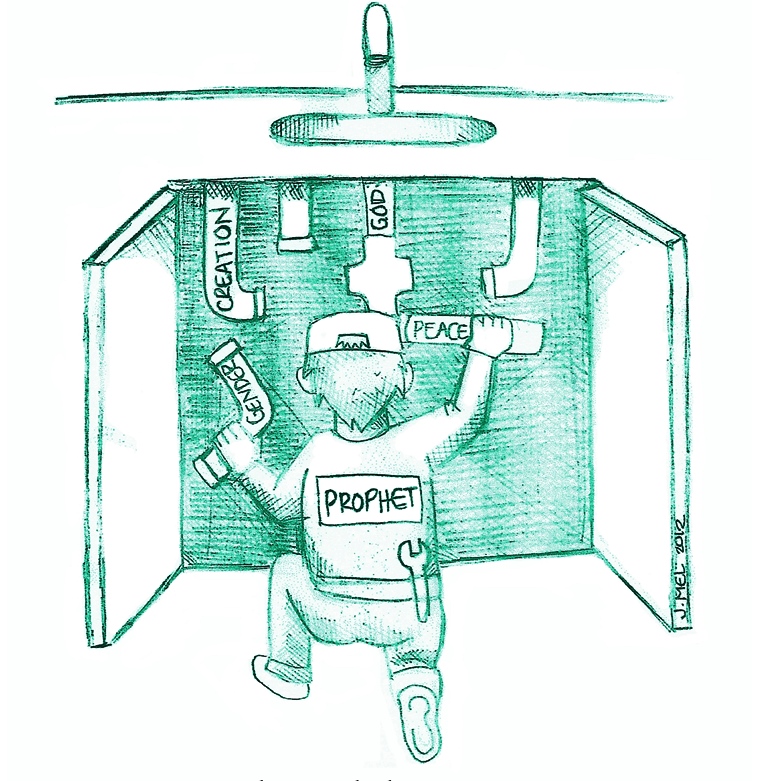
What is to be done about these painful schisms? Thankfully, they are all resolved in Christ, as we the Church fulfill the prophetic task! We proclaim the Kingdom of God, and partner with God in his work of connecting, redeeming, healing, and bringing Kingdom-of-God life and peace to every facet of Boston.
Consider the refugees coming to Boston today. What will they find? Will they experience more schism in their torn lives? Or will some neighborhood church in Boston welcome them, embrace them as valued people loved by God, and begin to effectively reverse the curse of schisms in their lives by loving them well? (Learn more: Greater Boston Refugee Ministry).
And if some Boston residents were to observe Christians living in their neighborhood, reversing the curses of the four schisms, would these observers not be more ready to listen to the spoken Gospel message?
Dream #4: The Good News Proclaimed in Boston’s Heart Languages
I believe God is calling evangelists to speak the Gospel in the languages of Boston.
I want to see Boston gifted with many evangelists, men and women who can speak and live out the Gospel in the languages of Boston’s old-timers, of second- and third-generation Southies, or Townies, or Dorchesterites. Who will speak the Gospel to:
the retired men of South Boston who hang at the coffee shop every day?
the women who gather at Ramirez Grocery or Rossi Market?
the generations of men and boys who gather at the corner barbershop?
the freshmen or grad students at BU or BC or MIT?
those who speak the 100+ languages of newcomers arriving from the four corners of the earth?
We know the Gospel is two handed: word and deed. We need to do both: preach the Word and do the Gospel.
Today particularly, we need to be careful not to focus only on meeting basic needs and neglect preaching. One follows the other. After neighborhoods see the Gospel in action, I think they will be more ready to have someone fully explain it to them and invite them to believe in Jesus themselves. Show and tell.
Who of those already living in Boston are called to evangelistic preaching in Boston specifically? Who yearns to spend their lives preaching the Gospel in Boston? Do you?
In Romans, Paul asked, “And how can they believe in the one of whom they have not heard? And how can they hear without someone preaching to them? And how can anyone preach unless they are sent? As it is written: ‘How beautiful are the feet of those who bring good news!’” (Rom. 10:14,15)
Dream #5. Church Planters Collaborating Closely
I want to see church planters in Boston thinking of themselves as players on a Boston-wide team.
The Greater Boston Church Planting Collaborative started gathering in 2000, and we chose the word “collaborative” intentionally. In the Book of Acts, the story of early church planting, we see nothing but collaborative ministry efforts. One church, one basic team, one overarching goal everyone shared and worked toward—that’s the Acts of the Apostles.
Collaboration is basic to church planting—and so it should be in Boston. I want to see Boston’s church planters meeting face-to-face, setting shared goals, being mutually accountable, and being passionately focused.
I imagine church planters setting Boston-wide church-growth and church-planting goals collaboratively. I envision shared strategies to cover ground and to plan over time—setting 6-month, 12-month, 2-year, and 15-year goals.
“How long will it take you to build the wall, Nehemiah?” King Artaxerxes asked (Neh 2:6). Nehemiah, a slave in a foreign land under a tyrant, was the last person in a position to guarantee any purpose-driven time goals. But he did set a time goal for Artaxerxes because he had to. And they met it—the collaboration of faithful residents working side by side in Jerusalem finished the wall in fifty-two days!
Let’s collaborate, set some prayerful goals, and see the work get done!
To see the full-length article, click here: I’m Dreaming About Boston’s Future—Are You?
TAKE ACTION
So those are my five big church planting dreams for Boston. What do you think? Are you dreaming with me? Dream big! When we get some more ideas, we’ll share them in a future post. Send me an email—I would love to hear from you.
Are you a church planter? I invite you to join us at the Greater Boston Church Planting Collaborative!

Ralph Kee came to Boston in 1971 to help plant a church emerging out of the Emmanuel Gospel Center’s neighborhood outreach. Starting churches became his clear, lifelong calling. He was involved in launching or revitalizing dozens of churches in and around Boston. In 2000, Ralph started the Greater Boston Church Planting Collaborative, a peer mentoring fellowship to encourage and equip church planters. He mentored church planters, mostly one-on-one, usually over coffee for many years. He passed away on February 4, 2026, at the age of 90.


Keywords
- #ChurchToo
- 365 Campaign
- ARC Highlights
- ARC Services
- AbNet
- Abolition Network
- Action Guides
- Activism
- Administration
- Adoption
- Aggressive Procedures
- Andrew Tsou
- Annual Report
- Anti-Gun
- Anti-racism education
- Applied Research
- Applied Research and Consulting
- Asking for help
- Ayn DuVoisin
- Balance
- Battered Women
- Berlin
- Bianca Duemling
- Bias
- Biblical Leadership
- Biblical leadership
- Black Church
- Black Church Vitality Project
- Book Recommendations
- Book Reviews
- Book reviews
- Books
- Boston
- Boston 2030
- Boston Church Directory
- Boston Churches
- Boston Education Collaborative
- Boston General
- Boston Globe
- Boston History
- Boston Islamic Center
- Boston Neighborhoods
- Boston Public Schools
- Boston-Berlin
- Brainstorming
- Brazil
- Brazilian
- COVID-19
- CUME
- Cambodian








With limited meeting space in some of our cities, how do churches who practice their faith in different ways gather under the same roof and learn to love each other?