Showing Up for Racial Justice
Emmanuel Gospel Center
Showing Up for Racial Justice
Lessons l’m learning on the road to civic engagement.
by Megan Lietz, Founding Director, The Race & Christian Community Initiative
Joanne Bland spoke with wisdom and authority as she recounted her experiences as one of the youngest participants in the 1965 march from Selma to Montgomery. She recalled the events of Bloody Sunday and spoke of her community’s tireless efforts to help preserve this history and the voting rights so many had fought and bled to secure. As she concluded, a participant asked, “So, what should we be fighting for today?”
With clarity and conviction, Ms. Bland said, “The same thing we fought for back then.”
She said this in 2024. I couldn’t have imagined how true her words would ring today. We must keep fighting.
Many of the deeply rooted problems we see in our country won’t go away through personal transformation alone. The enduring issues that plague our nation are rooted in policies and social systems beyond our immediate control.
One way we can contribute to changing these systems is through civic engagement and political action. I believe these are tools Christians can use to continue Christ’s redemptive work and seek the kingdom of God.
As someone who cares deeply about addressing racial injustice, I’ve long had civic engagement on my radar as a way to make change. But as someone who was also raised as a white evangelical, I encountered obstacles to living out my faith by pursuing systemic change.
As someone still new to civic engagement, I wanted to reach back and share both the obstacles I encountered—and what helped me navigate them. By sharing some of the obstacles that I encountered, it’s my hope that my story might help others overcome their own barriers to civic engagement and encourage Christians to be more active participants in contributing to the change they want to see.
“I don’t know how to get started!”
This is something I often hear as I talk to white evangelicals; and trust me, I can relate. We didn’t talk about politics in my family growing up. At church, we were encouraged to make a difference for Jesus, but it was assumed that this would happen in our personal spheres. So when I desired to learn more about how to make social change and contribute to the dismantling of systemic racism, I felt like neither my family nor my church had equipped me to enter the civic sphere.
As I sought to learn, I realized I didn’t even know how to get started. I wasn’t sure how change happens or how to get involved. What’s more, I didn’t see others from my evangelical background working to address systemic racism. I didn’t have examples from my own tradition to follow or a pathway from within my community to help me learn.
I lamented that the community I had come to love didn’t speak into matters so close to God’s heart. I lamented the narrow view of God’s redemptive work that had come to inform our practice. I lamented how I felt I needed to leave my people and my homeland in order to more faithfully follow Jesus in a multiracial world.
Sometimes, as Christians, we can feel deeply about something, but let practical barriers keep us from responding to our convictions. I wanted to get involved, but felt I didn’t know how. It was hard enough for me to carve out time to take action. So, finding time to learn about civic engagement felt like a learning curve I just didn’t have the capacity to climb.
But herein lies my first faulty assumption: That in order to get involved, I have to know before I go.
Especially as white people, we’re often used to being informed. To being the knowledge-holders. To having the privilege, before starting an endeavor, to get all our ducks in a row.
But with something as vast and complicated as contributing to systemic change, that’s an unrealistic expectation. While we should do our homework and do our best to be informed, we cannot let this be a barrier to engagement.
Instead of feeling that we need to know everything—or be embarrassed for not knowing—we simply need get started and learn as we go.
“I don’t need all the answers to get started. I can learn as I go. ”
So that’s what I did. I jumped in. I joined the meeting. Attended the rally. Helped people register to vote. I didn’t always know what I was doing. I often felt like the awkward new kid. I had to ask questions to figure things out. But I was there. And in being in the room, I’m learning lessons I can share, noticing gaps that need to be bridged, and beginning to discover pathways that, as imperfect as they may be, might provide next steps for those who come behind me.
Just start somewhere…
So if you want to get involved in civic engagement, I encourage you to just start somewhere. No, you don’t know everything. Yes, it will be awkward and clunky. And that’s OK.
Start at a place that feels accessible. Reach for the low-hanging fruit. It doesn’t have to be ideal; it just has to get you moving.
More specifically, I’d encourage you to start local. There are ample opportunities to participate in civic engagement in Greater Boston, many of which may connect with issues you’re experiencing in your own community. Action that feels proximate and contextualized can be easier to enter into, sustain, and understand.
Practical next step
Learn more about the following local organizations and join the newsletters of an org that interests you! Joining their newsletter will help you stay informed about upcoming learning and action opportunities.
Boston-based: Prophetic Resistance Boston
North Shore: Essex County Community Organizing
In my experience, as someone who jumped in with far less preparation than I would have liked, I found local groups to be welcoming and happy to answer questions. They even offer trainings to help people learn and grow.
This comes with two caveats, though: I came humbly, and I came to help. I didn’t come to lead—I came to learn. And I learned through action. I wasn’t just bringing my questions, but giving of my time and energy to support the cause at hand.
Recap: When I let my lack of knowledge be a barrier to entry, I didn’t contribute to systemic change. But when I jumped in and took a learning posture, I realized you can learn while making a difference. I don’t need all the answers to get started; I can learn as I go.
“But I need to do something ‘big’!”
I care deeply about issues related to race. My passion is both a motivating force and an expression of God’s heart. But it can also be an obstacle when I feel my action needs to be commensurate with my passion. Just because I care deeply about something doesn’t mean I need to get involved in a big way—at least not to begin!
But this isn’t just about my passion or my experiences as a leader in various spheres. It gets at something deeper within the human psyche, as well as a common obstacle I’ve seen in white folks desiring to contribute to the dismantling of racism.
Often, white people want to do something that feels big or significant. Something they can feel good about or proud to share with a friend. While I could muse on why I think this is, what I know is that this inclination is often a barrier to effective action. In an effort to do something that feels big, we often take on a task outside our capacity. And despite our best intentions, we aren’t able to actually do that “big” thing.
For me, this meant wanting to show up as a committed, ongoing volunteer. But as a ministry director, church leader, and mother of elementary-age children, I never had the capacity to dive in.
Then I traveled down South and met with foot soldiers from the civil rights movement. I met ordinary people who contributed to real change, not because they had the capacity in their lives to do big shiny things, but because—even in the midst of life—they kept showing up. They kept doing what they could. Many of these people were children and teenagers at the time. They weren’t the leaders of society; they were people who could show up. They were bodies who could be counted. They were volunteers who could help with that one thing.
And if they could do it, I could do it. I would no longer believe the lie that what I had to offer was not big enough.
“Don’t let the desire to do something big prevent you from doing anything at all. ”
Commit to the little things.
So I committed to showing up whenever I could. A phone bank, an email to my senator, a community conversation, a service day. My action wasn’t consistent, but it was persistent. And over time, I ended up doing far more by committing to doing the little things I could, instead of waiting to do something that felt big or shiny.
More importantly, this work had me in the role best suited for me as a white person and as someone not originally from my current community. I didn’t serve as a leader but as a follower of people of color and seasoned activists who best understand the needs of their community.
I encourage you to worry less about doing something that feels big and get involved in ways that simply allow you to take action. The little things make a big difference when we all work together in community!
Practical next step
The next time you see an opportunity to take civic action, do your best to take it. You may not be able to swing it, but try. When you see these opportunities, ask yourself, could I do that one thing? It may not be much on its own, but if you make an honest effort to participate, you’d be surprised by how, despite all the other responsibilities and distractions, you can get it done. And before you know it, that one thing becomes a longer list of small, but significant actions.
Recap: Don’t let the desire to do something big prevent you from doing anything at all. Small actions over time can have a significant impact!
“Will my contributions even matter?”
Do the little things I do really matter? I mean, when I’m one body, one signature, one vote in a sea of thousands, does it really make a difference if I show up?
These are some of the questions that would go through my mind as I juggled different priorities and did the math on whether or not it was worth showing up. And to be honest, in any singular instant, no, it probably doesn’t matter that much. But collectively, little things make a difference.
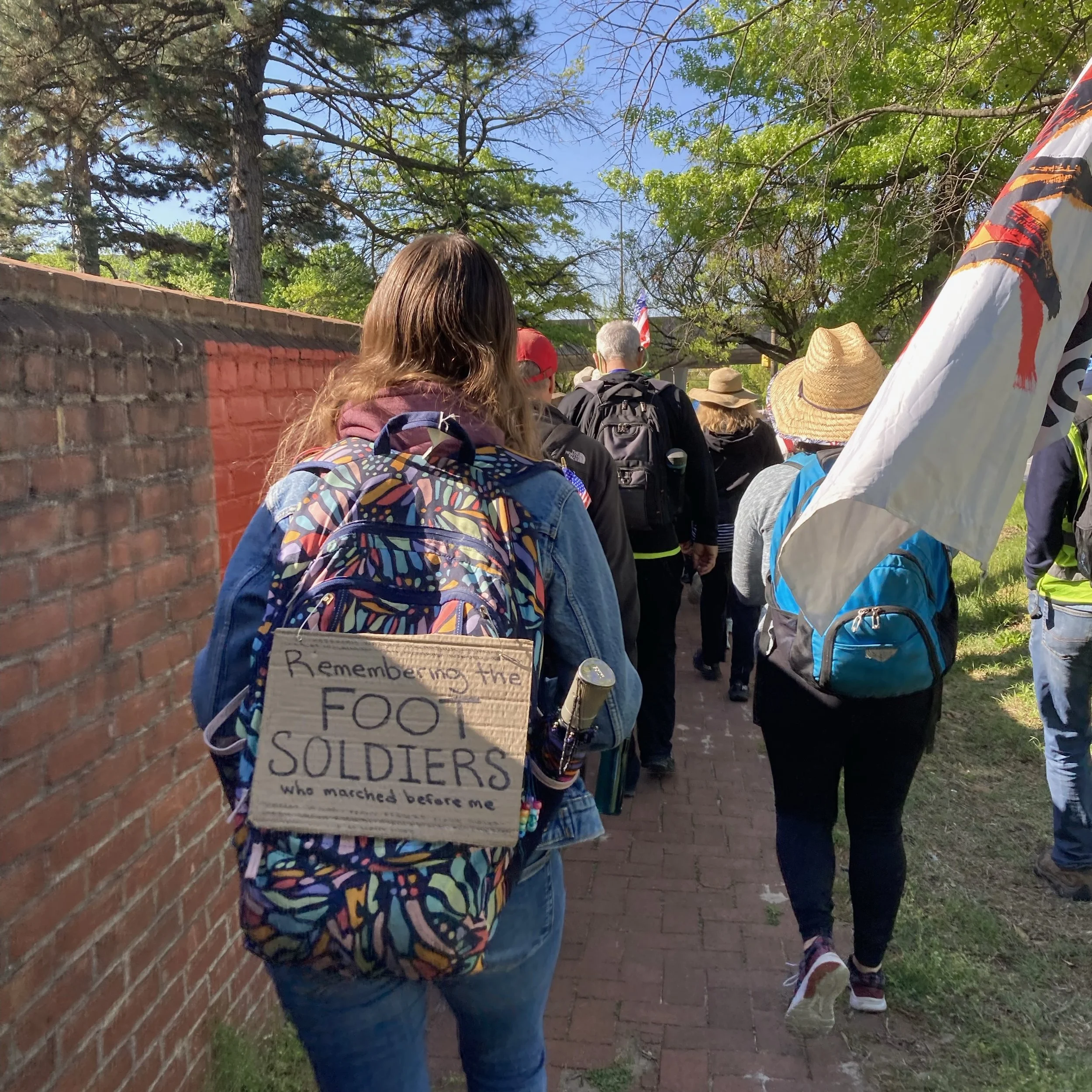
I recently experienced collective power in a deeply encouraging way, reminding me of how little actions can make a big difference. I was one of about 50 marchers who, collectively, walked from Philadelphia to Washington, D.C. While none of us could have done it alone, lots of people did little things to support this massive undertaking. There were people who coordinated, cooked for us, offered us a place to stay, or simply let us use their bathroom. Every day, we all worked together to load or unload our supplies. And little jobs, like driving shuttles that offered individuals a break when needed or making sure that everyone had a name tag, made a felt difference in building an inclusive and welcoming community.
“When everyone does their part, we can accomplish great things through the power of community.”
By themselves, the march wasn’t going to make or break based on whether or not Sister So-and-So brought her casserole to the potluck or that driver honked in support as we marched down the road. But it was the simple acts of kindness that nourished our bodies and souls. It was the little things that made a difference in the day-to-day and, collectively, helped everyday people walk over 160 miles.
Put it in perspective.
When everyone does their part, we can accomplish great things through the power of community. So I encourage you to evaluate your action not by the size of the action itself, but by its impact when added to the collective efforts of a community.
Practical next step
Check out this two-minute video to learn about how the collective power of everyday people contributed to the success of the Montgomery Bus Boycott.
Recap: Individual actions may feel insignificant in isolation, but collective effort—made up of countless small contributions—is what makes big things possible. Showing up matters, even when it doesn't feel like it.
It’s our turn.
Joanne Bland, who set an example through her activism, passed away earlier this year. She is no longer with us to fight for the voting rights she gave so much of her life for. Nor was she alive to hear the recent Supreme Court ruling, which limited the power of the Voting Rights Act—yet again.
But now it’s our turn. At a time when our country is rolling back civil rights and threatening the very practices that make us a democracy, it’s time to take a stand.
We would all like to think that, if we were alive during the civil rights movement, we would have stood on the right side of history. We would have marched like the young Joanne Bland. But the fact of the matter is that what we’re doing now is what we would have done back then.
If you want to take action and contribute to change, you can. Even if you don’t know how to get started, even if you feel you can’t do anything big, and even if you question whether the little you might contribute makes a difference.
It’s not too late. You don’t have to let those obstacles stop you. They stopped me for a while, but I pray that you, too, can overcome.
Want to learn more about how Christian faith calls us to build shalom in our communities? Check out RCCI’s Toward Shalom Workshop Series to explore the biblical and theological foundations for addressing racism today.